In een wereld vol lawaai en druk zijn de moedigste leiders niet de luidruchtigste, maar degenen die ruimte creëren voor stilte en eerlijke zelfreflectie. Zoals een stille brug weerspiegeld wordt in kalm water, ontstaat authentiek leiderschap wanneer we standvastig zijn in wie we zijn en naar binnen durven kijken. Duidelijkheid, integriteit en aanwezigheid beginnen niet met actie, maar met bewustzijn.
Watching Arthur Brooks’ talk on the science of happiness offers a powerful insight for leaders: happiness isn’t a mood — it’s a disciplined practice that shapes how you lead. Brooks reveals that enjoyment, satisfaction, and meaning form the foundation of true well-being, and only a small part of it depends on circumstances. The rest comes from daily habits rooted in relationships, purpose, and service. For leaders, this is transformative: it shifts happiness from a personal luxury to a strategic imperative. When leaders cultivate happiness intentionally, they strengthen resilience, deepen trust, and create the conditions in which teams can thrive.
Het is niet je mentaliteit. Niet je CV. Niet netwerken. Het is tijd.
We praten over ontslagen alsof ze lineair zijn: baan eindigt > nieuwe baan begint.
Maar zo werkt het echte leven niet.
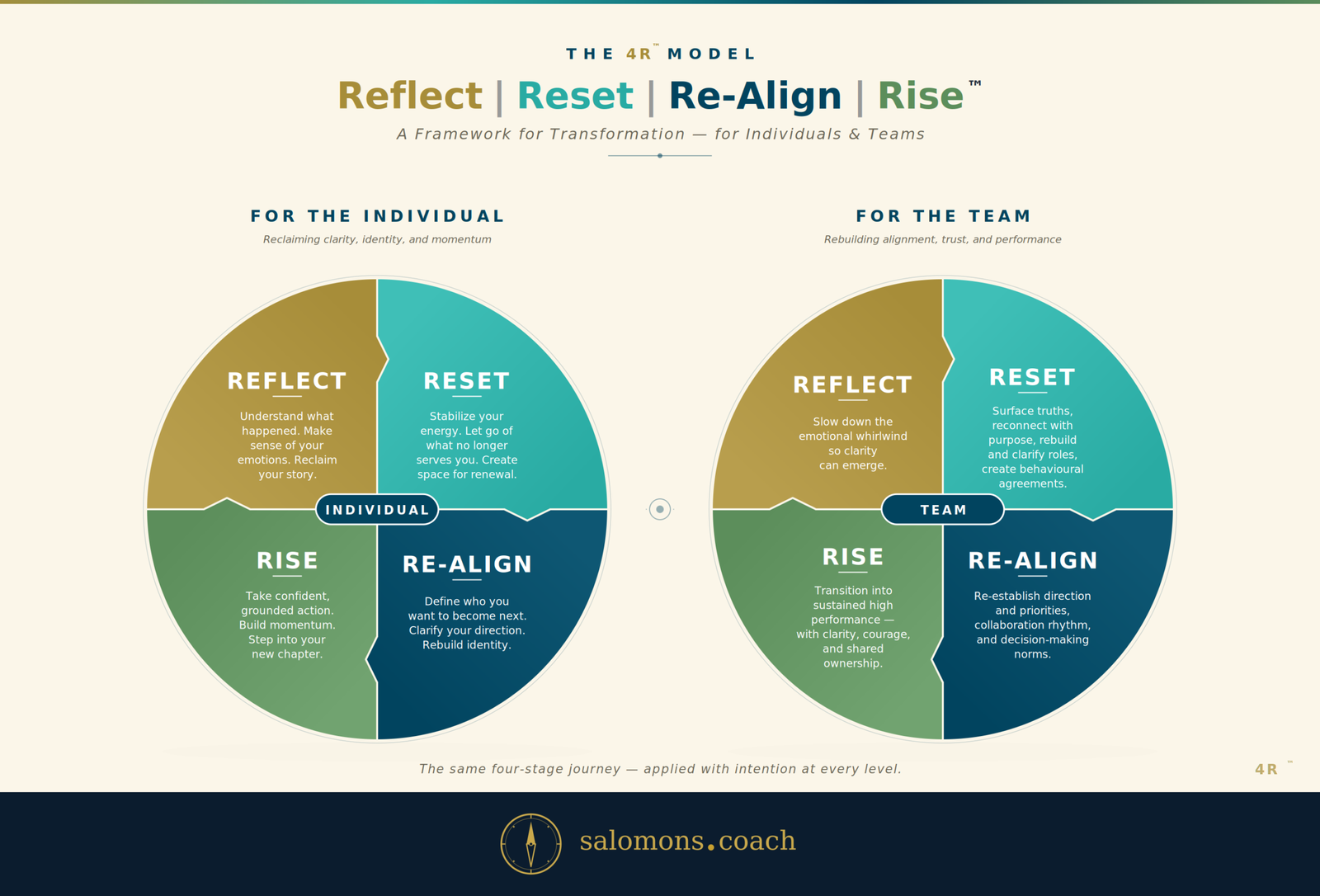
Wat bepaalt of iemand goed herstelt of vastloopt, is de hoeveelheid tijd die hij heeft om de innerlijke reis te doorlopen: Reflecteren > Resetten > Opnieuw afstemmen > Opstaan™.
Redundancy is often treated as a quick transition, but the real determining factor in someone’s recovery is time. The pace at which a person can move through the inner journey of Reflect–Reset–Re-Align–Rise™ depends on financial pressure, VSO terms, WW timelines, emotional impact, and life circumstances. When the process is rushed, unresolved phases return later as stress, confusion, or poor career choices. When people are given time, clarity grows, confidence returns, and their next step becomes intentional rather than reactive. Time isn’t a delay—it’s the space where healing and identity reconstruction take place.
In a VUCA world, the leaders and professionals who thrive are not the ones with the most experience — but the ones with the best learning habits. Inspired by Daniel H. Pink’s science-based insights, this article explores eight powerful habits that sharpen thinking, build resilience, and accelerate growth. Whether you’re leading in uncertainty or navigating a career transition after redundancy, these habits — combined with my 4R Model (Reflect > Reset > Re-Align > Rise™) — provide a practical roadmap to stay adaptive, confident, and future-ready.
Redundancy in the Netherlands is often misunderstood as a personal failure, while in reality it is a legally structured process with strong employee protections. This article explains your rights, the procedures employers must follow, and the timeframes involved — from UWV approval and notice periods to reassignment obligations, dismissal bans, transition payments and WW benefits. With clarity and compassion, it guides you through what the law requires, what you can expect, and how to move forward confidently in your next career chapter.
The 4R Model—Reflect, Reset, Re-Align, Rise™—emerged from more than 35 years of leading and coaching in complex, high-pressure environments, combined with solid foundations in transition theory, emotional intelligence, identity work, and psychological safety. Supported by globally respected research (including HBR), the model provides a clear, humane framework that helps people navigate redundancy, burnout, and major career shifts. Instead of treating change as a purely logistical process, 4R guides the deeper psychological journey: understanding what’s happening internally, letting go of old identities, rebuilding direction, and rising with confidence and sustainable momentum. It turns disruption into structured growth.
Doel is geen slogan of een verklaring - het is een kracht die je beweegt. In dit artikel verkent Jan Salomons het verschil tussen een intellectueel doel en een diep doel: het soort doel dat je oproept om in actie te komen, zelfs als dat ongemakkelijk is. Hij baseert zich op inzichten van Frederic Laloux, zijn coachingpraktijk en zijn ervaring in VUCA-leiderschap en legt uit hoe purpose keuzes stuurt, vertrouwen opbouwt en focus creëert in onzekerheid. Ontdek hoe je je ware doel kunt voelen - niet vanuit je verstand, maar vanuit wat diep juist voelt - en hoe je van daaruit kunt leiden.
Druk zijn is een erezaak geworden, maar het leidt zelden tot impact of welzijn. In dit artikel onderzoekt Jan Salomons waarom druk zijn vaker een gewoonte is dan een noodzaak - en hoe leiders kunnen overschakelen van het managen van tijd naar het managen van focus. In een VUCA-wereld, waar snelheid en complexiteit domineren, worden duidelijkheid en reflectie de echte onderscheidende factoren van leiderschap. Leer hoe je van beweging naar betekenis kunt gaan door zelfbewustzijn, aandacht en doelgerichtheid en ontdek waarom vertragen wel eens de slimste zet zou kunnen zijn die je kunt doen.
Feedback wordt vaak verkeerd begrepen als iets dat je moet verdragen in plaats van omarmen. Maar in mijn jaren als executive en leiderschapscoach heb ik geleerd dat groei niet voortkomt uit het geven van de perfecte feedback, maar uit het goed ontvangen ervan. Wanneer we onze defensiviteit achter ons laten en kritiek zien als potentiële coaching, verandert feedback van een bedreiging in een hulpmiddel om te leren. Op het moment dat we onze mindset veranderen van “Wat is er mis met mij?” naar “Wat kan ik hier leren?”, ontsluiten we een van de krachtigste hefbomen van leiderschapsgroei: het vermogen om coaching te vinden in kritiek.