Je sterke punten zijn de reden waarom je vastzit.
Leiderschapsontwikkeling · De Competentieval
Je sterke punten zijn de reden waarom je vastzit.
De competenties waarmee een senior leider zijn plek heeft verdiend, zijn dezelfde competenties die hem er stilzwijgend in houden. Over outsight, eindes, en waarom groei aan de top van buiten naar binnen loopt.
Elke senior leider heeft een kernkwaliteit. Datgene waar ze bekend om staan, waarvoor ze beloond en gepromoveerd worden. Het is ook, vaker dan iemand toegeeft, datgene wat hen op hun plaats houdt.
De competentie die je hier heeft gebracht, was nooit gebouwd om je daar te krijgen. Het was gebouwd om je hier. En het is zeer, zeer goed om je hier te houden.
Twee spellen, twee strategieën
Hier is de nuance die de meeste kracht-bashen missen. Een senior leider speelt eigenlijk twee verschillende spelletjes, en ze belonen tegengestelde zetten.
Om beter te worden in de baan die je hebt, zet je kracht in. Ga dieper, verscherp het, ga ervoor. Dit is precies goed. Meesterschap wordt opgebouwd door meer te doen van waar je al goed in bent.
Om de baan te krijgen die je wilt, doe het tegenovergestelde. De volgende rol beloont de vaardigheden die je nog niet hebt, niet meer van de vaardigheden die je wel hebt. Vooruitgang bouw je op door bewust opnieuw beginner te worden.
Carrières lopen vast wanneer leiders de eerste stap zetten tegen het tweede probleem: ze steken energie in een kracht, precies wanneer het volgende niveau stilzwijgend vraagt om een capaciteit die ze nog niet hebben opgebouwd. Beter worden en vooruitkomen zijn geen gelijkwaardige projecten.
De competentieval
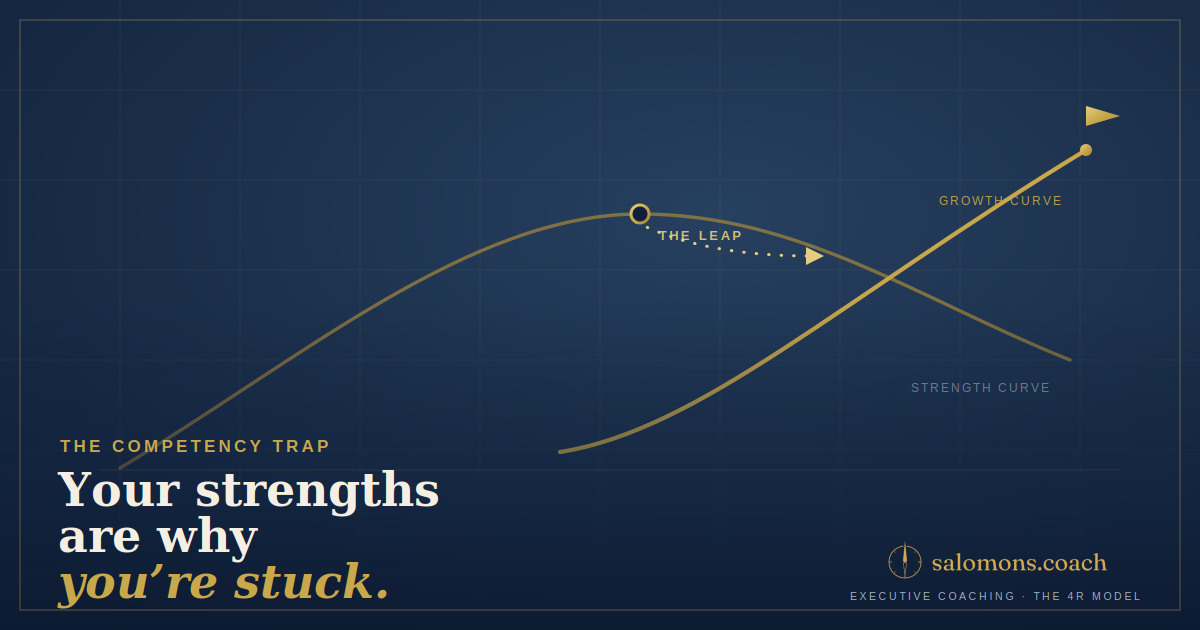
Er is een tweede gevaar, en het is subtieler. Een kracht is niet alleen het verkeerde gereedschap voor het volgende spel. Als je het te veel gebruikt, dient het je zelfs in het huidige spel niet meer.
We neigen naar wat we al goed doen. Het voelt productief. Het levert applaus op. Dus doen we er meer van, en het nieuwe, onhandige gedrag met lagere status dat ons eigenlijk zou doen groeien, wordt verdrongen. De valkuil is niet incompetentie. Het is juist bekwaamheid, te veel toegepast.
Een leider die bekend staat om operationele nauwgezetheid, grijpt steeds terug op nauwgezetheid wanneer het moment vraagt om visie. Een briljante afsluitmaker blijft afsluiten wanneer de rol nu vereist dat ze anderen opbouwen die dat kunnen. De kracht wordt een reflex, de reflex wordt een plafond, en het plafond is onzichtbaar juist omdat het bestaat uit dingen waar je goed in bent.
De Nederlandse bril: elke kwaliteit heeft een valkuil
Daniel Ofman’zijn kernkwadrant maakt het mechanisme precies. Elke kernkwaliteit draagt een struikelblok: hetzelfde eigenschap, overdreven. Besluitvaardigheid, te ver geduwd, wordt overweldigend. Zorg wordt bemoeienis. Gedrevenheid wordt burn-out. Strengheid wordt muggenziften. Het werk is niet om de kwaliteit op te geven, maar om de dosis te bewaken. Een kracht faalt zelden een leider door te weinig te zijn. Het faalt hen door te veel te zijn, en degene waarop je het hardst leunt, is degene die het meest waarschijnlijk omvalt.
De theorie: outsight, niet inzicht
Herminia Ibarra genoemd in Leid als een leider, denk als een leider. Het conventionele model zegt: verander jezelf door eerst te reflecteren, dan te handelen. Zij draait het om. We groeien uit tot leiders door act zoals één en verdienen inzicht, het frisse, buiten-naar-binnen perspectief dat alleen nieuwe actie en nieuwe mensen kunnen bieden. Inzicht, het introspectieve soort, heeft de neiging om jezelf te bevestigen zoals je al bent. Outsight verstoort het. Je kunt er niet uit denken uit een competentieval. Je handelt je eruit, en laat de nieuwe ervaring het denken herschrijven.
Voor een nieuw zelf, een einde
Hier is het deel waar leiders het meest tegenin gaan. Om in de volgende versie van jezelf te stappen, moet je eerst de identiteit loslaten die is gebouwd op je huidige sterke punten. En juist die identiteit is degene die aan het winnen was.
Het loslaten van “de operator”, “de closer”, “de brandweerman” voelt als een verlies van jezelf voordat het als een winst voelt. Dat hoort ook zo. Dat ongemak is geen teken dat je het verkeerd doet. Het is het teken dat je eindelijk begonnen bent.
De theorie: elke overgang begint met een einde
William Bridges het onderscheid maken tussen verandering en transitie. Verandering is de externe gebeurtenis. Transitie is de innerlijke heroriëntatie die het vereist, en het begint niet met een nieuw begin maar met een eindeeen loslaten van de rol en het zelfbeeld dat daarbij hoort. Leiders die het einde overslaan, die de nieuwe zelf proberen te koppelen zonder de oude los te laten, blijven half opgesloten en blijven daar stilstaan. Het einde is niet het obstakel voor heruitvinding. Het is de ingang.
Wat verandert er eigenlijk, en het verandert van buiten naar binnen
Outsight is geen stemming die je oproept. Het is het bijproduct van het doen van verschillende dingen met verschillende mensen. Ibarra wijst op drie hefbomen, en geen van deze begint in je hoofd:
Herdefinieer het werkOnderneem projecten buiten je bewezen werkterrein, waar je kenmerkende kracht niet van toepassing is en je op iets anders moet leunen. Het ongemak is het doel.
Verander de vorm van het netwerkJe huidige cirkel weerspiegelt je huidige zelf naar je terug. Nieuwe, meer gevarieerde relaties zijn waar je blik naar buiten daadwerkelijk vandaan komt. Je leent de volgende versie van jezelf van mensen die die al leven.
Speel met het zelfProbeer voorlopige versies van de leider die je zou kunnen worden, voordat je zeker bent. Heruitvinding wordt niet verklaard. Het wordt geoefend.
Het meest geavanceerde excuus
Wanneer een senior leider niet wil veranderen, is de meest respectabele reden die hij geeft: “Dat ben ik gewoon niet.” Ibarra noemt dit de authenticiteitsvalkuil. Te strak vastgehouden, beschermt authenticiteit niet langer wie je bent en begint het te bewaren wie je vroeger was. Een groeiende leider behandelt identiteit als een conceptversie, niet als een monument.
De leiders die een plateau bereiken, zijn zelden degenen die geen talent meer hadden. Het zijn degenen die bleven investeren in het talent dat al winst had opgeleverd. Groei aan de top gaat zelden over het toevoegen van een kracht. Het gaat over het loslaten van degene die je het meest vertrouwt, het beëindigen van de versie van jezelf die daar omheen was gebouwd, en handelen naar de volgende fase.
Kijk volgende
De authenticiteitval, in de woorden van de onderzoeker die het bedacht.
Herminia Ibarra, “De authenticiteitsparadox” · TEDxLondonBusinessSchool
Voel je dat je sterkste kaart degene is geworden die je niet kunt neerleggen?
Dat is het gesprek dat ik wekelijks voer met leidinggevenden. Begin de jouwe op Salomons.Coach.
Verder lezen
, Leid als een leider, denk als een leider (Harvard Business Review Press, 2015). De bron van outsight en de competency trap, en het belang van verandering van buitenaf.
, Werkidentiteit: Onconventionele Strategieën om je Carrière te Heruitvinden (Harvard Business School Press, 2003). Voorlopige zelfbeelden en heruitvinding door actie in plaats van introspectie.
, Overgangen: Zin geven aan de veranderingen in het leven (Addison-Wesley, 1980). Waarom elke heruitvinding begint met een einde.
, Kernkwaliteiten: Een Poort naar Human Resources (de Engelse editie van Bezieling en kwaliteit in organisaties. Het kerndoel, en hoe elke kracht, indien overmatig gebruikt, een valkuil wordt.
Jan Salomons, Executive Coach & Transformatie Consultant, Salomons.Coach. Lid, Harvard Business Review Advisory Council. 35+ jaar in leiderschap, 20+ jaar coacht C-suite leiders in 55+ landen.