De volledige logica (en context) van ja en nee
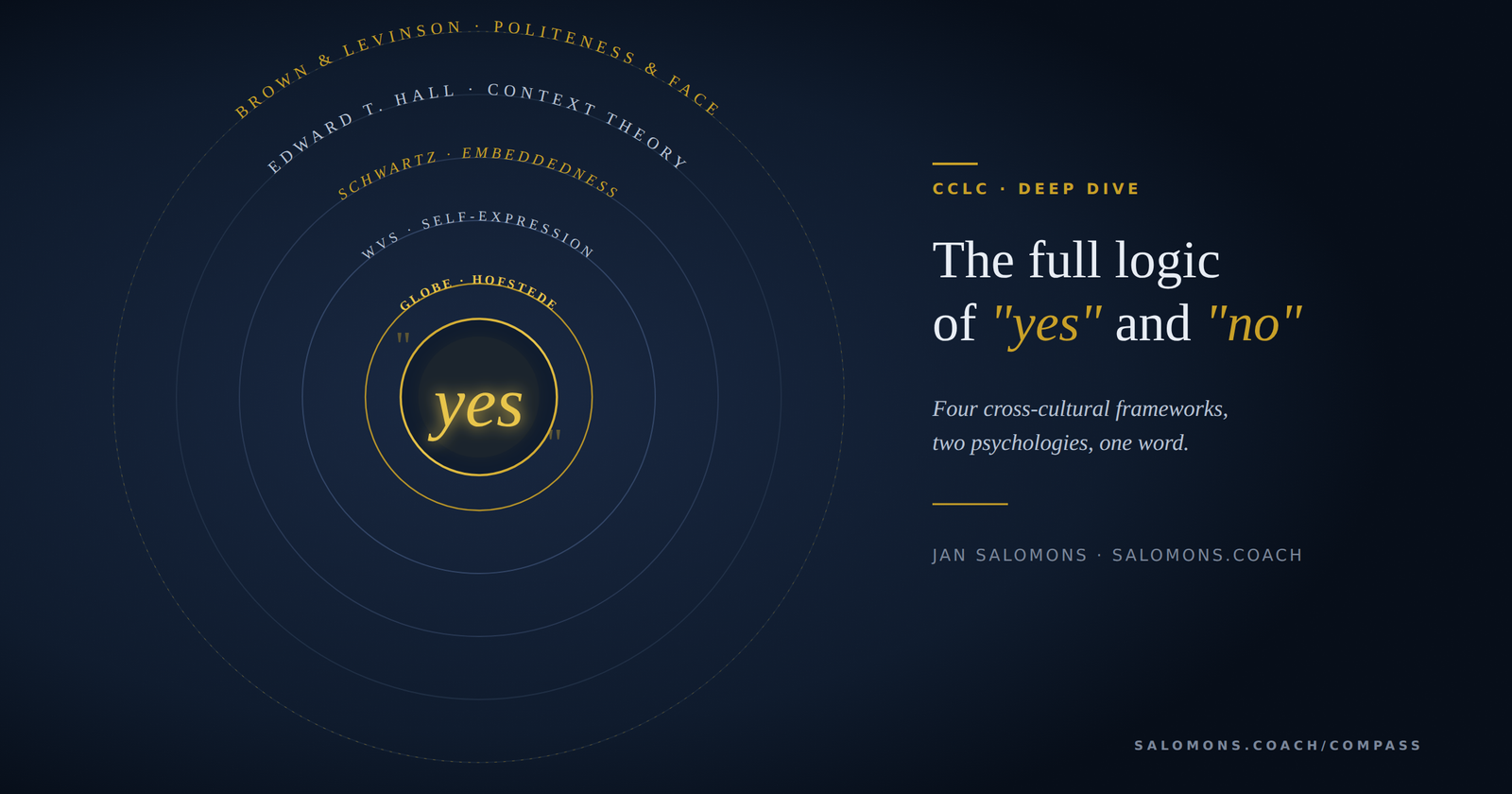
Hoe vier cross-culturele raamwerken en de psychologie erachter verklaren waarom instemming en weigering zulke verschillende betekenissen hebben in verschillende kamers.
Crosscultureel Leiderschap Kompas
Een leider die in de ene cultuur een ja letterlijk en in de andere metaforisch opvat, maakt geen vertaalfout. Hij maakt een interpretatiefout. Het woord is identiek; de cognitieve en sociale machinerie die het produceert, is dat niet. Elk van de vier academische kaders in het Cross-Cultural Leadership Compass, Hofstede, GLOBE, de World Values Survey en Schwartz, bekijkt die machinerie vanuit een andere hoek. Samen verklaren ze waarom een ja uit Beijing en een ja uit Amsterdam uit dezelfde mond op dezelfde vergadering kunnen komen en radicaal verschillende dingen kunnen betekenen.
Dit stuk loopt de volledige logica, raamwerk per raamwerk, door, en sluit af met de twee psychologische theorieën, Halls communicatie in high/low-context en Browns & Levisons facetheorie, die het onderliggende mechanisme verklaren. Sla over naar de matrix aan de achterkant als je de geconsolideerde leesstof wilt.
Wat de vraag eigenlijk is
Wanneer een leider een ja hoort over een culturele grens heen, stelt hij geen enkele vraag. Hij stelt er vier:
- Van wie is deze overeenkomst? De persoonlijke reactie van de spreker, of de verwachte reactie van de groep?
- Wat loopt de spreker risico door nee te zeggen? Onenigheid, gezichtsverlies voor zichzelf, gezichtsverlies voor de senior persoon in de kamer, verstoring van het sociale weefsel?
- Is onenigheid hier te uiten, of elders? In de vergadering, in de gang erna, via een derde, of nooit expliciet?
- Wat betekent stilte? Instemming, ontzag, onuitgesproken onenigheid, of afwezigheid van mening?
Elk framework beantwoordt een andere van die vragen het best.
Raamwerk één: Hofstede, de structurele druk op het woord
Twee van Hofstede's zes dimensies verklaren het meeste van de 'ja' en 'nee'-antwoorden, en een derde dimensie voegt een belangrijke modificatie toe.
Machtsverschilindex. Hoe sterk hiërarchie het antwoord filtert. In een cultuur met een hoge PDI (China 80, India 77, Indonesië 78), draagt een ja dat naar boven wordt gegeven ontzag vóór instemming. In een cultuur met een lage PDI (Nederland 38, Denemarken 18) is het ja van de ondergeschikte hun eigen toezegging, geen beleefdheid tegenover rang.
Individualisme (IDV). Of de "ja" de persoonlijke inzet van de spreker is of de verwachte positie van de groep. In een collectivistische cultuur (China 20, Indonesië 14) kan de "ja" coderen wat de groep geacht wordt te zeggen. In een individualistische cultuur (VS 91, NL 80, VK 89) is de "ja" een persoonlijk statement.
Onzekerheidsaversie (UAI). Hoe een cultuur omgaat met de ambiguïteit die onenigheid zou creëren. België scoort 94, het hoogste in West-Europa. Een ja in het bijzijn van anderen is deels een manier om publieke ambiguïteit te bezweren; het echte gesprek vindt achteraf bilateraal plaats. Singapore (UAI 8) is het tegenovergestelde: open, verkennend, comfortabel met het onopgeloste.
Wat Hofstede je vertelt over het woord: Een ja uit een cultuur met een hoge PDI en lage IDV staat structureel meer onder druk dan een ja uit een cultuur met een lage PDI en hoge IDV. De druk maakt het ja niet ongeldig, maar verandert het interpretatieve gewicht dat een leider eraan zou moeten toekennen.
Raamwerk twee: GLOBE, de gedragsdruk in de kamer
GLOBE is gebouwd na Hofstede en voegt expliciet de gedragsmatige en leiderschaps-effectiviteitslagen toe waar Hofstede op cultureel niveau stopte. Voor ja en nee zijn drie GLOBE-dimensies het belangrijkst.
Assertiviteit. Hoe comfortabel de cultuur is met directe confrontatie. De VS, Duitsland en Nederland scoren hoog; Japan, Zweden en Nieuw-Zeeland scoren laag. In culturen met een hoge assertiviteit wordt een "nee" verwacht als uiting van onenigheid. In culturen met een lage assertiviteit is een "nee" sociaal kostbaar en wordt deze vaak vervangen door een verzacht "ja" of een omleiding.
Groepscollectivisme. Trots, loyaliteit en cohesie binnen de directe groep. China, de Filipijnen en India scoren erg hoog; Denemarken, Zweden en Nederland scoren laag. Een ja in een hoge in-group context is niet alleen persoonlijk, het draagt de houding van de groep, wat publiekelijk moeilijker terug te trekken is dan een privé mening.
Praktijken versus Waarden. GLOBE meet afzonderlijk welke culturen doen en wat ze zeggen dat ze waarderen. De kloof is van belang: veel culturen hechten veel waarde aan assertiviteit, maar scoren laag op de daadwerkelijke praktijk. Een leider die zich baseert op verklaarde waarden zal de situatie verkeerd inschatten. Het gedrag dat getoond wordt in vergaderingen is wat telt.
Wat GLOBE je vertelt over het woord: Hofstede vertelt je de culturele dispositie; GLOBE vertelt je de gedragsverwachting in de kamer, hoe onenigheid wordt geacht te worden geuit indien die bestaat, en of een 'nee' professioneel beschikbaar is als registratie.
Framework drie: World Values Survey, de waarden druk onder de woorden
De WVS brengt twee grote assen in kaart over de wereldbevolking: traditioneel versus seculier-rationeel, en overleving versus zelfexpressie. Voor ja en nee draagt de tweede as meer gewicht.
Overleven versus zelfexpressie. Op overlevingsgerichte samenlevingen (groot deel van Zuid- en Zuidoost-Azië, groot deel van de post-Sovjetruimte, delen van Afrika) gericht zijn economische en fysieke zekerheid prioriteit; vertrouwen buiten de directe groep is laag; publiekelijk afwijkende meningen uiten brengt sociale risico's met zich mee. Zelfexpressiesamenlevingen (Noord-Europa, Angelsaksische landen) geven prioriteit aan autonomie, stemrecht en het recht om het oneens te zijn. Nederland scoort 86 op deze as; China scoort 40, een verschil van 46.
Institutioneel Vertrouwen. Hoeveel de bevolking instellingen en autoriteit vertrouwt. Omgevingen met veel vertrouwen maken individuele afwijkende meningen professioneel veiliger. Omgevingen met weinig vertrouwen maken een publiek "nee" een riskantere sociale handeling.
Traditioneel versus seculier-rationeel. Minder direct relevant voor ja en nee, maar waar traditionele waarden domineren, draagt een ja tegenover een oudere of senior een gewicht van familie-respect met zich mee dat verder gaat dan de context van de werkvloer.
Wat de WVS u vertelt over het woord: Hofstede meet cultuur op de werkvloer. De WVS meet het onderliggende, bevolkingsbrede waardensubstraat dat bepaalt of 'nee' zeggen door mensen van een cultuur over het algemeen gevoeld wordt toegestaan te doen, in instellingen, gezinnen, het maatschappelijk leven en op het werk.
Framework vier: Schwartz, de relationele druk die het woord mogelijk, of onmogelijk maakt
Het kader van Schwartz, dat door Europa heen is gevalideerd via de European Social Survey, is het meest psychologisch uitgewerkte van de vier. Het ziet cultuur als de drie antwoorden die samenlevingen geven op drie universele uitdagingen. Voor ja en nee is de eerste uitdaging beslissend.
Verankering vs. Autonomie. De eerste uitdaging: de relatie tussen het individu en de groep. Geïntegreerde culturen (China 78, veel van Azië, veel van de Arabische wereld) zien mensen als fundamenteel onderdeel van een collectiviteit, waarbij betekenis, identiteit en verplichting via de groep stromen. Autonomieculturen (Nederland 28, veel van West-Europa) zien mensen als afgebakende individuen met het recht om hun eigen posities te vormen en te uiten. Een 'nee' in een geïntegreerde cultuur bedreigt het sociale weefsel op een manier zoals een 'nee' in een autonomiecultuur dat niet doet.
Hiërarchie versus egalitarisme. De tweede uitdaging: hoe autoriteit en middelen legitiem worden verdeeld. Hiërarchische culturen (Schwartz's China score: 66) legitimeren ongelijke status; een nee omhoog is een diepere sociale daad dan in een egalitaire cultuur (NL 18).
Harmonie versus Meesterschap. De derde uitdaging: relatie met de natuurlijke en sociale wereld. Harmonieculturen benadrukken erbij horen; beheersingsculturen benadrukken actief vormgeven. Onenigheid wordt anders gelezen onder beide, als verstoring onder harmonie, als betrokkenheid onder beheersing.
Wat Schwartz je vertelt over het woord: Een ja in een cultuur met hoge embeddedness is deels een onderhoudshandeling voor het sociale weefsel. Het weigeren ervan is niet zomaar een professionele onenigheid, het draagt een relationeel signaal met zich mee dat de vergadering weken of maanden kan overleven.
De psychologie erachter
De vier raamwerken beschrijven hoe culturen er op dimensioneel niveau uitzien. Twee psychologische theorieën leggen het mechanisme uit waarmee die dimensies zich vertalen naar het daadwerkelijke gedrag van ja of nee zeggen in een ruimte.
Edward T. Hall, hoog-context versus laag-context communicatie
Hall's onderscheiding is het meest directe psychologische mechanisme voor ja en nee. In high-context culturen, het grootste deel van Oost-Azië, een groot deel van het Midden-Oosten, een groot deel van Latijns-Amerika, de betekenis wordt gedragen door de context, de relatie, de toon en wat er vereist zei. De luisteraar is verantwoordelijk voor het afleiden; de spreker is verantwoordelijk voor het niet dwingen van de luisteraar tot een ongemakkelijke expliciete weigering. Een ja in dit systeem kan een manier zijn om de relatie te behouden en tegelijkertijd de werkelijke positie te signaleren via allesbehalve, houding, omhaalwoorden, vertraging, communicatie met derden.
In lage-context culturen, Duitsland, Nederland, de Scandinavische landen, de Angelsaksische wereld, betekent dat de betekenis in de woorden zelf wordt verwacht. De spreker is verantwoordelijk voor duidelijkheid. Een ja betekent ja; een nee betekent nee; ambiguïteit is een communicatiefout. Een implicien signaal wordt niet geïnterpreteerd als inhoud; het wordt geïnterpreteerd als ruis, of erger nog, als ontwijking.
De mislukking door cultuurverschillen: een luisteraar met een lage context hoort een 'ja' met een hoge context en handelt er letterlijk naar. Ze zijn niet bedrogen. Ze hebben het kanaal waar het eigenlijke antwoord werd gegeven, niet gelezen.
Brown & Levinson, beleefdheid en face
Politeness theory, ontwikkeld door linguïstische antropologen Penelope Brown en Stephen Levinson in 1987 en sindsdien uitgebreid verfijnd, verklaart waarom het gedrag met hoge context bestaat. Hun argumentatie: elke spraakhandeling ondersteunt of bedreigt de luisteraar gezicht, het publieke zelfbeeld dat ze in stand willen houden. Ongenoegen, weigering, kritiek en correctie zijn allemaal gezichtsbedreigende handelingen. Cultures verschillen in de mate waarin ze belang hechten aan het beschermen van 'face', en welk soort 'face' het belangrijkst is.
Hier volgen twee onderscheidingen. Positief gezicht de wens om goedgekeurd en geaccepteerd te worden; negatief gezicht is het verlangen om onbelemmerd en autonoom te zijn. Individualistische culturen hechten doorgaans meer belang aan negatieve face (laat me met rust, dwing niets aan me op). Collectivistische culturen hechten doorgaans meer belang aan positieve face (houd me in een goed blaam bij de groep).
Een ja in een cultuur met hoge gezichtsbescherming is vaak een positieve-gezichtsdaad: het behoudt de status van de vragensteller in de ruimte, de status van de spreker in de ruimte en het relationele weefsel daartussen. De letterlijke inhoud van het ja is ondergeschikt aan het gezicht dat het beschermt. De positie zelf komt elders, privé, later, via een ander kanaal naar voren, waar deze zonder gezichtskosten kan worden geuit.
Dit is het mechanisme achter bijna elke verkeerd begrepen ja in internationaal management. De luisteraar met een lage gezichtsbescherming beschouwt het ja als informationeel. De spreker met een hoge gezichtsbescherming gaf het als relationeel. Beiden gebruiken hetzelfde woord; slechts een van hen gebruikt het om te betekenen wat de ander denkt dat het betekent.
Een ja is zelden een leugen. Het is vaker een gezichtsbeschermende actie in een systeem waar gezichtsbescherming professioneel gedrag is, geen zwakte.
De geconsolideerde matrix
Gezamenlijk: wat elk raamwerk en elke theorie een leider vertelt over wat het woord werkelijk betekent.
| Kader | Wat “ja” onthult | Wat “nee” onthult |
| Hofstede | Persoonlijke inzet als PDI laag is en IDV hoog; ontzag en groepsconformiteit als PDI hoog is en IDV laag. | Directe afwijzing (lage PDI / hoge IDV); zeldzaam en kostbaar (hoge PDI / lage IDV), meestal vervangen door een verzacht 'ja' of strategische stilte. |
| GLOBE | In culturen met hoge assertiviteit, bezeten en betwistbaar. In culturen met lage assertiviteit, hoge in-group, een relationele handeling eerst, de houding van de groep, niet het belang van het individu. | Professioneel beschikbare registers in culturen met een hoge assertiviteit. In culturen met een lage assertiviteit worden deze vervangen door ambiguïteit, vertraging of bilaterale kanalen na de vergadering. |
| WVS | In zelfexpressieve samenlevingen, een persoonlijke houding. In overlevingssamenlevingen met weinig institutioneel vertrouwen, deels een zelfbeschermend signaal dat weinig kost om te geven. | Veiliger in zelfexpressie-maatschappijen met hoog vertrouwen in instituties en inspraak. Riskanter in overlevingsgerichte maatschappijen, publieke onenigheid heeft historische sociale kosten. |
| Zwart | In autonomieculturen is er een individuele claim. In ingebedde culturen is het een daad van sociale weefselonderhoud; het bewaren van de collectiviteit is belangrijker dan de letterlijke claim. | Acceptabel meningsverschil in autonomie / egalitaire culturen. In ingebedde / hiërarchische culturen bedreigt het relationele continuïteit buiten de directe uitwisseling. |
| Hallo | In low-context culturen is het antwoord het woord. In high-context culturen zit het antwoord in het omringende signaal, het woord is de beleefdheid. | Gesproken in duidelijke bewoordingen in laag-contextuele culturen. In hoog-contextuele culturen, gecodeerd in vertraging, kwalificatie, onderwerpverandering of een kanaal van derden. |
| Brown & Levinson | Waar positief gezicht domineert (collectivistisch), is een ja een gezichtsbeschermende daad voor iedereen in de kamer. Waar negatief gezicht domineert (individualistisch), is een ja informatief. | Een gezichtsbedreigende daad overal, maar culturen verschillen enorm in de mate waarin ze de kosten van de bedreiging verzachten, omleiden, uitstellen of simpelweg accepteren. |
De praktische conclusie
De vier kaders komen samen bij één aanbeveling die bijna geen enkele senior leider daadwerkelijk opvolgt: stop met het vertrouwen op het woord, en begin met het lezen van het systeem. Een ja is een datapunt binnen een structurele en psychologische context. Zonder die context is het datapunt betekenisloos. Met de context wordt het datapunt leesbaar, soms letterlijk een akkoord, soms een face act, soms een deferentie signaal, soms een plaatsvervanger totdat het echte gesprek elders kan plaatsvinden.
Dit is het punt van het Cross-Cultural Leadership Kompas. De vier raamwerken zijn elk onafhankelijk ontwikkeld om iets andere vragen te beantwoorden. Convergentie tussen hen is het sterkste signaal dat u kunt vinden. Waar Hofstede, GLOBE, het WVS en Schwartz alles Als een cultuur zich aan de ingebedde, hoog-PDI, lage assertiviteit, op overleven gerichte kant van het spectrum bevindt, doet het 'ja' dat je daar hoort ander werk dan het 'ja' dat je hoort in Amsterdam. De Compass is het analytische apparaat dat dat zichtbaar maakt voordat je handelt op basis van een verkeerde interpretatie.
De interpretatie is symmetrisch, en dat is het deel dat senior leiders het vaakst missen. Het raamwerk geldt net zo goed wanneer een leider in Londen het ja van een collega uit Jakarta interpreteert tijdens een Zoom-gesprek als wanneer dezelfde leider in Jakarta is. Culturele context reist mee met de spreker. Dat geldt ook voor de interpretatieve last.
Jan Salomons ontwikkelde de Cross-Cultural Leadership Compass (Leiderschapskompas voor Cross-Cultureel Leiderschap) gedurende drie decennia internationale management, training en executive coaching. Het kompas verenigt vier academische kaders – Hofstede, GLOBE, de World Values Survey, en Schwartz – tot één tool voor senior leiders die zich voorbereiden op cross-cultureel werk.

Dit vind je misschien ook leuk


ADHD Leiderschap Video's