Het dagelijkse vuurgevecht kaapt je leiderschap, niet alleen je agenda
Het dagelijkse vuurgevecht kaapt je leiderschap, niet alleen je agenda
Elke leider in een operationele omgeving kent de dag die verdampt in ad-hoc problemen. Je begint met een plan en eindigt met een inbox vol branden die je “even snel” hebt geblust. De bekende klacht tegen de avond: “Ik ben nooit aan de belangrijke dingen toegekomen.” Alsof het probleem tijd was.
Het is niet zo. Het dagelijkse vuurgevecht steelt niet je uren, het steelt je houding. En vanuit de verkeerde houding worden het strategische werk, de ontwikkeling van je mensen en het managen van je eigen baas niet slechts uitgesteld. Ze worden onmogelijk.
Om te zien waarom, helpt een eenvoudig model uit de communicatiepsychologie: Transactionele Analyse, ontwikkeld door psychiater Eric Berne. Berne beschreef drie interne houdingen waar we allemaal tussen schakelen, de hele dag door, de Ouder (corrigeren, normen stellen, beschermen, redden), de Kind (reagerend vanuit gevoel: behagen, mokken, verdedigen, of spontaan en creatief), en de Volwassene (het hier en nu verwerken: feiten, opties, beslissingen, gelijkheid). Geen rollen, geen karakters, maar houdingen waar je in- en uitstapt. En precies één daarvan, de Volwassene, is de zetel van alles wat strategisch leiderschap vereist.
Elk vuur is een uitnodiging
Het verraderlijke aan een operationele omgeving is dat elk ad-hoc probleem een uitnodiging om in een reactieve houding te vervallen. Een transactie, in Berne's termen: de chaos biedt je een houding, en als je niet oplet, trap je erin.
Je geeft meestal op een van de volgende twee manieren fooi. De eerste is de Ouder redden: “Geef het hier, ik regel het wel.” Het voelt productief, zelfs edel, je bent de leider die dingen oplost. Maar het houdt je tegen in de uitvoering, en het traint je mensen om alles naar jou te brengen. De tweede is de overweldigd kindreactief, defensief, ja zeggen tegen alles wat langskomt, omdat nee zeggen voelt alsof er geen ruimte is.
Warm en beslissend, nietwaar? Maar tel de gevolgen bij elkaar op. Het teamlid leert het niet zelf op te lossen. Het volgende probleem komt direct weer bij jou terecht. En ondertussen heb je een uur verspild dat je aan niets anders hebt besteed, niet omdat je tijd tekortkwam, maar omdat je dat uur hebt besteed aan het staan in de Ouder.
Wat reactieve houdingen je echt kosten
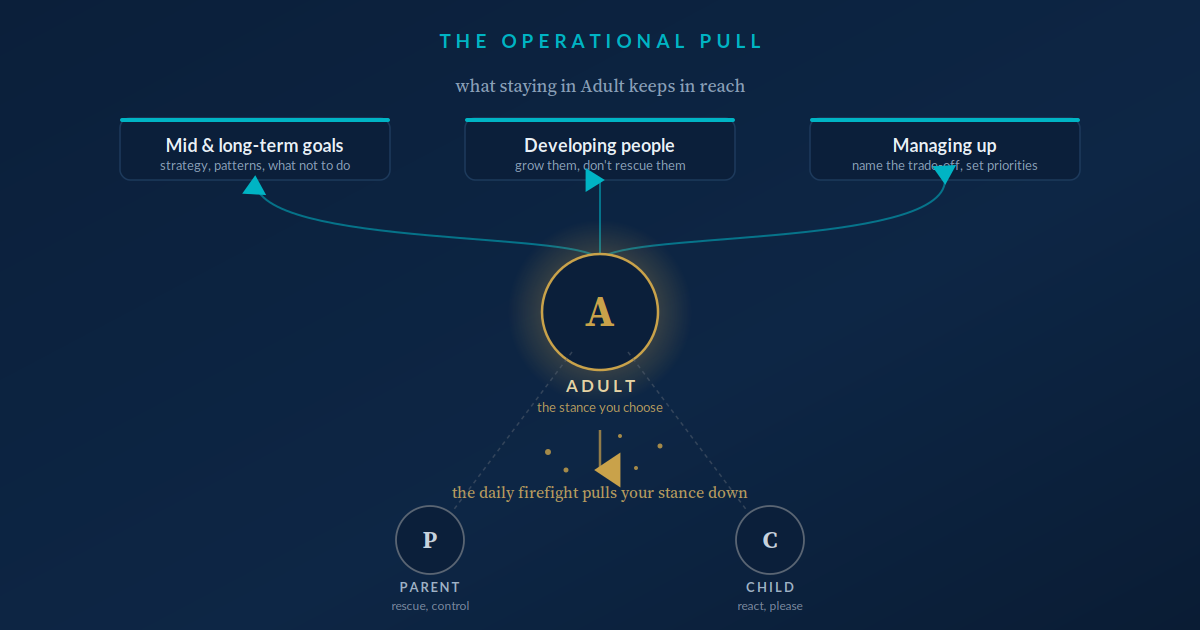
Drie dingen vereisen onvermijdelijk de Volwassene. En die exacte drie verdwijnen wanneer het dagelijkse vuurgevecht je in de Ouder of het Kind houdt.
De middellange- en langetermijndoelen. Strategisch denken, drie kwartalen vooruitkijken, patronen zien, kiezen wat vereist te doen, is alleen mogelijk vanuit het volwassen brein. Het is letterlijk een ander deel van je hersenen dan het reactieve systeem dat dient voor het vuur van de volgende drie minuten. Je kunt niet strategisch denken vanuit een houding die bezig is met blussen. Daarom is “geen tijd voor strategie” bijna nooit een agenda-probleem; het is een houding-probleem.
De mensen. Het ontwikkelen van mensen is werk van volwassene-naar-volwassene: verantwoordelijkheid teruggeven, iemand laten groeien door het moeilijke in plaats van het over te nemen. Vanuit de reddende ouder doe je het tegenovergestelde, je houdt mensen klein en de afhankelijkheid die je creëert produceert meer vuren. Het is een vicieuze cirkel: hoe meer je opruimt, hoe meer er is om op te ruimen. De enige uitweg loopt via de Volwassene, degene die durft te zeggen: “Dit is moeilijk, vertel me waar je vastzit en we denken er samen over na, maar het blijft van jou.”
Omgaan met je leidinggevende. Dit is het minst gewaardeerde van de drie. Onder operationele druk ga je je eigen manager relateren vanuit het Kind: behagen (“ja, zal ik doen”), defensief worden, of stilletjes in opstand komen. En hier ligt de kern waarom TA zo krachtig is op dit punt: onder druk spreekt je baas vaak vanuit de Ouder, en een Ouder-stimulus trekt het Kind uit je voort. Je wordt er actief naartoe getrokken.
Goed omgaan met je leidinggevende betekent niet de uitnodiging accepteren, maar antwoorden vanuit de volwassene, wat Berne de de transactie overschrijden:
Dezelfde boodschap, maar nu maak je de afweging zichtbaar in plaats van deze zonder commentaar te laten vallen. Je nodigt je baas uit om met jou in de Volwassen fase te stappen, waar er een werkelijk gesprek te voeren valt over echte prioriteiten.
Eruit komen en het volhouden
Het goede nieuws is dat je het dagelijkse vuurgevecht niet hoeft te laten verdwijnen om er anders in te staan. Je hoeft er alleen maar mee op te houden om te kantelen. Vier dingen helpen.
Voel de aantrekkingskracht, voordat je reageert. De hele vaardigheid begint met een halve seconde van waarnemen. Voordat je reageert op de volgende brand, stel jezelf één vraag: “In welke positie brengt dit me?” Die ene vraag creëert de ruimte om te kiezen, in plaats van automatisch te blussen.
De transactie kruisen. Reageer op het vuur van de volwassene: triage in plaats van reflex. Beslis wat je zal niet do. Delegeer door de verantwoordelijkheid terug te geven, ondersteunend zonder het over te nemen. Dat is geen afkoelen; het is dezelfde zorg, met de verantwoordelijkheid op de juiste plaats gelaten.
Bescherm de volwassen ruimte bewust. Strategie en personeelsontwikkeling overleven niet in de reactieve stroom; ze hebben doelbewust beschermde tijd nodig waarin je niets aan het blussen bent. Dit is geen tijdmanagementmantra, het is houdingsbeheer. Je beschermt geen tijd, je beschermt een standpunt.
Een houding die je alleen in een rustig moment begrijpt, is niet beschikbaar onder druk. Een klein, herhalend ritueel maakt het verschil: aan het einde van een chaotische dag, twee minuten, in welke positie trok de chaos mij, en wat zou de Volwassene hebben gedaan? Onder druk val je niet terug op je intenties; je valt terug op je oefening.
De houding die jij inneemt, bepaalt de houding waar iedereen om je heen in wordt meegetrokken.
Het punt
De leider die een operationele omgeving werkelijk beheerst, is niet degene die de meeste branden het snelst blust. Dat is precies de 'parent trap', en het vergroot de chaos, omdat het de afhankelijkheid creëert die de volgende brand veroorzaakt.
Het is degene die het vuur aan hun positie voelt trekken en toch voor de volwassene kiest: nu triageren, mensen ontwikkelen zodat het vuur krimpt en omhoog managen zodat de prioriteiten realistisch worden. De dagelijkse brandjes zullen niet verdwijnen. Maar je hoeft er niet in om te vallen, en dat verschil is precies waar leiderschap zichtbaar wordt.
Nieuw bij het model? Begin met “Transactionele Analyse voor Leiders: De Grondbeginselen en Hoe Ze te Gebruiken”, onderdeel van mijn serie over Leiderschap en Transactionele Analyse. Het behandelt waar het Ouder, Volwassene, Kind model vandaan komt, de psychologie erachter, hoe het verband houdt met andere modellen die je misschien kent, en hoe je het in dagelijks leiderschap kunt toepassen.