The Daily Firefight Hijacks Your Leadership, Not Just Your Calendar
The Daily Firefight Hijacks Your Leadership, Not Just Your Calendar
Every leader in an operational environment knows the day that evaporates into ad-hoc problems. You start with a plan and end with an inbox full of fires you “just quickly” put out. The familiar complaint by evening: “I never got to the important things.” As if the problem were time.
It isn’t. The daily firefight doesn’t steal your hours, it steals your stance. And from the wrong stance, the strategic work, the developing of your people, and managing your own boss aren’t merely postponed. They become impossible.
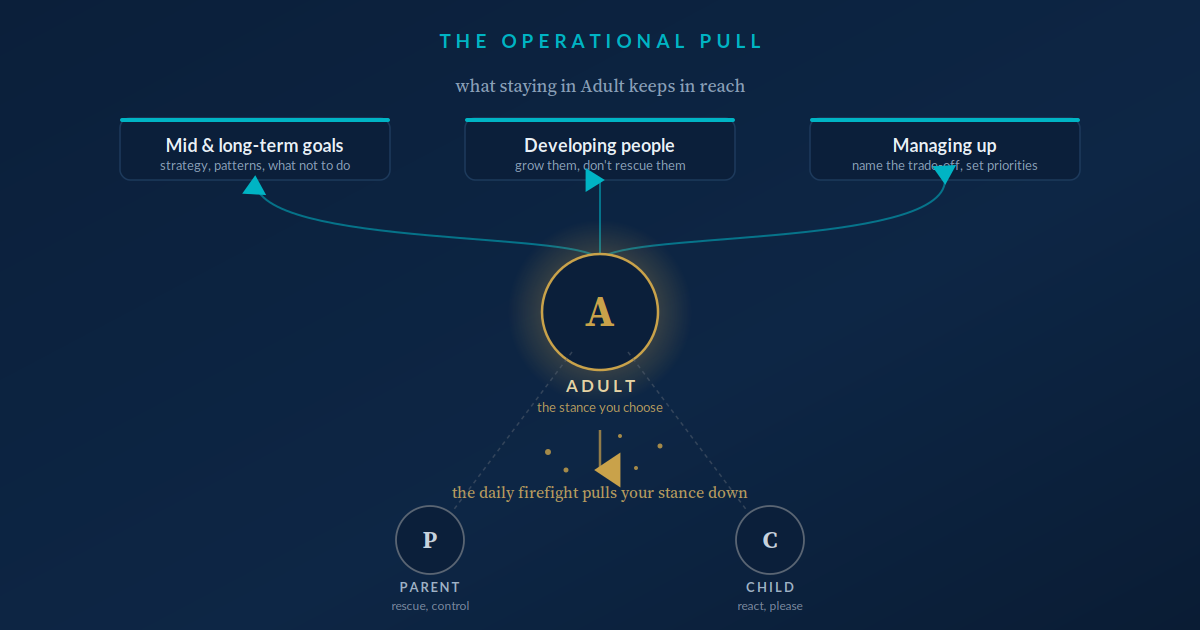
To see why, a simple model from communication psychology helps: Transactional Analysis, developed by psychiatrist Eric Berne. Berne described three internal stances we all shift between, all day long, the Parent (correcting, setting standards, protecting, rescuing), the Child (reacting from feeling: pleasing, sulking, defending, or spontaneous and creative), and the Adult (processing the here-and-now: facts, options, decisions, equality). Not roles, not characters, stances you step into and out of. And exactly one of them, the Adult, is the seat of everything strategic leadership demands.
Every fire is an invitation
The treacherous thing about an operational environment is that every ad-hoc problem is an invitation to drop into a reactive stance. A transaction, in Berne’s terms: the chaos offers you a stance, and if you’re not paying attention, you take the bait.
You usually tip one of two ways. The first is the rescuing Parent: “Give it here, I’ll handle it.” It feels productive, even noble, you’re the leader who solves things. But it keeps you down in the execution, and it trains your people to bring everything to you. The second is the overwhelmed Child: reactive, defensive, saying yes to everything that lands because saying no feels like it has no room.
Warm and decisive, isn’t it? But add up the consequences. The team member doesn’t learn to solve it themselves. The next fire comes straight back to you. And meanwhile you’ve spent an hour you didn’t spend on anything else, not because you ran out of time, but because you spent that hour standing in the Parent.
What the reactive stances really cost you
Three things inevitably require the Adult. And those exact three vanish when the daily firefight keeps you in Parent or Child.
The mid- and long-term goals. Strategic thinking, looking three quarters ahead, seeing patterns, choosing what not to do, is only possible from the Adult. It is literally a different part of your brain than the reactive system serving the fire of the next three minutes. You cannot think strategically from a stance that is busy extinguishing. That’s why “no time for strategy” is almost never a calendar problem; it’s a stance problem.
The people. Developing people is Adult-to-Adult work: handing responsibility back, letting someone grow through the hard thing rather than taking it over. From the rescuing Parent you do the opposite, you keep people small, and the dependency you create produces more fires. It’s a vicious circle: the more you put out, the more there is to put out. The only way out runs through the Adult, the one that dares to say: “This is hard, tell me where you’re stuck and we’ll think it through together, but it stays yours.”
Managing up. This is the most underrated of the three. Under operational pressure you start relating to your own manager from the Child: pleasing (“yes, will do”), getting defensive, or quietly rebelling. And here lies the heart of why TA is so powerful in this spot: under pressure your boss often speaks from the Parent, and a Parent stimulus pulls the Child out of you. You’re actively drawn toward it.
Managing up well means not accepting the invitation, but answering from the Adult, what Berne called crossing the transaction:
The same message, but now you make the trade-off visible instead of silently swallowing it. You invite your boss up with you into the Adult, where there’s an actual conversation to have about real priorities.
Getting out, and making it stick
The good news is that you don’t have to make the daily firefight disappear in order to stand differently inside it. You only have to stop tipping over with it. Four things help.
Feel the pull, before you react. The whole skill begins with a half-second of noticing. Before you act on the next fire, ask yourself one question: “Which stance is this putting me in?” That question alone creates the room to choose, instead of automatically firefighting.
Cross the transaction. Respond to the fire from the Adult: triage instead of reflex. Decide what you won’t do. Delegate while handing the responsibility back, supporting without taking over. That isn’t going cold; it’s the same care, with the responsibility left in the right place.
Protect Adult space deliberately. Strategy and people-development don’t survive in the reactive stream; they need intentionally protected time when you’re not extinguishing anything. This isn’t a time-management mantra, it’s stance management. You’re not protecting time, you’re protecting a stance.
A stance you only understand in a calm moment isn’t available under pressure. A small, repeating ritual makes the difference: at the end of a chaotic day, two minutes, which stance did the chaos pull me into, and what would the Adult have done? Under pressure you don’t fall back on your intentions; you fall back on your practice.
The stance you hold sets the stance everyone around you is pulled into.
The point
The leader who truly masters an operational environment isn’t the one who puts out the most fires the fastest. That’s precisely the Parent trap, and it scales the chaos, because it breeds the dependency that produces the next fire.
It’s the one who can feel the fire tugging at their stance and chooses the Adult anyway: triage now, develop people so the fires shrink, and manage up so the priorities become real. The daily firefight won’t disappear. But you don’t have to tip over with it, and that difference is exactly where leadership becomes visible.
New to the model? Start with “Transactional Analysis for Leaders: The Foundations, and How to Use Them”, part of my series on Leadership and Transactional Analysis. It covers where the Parent, Adult, Child model comes from, the psychology beneath it, how it connects to other models you may know, and how to apply it in everyday leadership.

You may also like
Five Steps to Take Immediate Control of a Crisis
Most Leadership Teams Lack Dialogue