salomons.coachsalomons.coach
  • Home
  • About Me
  • Blog
  • Downloads
    • Cross-Cultural Leadership Compass
    • Psychological Safety Field Guide
    • Energy Awareness Journal
    • The Executive Presenting Framework
    • The Executive Ownership Reinforcement Framework
    • The Evidence Base for Coaching Effectiveness
    • The Art of Time Boxing
    • VUCA Leadership WorkBook
    • VUCA Leadership Book
  • Services
  • Testimonials
  • Session Scheduler
  • Contact
  • Change language to Nederlands
Back
  • Home
  • About Me
  • Blog
  • Downloads
    • Cross-Cultural Leadership Compass
    • Psychological Safety Field Guide
    • Energy Awareness Journal
    • The Executive Presenting Framework
    • The Executive Ownership Reinforcement Framework
    • The Evidence Base for Coaching Effectiveness
    • The Art of Time Boxing
    • VUCA Leadership WorkBook
    • VUCA Leadership Book
  • Services
  • Testimonials
  • Session Scheduler
  • Contact
  • Change language to Nederlands
  • Home
  • Blog
  • Blog
  • You Don’t Have a People Problem. You Have a System.
Blog

11 Jun

You Don’t Have a People Problem. You Have a System.

  • By salomons.coach
  • In Blog, Change & Transformation, Organizations & Culture, Self & Personal Growth, Teams & Collaboration, VUCA & Leadership
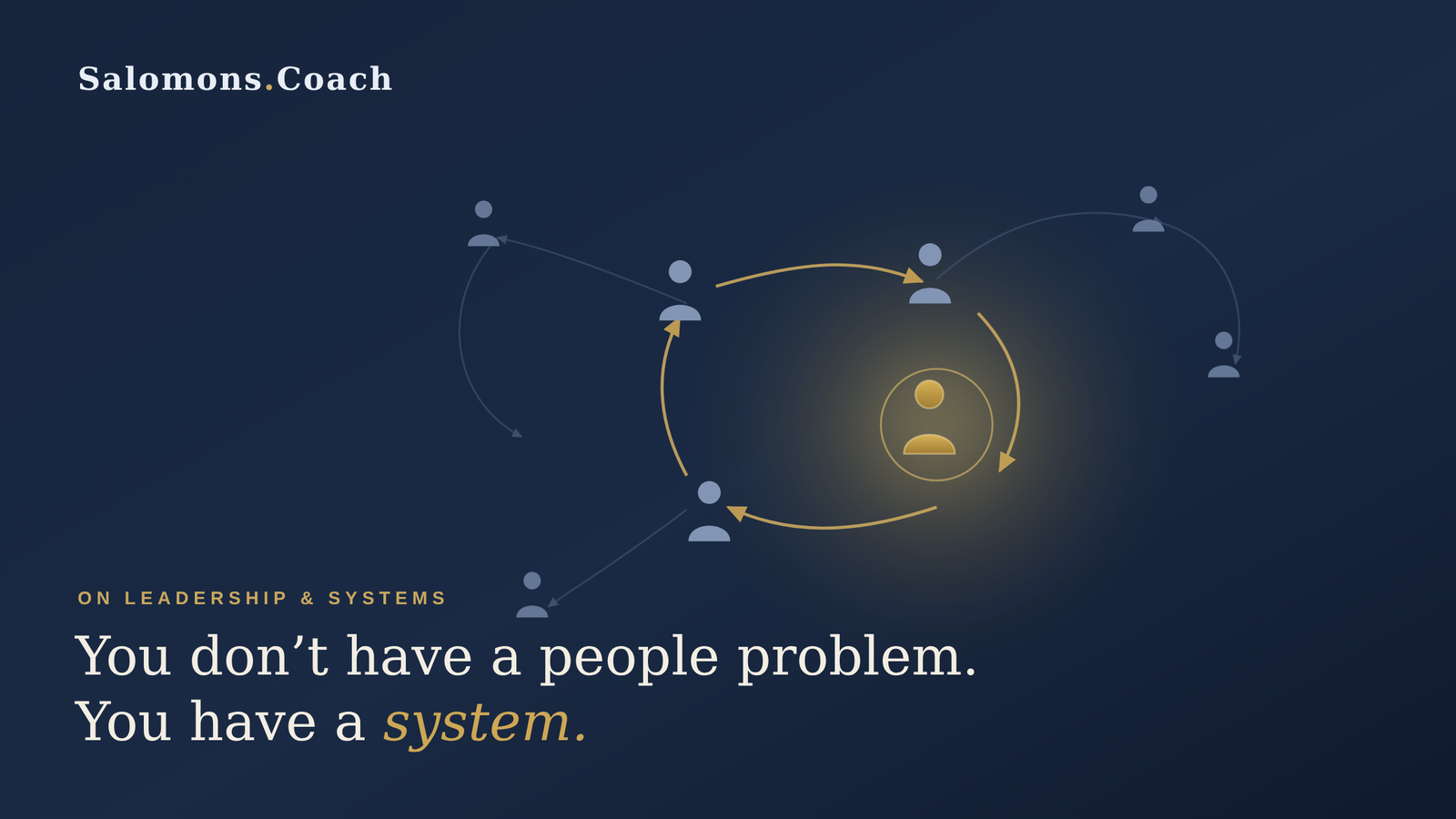
Systems-thinking infographic: scattered people icons, curved arrows around a glowing central circle on a dark blue gradient with the phrase 'You don't have a people problem. You have a system.'
You Don’t Have a People Problem. You Have a System. — Salomons.Coach
Salomons.Coach Leadership Notes
On leadership & systems

You Don’t Have a People Problem.
You Have a System.

Six things capable leaders say out loud. Each one a quiet sign that the problem was never where they were looking.

JS
Jan Salomons · Executive Coach, Salomons.Coach
On the structures behind the behaviour you keep blaming on people

You are good at your job. That is what makes the following so disorienting. You are experienced, you work hard, you make sound decisions; and yet some problems simply will not move, no matter how much competence you throw at them. You have started to wonder, quietly, whether the issue is you. It usually isn’t. See whether any of these sound like your week.

1

“My team won’t take ownership. I end up carrying everything.”

You step in because it’s faster, and because you can already see the answer. And slowly, the people around you stop reaching for answers of their own, because why would they? You didn’t inherit passive people. You trained capable ones to wait.

2

“It’s one crisis after another around here.”

Each one arrives with its own name, its own cast, its own urgency. You handle it well. Then the next one comes, wearing a different face, and you handle that too. After a few years you begin to suspect you are not fighting separate fires. You are tending the same one.

3

“We fixed that, so why has it come back somewhere else?”

You cleared the bottleneck in delivery, and a month later it surfaced in quality. You resolved the friction between two managers, and the tension simply moved down the corridor. The problem didn’t disappear. It relocated. Problems do that, when the thing producing them is left untouched.

4

“Everyone is flat out, and still nothing moves.”

This is the one that keeps leaders awake. Not laziness! Its the opposite. Real talent, long hours, genuine effort, and a strange sense of running hard to stand still. When effort that large produces change that small, the problem is almost never the people. It is where they are being asked to push.

5

“I knew who the problem was. I replaced them. Nothing changed.”

This is the most expensive lesson in leadership, and nearly everyone pays for it once. It turned out the seat was shaping the behaviour, not the person in it. The next occupant will surprise you by behaving remarkably like the last.

6

“I’m the reasonable one, so why am I always the one stretched?”

You keep getting pulled into other people’s conflicts as the steady pair of hands. You carry tension that was never yours to hold. And you have started to wonder why the calm person in the room always ends up the most depleted.

if you recognised two of these, read the next line slowly

None of these is a character flaw. None is a people problem. Each is the shape of the system you are standing inside: the loops, the delays, the quiet incentives shaping behaviour you have been reading as personality.

And each is made worse by the advice you will get almost everywhere else: try harder, push more, lead stronger; at precisely the point that will not move.

Where my work begins

My work begins where that advice runs out. I don’t help leaders push harder. I help them see the structure they are caught in — and find the one move, often a surprisingly small one, that makes the whole pattern rearrange. Less about effort. More about sight.

I have spent more than three decades inside these systems, not merely studying them; two managing-director chairs, leadership work across fifty-five countries, the particular weight of being the person who finally has to decide. So I recognise these patterns quickly, and I will say the thing you came hoping someone would finally say. That is not always comfortable. It is the part that works.

The leaders I work with rarely arrive saying “I have a systems problem.” They arrive tired — and quietly bewildered that so much competence is producing so little change.

That bewilderment is usually the first clue that the problem was never where they were looking. Seeing it differently is where the change starts, and it tends to start faster than people expect.

If any of this sounded like your week, that is worth a conversation — not a pitch, a proper one. I work with a small number of senior leaders at a time, which means I can give each one real attention.

Start a conversation →

Jan Salomons — Salomons.Coach

Jan Salomons is an executive coach and leadership-development practitioner with more than three decades of senior management experience across fifty-five countries, including two managing-director roles. He is a member of the Harvard Business Review Advisory Council and the originator of the 4R Model™ and the Cross-Cultural Leadership Compass. His practice combines systemic, provocative, and experience-based coaching for leaders navigating genuine complexity.

Salomons.Coach · Leadership Notes

Tags:changecoachingleadershipleadership behaviorpeople-managementself-awarenesssystem thinkingsystemicsystemic-coachingVUCA leadership
  • Share:
salomons.coach
Jan Salomons is an international executive leader turned leadership specialist and executive coach with over 35 years of experience across IT, transport, and semiconductors. His senior roles in HR, L&D, operations, transformation, and portfolio management—combined with work in 50+ countries—give him a rare, practical understanding of how leadership behavior drives organizational success in high-pressure environments. Jan founded Salomons.Coach to help executives and teams create visible behavioral change and measurable results. In 2024, he joined the Harvard Business Review Advisory Council. Today he partners with CEOs and executive teams who want leadership behavior to become the engine of performance and transformation.

You may also like

Silhouetted heads in a line with one highlighted gold figure and a glowing vertical bar, against a dark gradient background; text mentions AI and coaching relationships.

AI Can Coach Your Career. It Can’t Coach You.

  • 10 June 2026
  • by salomons.coach
  • in AI
Generative AI is a superb career thought partner — for CVs, interviews, search strategy, and rehearsal. But coaching isn't...
Infographic 'The Contracting Conversation' showing six steps to turn an agreement into commitment, with numbered cards.
The Contracting Conversation: Why Some Yeses Hold and Others Evaporate
9 June 2026
Infographic header 'Your stress profile' with a radar chart showing stress factors and scores (Mindset 88, Active coping 75, Reframing 62, etc.). Value labels visible on each axis.
Your Stress Profile: A Mirror to Start Mastering Stress
7 June 2026
Diagram showing P, A, C nodes (Parent, Adult, Child) linked in a row on a dark blue background with the headline below.
Parent, Adult, Child: The Three Modes You Lead From
29 May 2026

Leave A Reply Cancel reply

Your email address will not be published. Required fields are marked *

This site uses Akismet to reduce spam. Learn how your comment data is processed.

Categories

  • AI (3)
  • Blog (126)
  • Books & Publications (6)
  • Change & Transformation (26)
  • Download (2)
  • Innovation & Strategy (5)
  • Learning & Development (12)
  • Organizations & Culture (31)
  • Self & Personal Growth (55)
  • Teams & Collaboration (22)
  • Tools & Methods (26)
  • Video (12)
  • VUCA & Leadership (57)
  • Web Courses & Programs (2)
  • Workshops & Events (10)

Recent Posts

Systems-thinking infographic: scattered people icons, curved arrows around a glowing central circle on a dark blue gradient with the phrase 'You don't have a people problem. You have a system.'
You Don’t Have a People Problem. You Have a System.
11Jun,2026
Silhouetted heads in a line with one highlighted gold figure and a glowing vertical bar, against a dark gradient background; text mentions AI and coaching relationships.
AI Can Coach Your Career. It Can’t Coach You.
10Jun,2026
Infographic 'The Contracting Conversation' showing six steps to turn an agreement into commitment, with numbered cards.
The Contracting Conversation: Why Some Yeses Hold and Others Evaporate
09Jun,2026

Tags

4R model (6) accountability (5) behavior (5) career (11) change (25) coaching (42) communication (6) cross-cultural leadership (8) culture (15) decision-making (8) dersonal-development (6) emotions (6) executive-coaching (6) executive coaching (5) feedback (4) focus (4) growth (6) habits (4) leadership (53) leadership behavior (37) leadership coaching (8) leadership development (8) leadership growth (4) leadership habits (4) learning (8) mindset (5) psychological safety (20) recovery (4) redundancy (9) reflection (29) resilience (17) self-awareness (43) self-leadership (13) self-management (9) self-regulation (5) stress (8) team alignment (5) team coaching (5) teams (7) tools (13) transformation (5) trust (7) VUCA (34) VUCA leadership (31) work-life balance (5)
All posts - searchable table
Recent videos
Brooks – Harvard – on Happiness

Happiness as a Leadership Strategy

In 5 December 2025
No Comment
L360 youyrownjourney landing page L360

Find your true purpose

NeuroPlasticity aquare

How the Brain Changes Itself – Learning is Forever!

Stress picture TED talk Kelly McGonigal

Are you getting burned-out? Read this!

GET IN TOUCH

Salomons.Coach
KvK: 72129131
+31 6 53 89 75 67

jan@salomons.coach

The Netherlands

USEFUL LINKS

  • About
  • Privacy policy
  • Term & Conditions
  • Refund & Returns
  • Payment policy
  • Digital Policy
  • Methodology & Sources

LinkedIn

  • Linkedin
Receive blog updates

salomons.coach by J.K. Salomons Holding B.V., 2018-2026

  • Home
  • About Me
  • Blog
  • Downloads
    • Cross-Cultural Leadership Compass
    • Psychological Safety Field Guide
    • Energy Awareness Journal
    • The Executive Presenting Framework
    • The Executive Ownership Reinforcement Framework
    • The Evidence Base for Coaching Effectiveness
    • The Art of Time Boxing
    • VUCA Leadership WorkBook
    • VUCA Leadership Book
  • Services
  • Testimonials
  • Session Scheduler
  • Contact
  • Change language to Nederlands
Change language to Nederlands