The EU Pay Transparency Directive shifts the burden of proof onto the employer. A pay difference will now require an objective, documented justification, or a correction. "She negotiated harder when she joined" is not a defence. "He's been here longer" might be — if your tenure logic is documented.
The leaders who navigate this well will be the ones who do the work before the questions arrive. Conversation by conversation, fairness becomes a leadership problem.
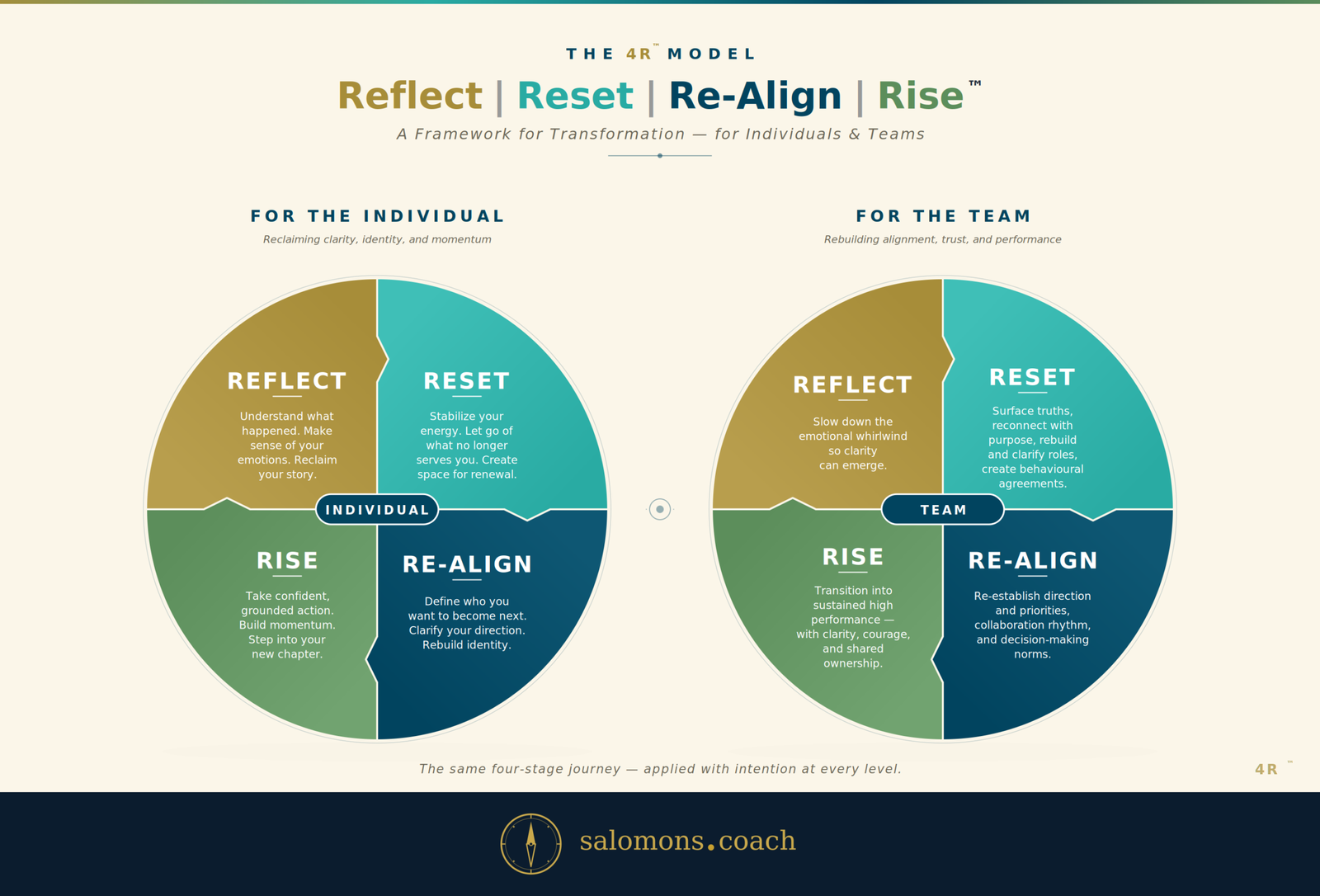
Setbacks demand action. Reflection demands stillness. The first stage of the 4R™ Model asks you to do the harder thing — stay with what happened long enough to make sense of it. Why Reflect is the foundation every transformation is built on.
When four of your twelve team members may be made redundant — but nothing is official yet — leadership becomes something different. It becomes the art of holding people together in uncertainty. This post offers six practical principles for leading through the wait: with honesty, focus, differentiation, and the kind of steadiness that people will remember long after the decision is made.
How does one person actually change the world? Not through grand gestures, but through shifts in thinking and behavior that ripple outward. This article explores the science behind societal change, from evolutionary psychology to systems thinking. It shows how mental models shape behavior, how small choices scale into cultural shifts, and why institutions tend to follow rather than lead. For leaders, the implication is clear: real change starts with how individuals see their role in the system. When enough people act differently, culture moves—and with it, performance, policy, and outcomes.
Most managers have two default tools when they need something to happen: tell people what to do, or escalate to someone who can. Direct communication and the chain of command. Both have their place. But if they are your primary or only tools for getting things done across an organization, you have a problem. Not because they don't work, but because they work less and less the higher you climb and the more complex your environment becomes.
The managers and project managers who consistently get things done are not the ones with the biggest title or the loudest voice. They are the ones who understand that in most modern organisations, influence is the currency that actually moves things. Directives produce...
AI is often framed as a technology challenge. In reality, it is a leadership one. By accelerating speed, increasing transparency, and making decisions comparable, AI exposes how leaders decide, where judgment is avoided, and how accountability is handled. This article explores why AI does not replace leaders, but reveals leadership behaviors that were previously hidden—and why credibility in an AI-driven world depends less on technical expertise and more on explicit judgment and ownership.
As AI becomes embedded in organizational decision-making, not all decisions should be automated. Some choices define values, require accountability, and demand human judgment under uncertainty. This article explores five leadership decisions AI should never make—not because AI is incapable, but because leadership legitimacy, responsibility, and trust cannot be delegated to technology.
Geert Hofstede spent decades researching one question: do people from different countries think and behave differently in professional contexts in ways that are systematic, measurable, and predictable? His answer — developed through surveys of over 100,000 IBM employees across more than 50 countries — was an unambiguous yes.
The result is the most widely cited framework in cross-cultural management research. Six dimensions. Numerical scores for over 90 countries. But knowing the framework exists and knowing how to use it are different things. This post explains what Hofstede's six dimensions actually measure — and how the Cross-Cultural Leadership Compass translates them into specific, situational leadership guidance.
For decades, organizations have treated change as something line managers or project managers can “absorb” alongside their real work. When change doesn’t land, we blame execution or resistance. What we rarely question is the operating model behind that assumption. This blog explores why change fails when adoption is assumed—and what senior leaders must do to engineer it deliberately.
Generative AI has not eliminated the need for expertise. It has eliminated the need for unexamined expertise. In organizations, the most damaging failures no longer come from a lack of technical capability, but from poor problem framing, misplaced optimization, and leaders who mistake speed for judgment. As AI takes over more of the executional “middle,” human value shifts to the boundaries: defining what truly matters and taking responsibility for real-world consequences. This is why so-called soft skills—critical thinking, systems awareness, ethical judgment, and human leadership—are no longer optional. They have become the premium capabilities of the AI era.