You Don’t Have a People Problem. You Have a System.
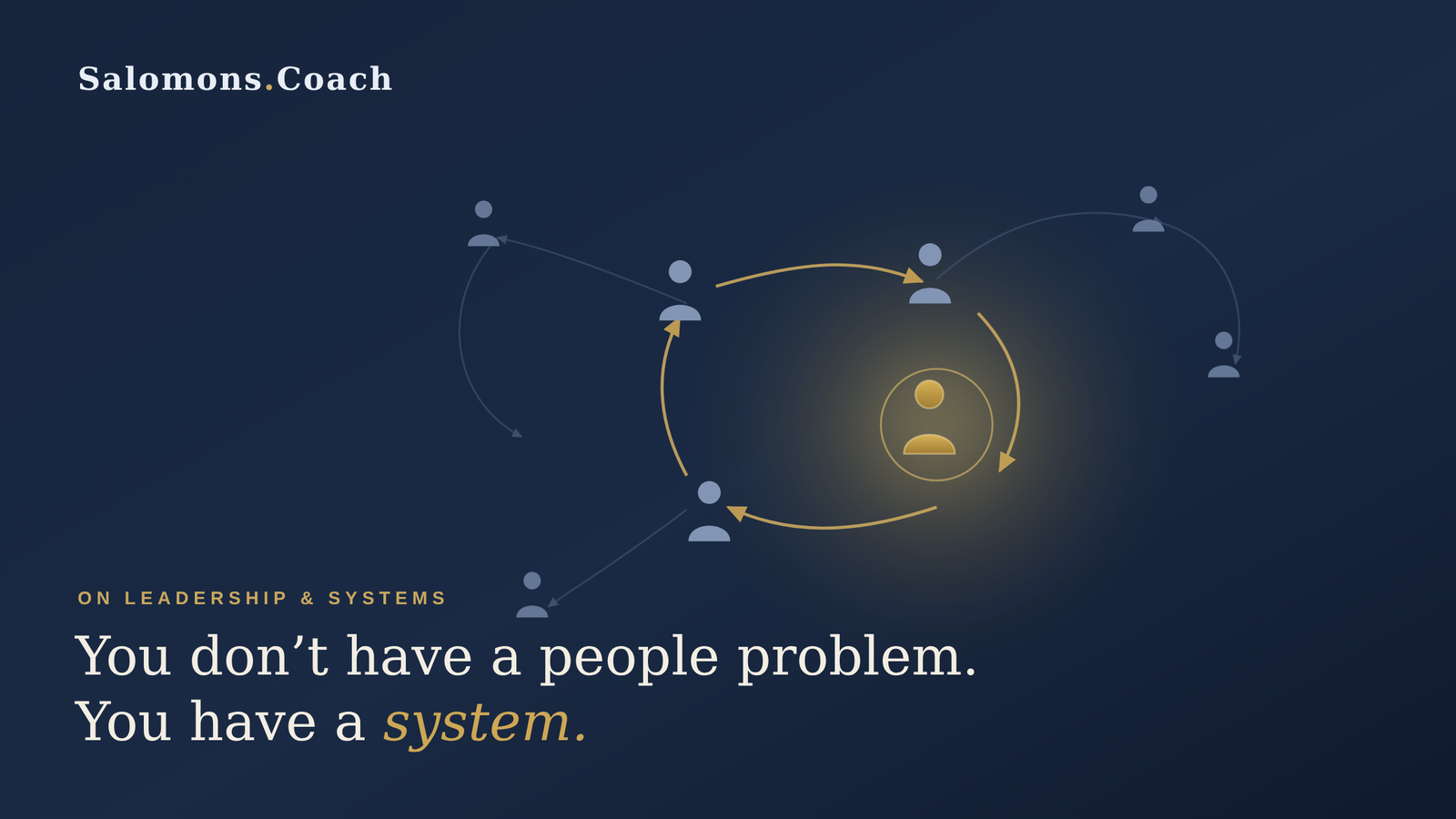
You Don’t Have a People Problem.
You Have a System.
Six things capable leaders say out loud. Each one a quiet sign that the problem was never where they were looking.
You are good at your job. That is what makes the following so disorienting. You are experienced, you work hard, you make sound decisions; and yet some problems simply will not move, no matter how much competence you throw at them. You have started to wonder, quietly, whether the issue is you. It usually isn’t. See whether any of these sound like your week.
“My team won’t take ownership. I end up carrying everything.”
You step in because it’s faster, and because you can already see the answer. And slowly, the people around you stop reaching for answers of their own, because why would they? You didn’t inherit passive people. You trained capable ones to wait.
“It’s one crisis after another around here.”
Each one arrives with its own name, its own cast, its own urgency. You handle it well. Then the next one comes, wearing a different face, and you handle that too. After a few years you begin to suspect you are not fighting separate fires. You are tending the same one.
“We fixed that, so why has it come back somewhere else?”
You cleared the bottleneck in delivery, and a month later it surfaced in quality. You resolved the friction between two managers, and the tension simply moved down the corridor. The problem didn’t disappear. It relocated. Problems do that, when the thing producing them is left untouched.
“Everyone is flat out, and still nothing moves.”
This is the one that keeps leaders awake. Not laziness! Its the opposite. Real talent, long hours, genuine effort, and a strange sense of running hard to stand still. When effort that large produces change that small, the problem is almost never the people. It is where they are being asked to push.
“I knew who the problem was. I replaced them. Nothing changed.”
This is the most expensive lesson in leadership, and nearly everyone pays for it once. It turned out the seat was shaping the behaviour, not the person in it. The next occupant will surprise you by behaving remarkably like the last.
“I’m the reasonable one, so why am I always the one stretched?”
You keep getting pulled into other people’s conflicts as the steady pair of hands. You carry tension that was never yours to hold. And you have started to wonder why the calm person in the room always ends up the most depleted.
None of these is a character flaw. None is a people problem. Each is the shape of the system you are standing inside: the loops, the delays, the quiet incentives shaping behaviour you have been reading as personality.
And each is made worse by the advice you will get almost everywhere else: try harder, push more, lead stronger; at precisely the point that will not move.
Where my work begins
My work begins where that advice runs out. I don’t help leaders push harder. I help them see the structure they are caught in — and find the one move, often a surprisingly small one, that makes the whole pattern rearrange. Less about effort. More about sight.
I have spent more than three decades inside these systems, not merely studying them; two managing-director chairs, leadership work across fifty-five countries, the particular weight of being the person who finally has to decide. So I recognise these patterns quickly, and I will say the thing you came hoping someone would finally say. That is not always comfortable. It is the part that works.
The leaders I work with rarely arrive saying “I have a systems problem.” They arrive tired — and quietly bewildered that so much competence is producing so little change.
That bewilderment is usually the first clue that the problem was never where they were looking. Seeing it differently is where the change starts, and it tends to start faster than people expect.
If any of this sounded like your week, that is worth a conversation — not a pitch, a proper one. I work with a small number of senior leaders at a time, which means I can give each one real attention.
Start a conversation →
You may also like


An Obeya Room Is Not a Wall Full of KPIs