
Most Leadership Teams Lack Dialogue
How leadership teams learn to think together before they decide
Tuesday, 09:00, the management team meeting. The agenda item is the new distribution strategy. The Commercial Director makes his case. The COO counters with capacity figures. The CFO questions the business case. Voices get a little louder, positions a little firmer. After ninety minutes the CEO sums up, a decision is taken, and everyone leaves.
Three weeks later the same decision is back on the table.
Nobody would describe that meeting as poor. People were engaged, prepared and direct. They had a good discussion. What they did not have was a dialogue, and that is exactly why the decision did not hold.
Here is the contradiction. Leadership teams pride themselves on robust debate, yet the more robustly they debate, the less they often learn from each other. Everyone leaves with the view they came in with, sharpened. Nobody leaves with a view they could not have had alone.
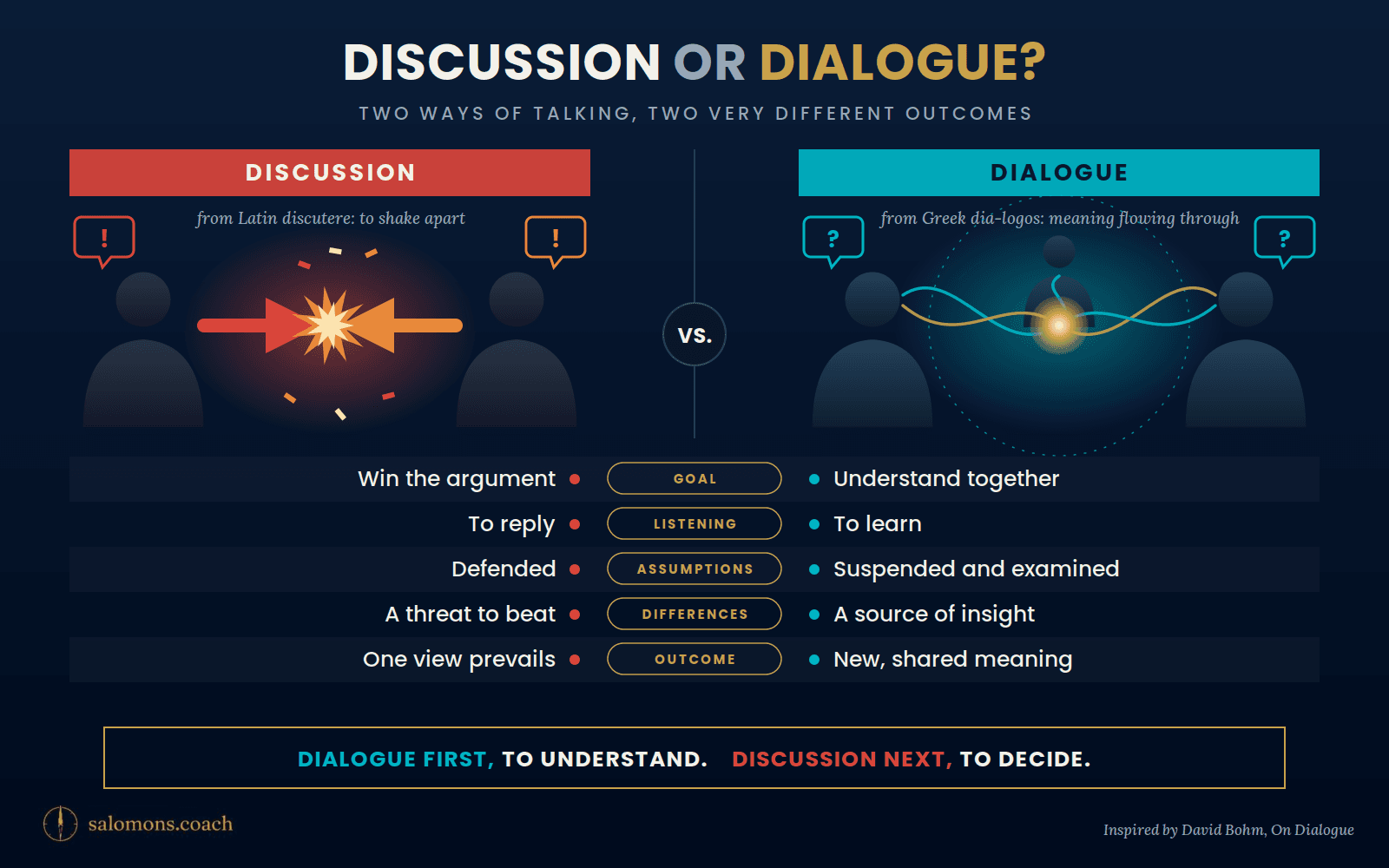
Discussion and dialogue are both conversations. They serve very different purposes.

| Discussion | Dialogue | |
|---|---|---|
| Goal | Win the argument, reach a decision | Understand together, before deciding |
| Listening | To reply | To learn |
| Assumptions | Defended | Suspended and examined |
| Differences | A threat to beat | A source of insight |
| Outcome | One view prevails | New, shared meaning |
Discussion narrows. Dialogue widens. A team that can only narrow will keep choosing between the options it already had.
The coaching case: the team that decided everything twice
A while ago I coached the CEO of a mid-sized logistics company. I will call her Ellen. Strong operator, quick thinker, respected by her board. Her frustration was specific: her management team took decisions, and then kept reopening them. Implementation stalled. Agreements made on Tuesday were quietly renegotiated in corridors by Friday.
“We have really lively discussions,” she told me. “Nobody holds back. That is not the problem.”
I asked if I could sit in on one of their meetings as an observer. She agreed. I kept a simple tally: statements on one side, genuine questions on the other. A genuine question being one where the person asking did not already know the answer they wanted.
In ninety minutes I counted well over a hundred statements. I counted four genuine questions. Two of them came from the most junior member of the team, and both were brushed aside within seconds.
The resistance
When I showed Ellen the tally, she was not impressed. “We are a management team, not a book club,” she said. “We don’t have time for philosophy. We need decisions.”
Fair point. So I asked her a different question: how much time did the team spend on decisions that came back? She did the maths herself. On the three biggest topics of the past quarter, the team had spent more time re-discussing than it had spent on the original decision. Speed in the room had created slowness everywhere else.
That landed.
The experiment
We agreed on a small experiment. For the next strategic topic, the first thirty minutes would be dialogue only. No proposals, no defending, no decisions. Just one question on the table: what do each of us see that the others might not?
The first attempt was awkward. The CFO lasted about six minutes before he started building his case for the option he preferred. Ellen, to her credit, stopped him: “Hold that. What makes you so sure?” His answer revealed an assumption about customer volumes that two of his colleagues did not share, and that nobody had ever said out loud.
That single exchange changed the decision. More importantly, it changed how the decision was held. Six months later, Ellen described it like this:
“We still argue. But now we argue about the right thing, and once we decide, it stays decided.”
The rest of this post draws on what that team learned, and on what I have seen work in leadership teams across many cultures since.
What really separates discussion from dialogue
The words themselves give the game away. Discussion shares its root with percussion and concussion: the Latin discutere, to shake apart. Dialogue comes from the Greek dia and logos: meaning flowing through. The physicist David Bohm, who spent the last part of his life on this subject, described dialogue as a stream of meaning flowing among and through a group, out of which something new can emerge.
Four differences matter most in practice.
1. The purpose. A discussion aims to converge: to choose, to decide, to close. A dialogue aims to explore: to understand the problem better before anyone chooses. Both are legitimate. Trouble starts when a team skips the second and rushes to the first.
2. The way people listen. In discussion, you listen for the weak spot in the other person’s argument, while preparing your own reply. In dialogue, you listen for what the other person sees that you do not. Same ears, completely different attention.
3. What happens to assumptions. In discussion, assumptions stay underground and positions are defended on top of them. In dialogue, assumptions are brought to the surface and looked at together. Bohm called this suspending: not dropping your view, but holding it up in front of you, so you and others can examine it.
4. What counts as success. Discussion succeeds when one view wins. Dialogue succeeds when the group understands something none of them understood alone.
One thing needs saying clearly. Discussion is not the villain. Leadership teams must decide, and deciding requires advocacy, challenge and closure. The problem is sequence. Most teams discuss first, and dialogue never, or only when the decision has already failed.
The impact: what it costs to only discuss
The cost of missing dialogue rarely shows up in the meeting itself. It shows up later, and elsewhere.
Decisions that do not hold. When people feel they lost an argument rather than contributed to an understanding, you get compliance instead of commitment. Compliance is fragile. It dissolves in the corridor, in the next meeting, or quietly in execution. Ellen’s reopened decisions were not a discipline problem. They were a dialogue problem.
The best information stays silent. Discussion rewards speed, confidence and seniority. The person with the most important doubt is often not the most confident speaker. Amy Edmondson’s work on psychological safety shows how easily teams lose exactly the input they most need, simply because speaking up feels risky.
Positions harden. Every round of debate makes people more attached to what they said in the previous round. Chris Argyris described how we climb a ladder of inference, from selected data to assumptions to firm conclusions, and then defend the top rung as if it were a fact. Discussion keeps everyone on their own ladder.
Culture amplifies the gap. In international teams, discussion mode favours those whose culture treats open disagreement as normal and useful. Colleagues from more hierarchical or relationship-oriented cultures often go quiet, not because they have nothing to say, but because the format does not invite it. What looks like alignment is often silence.
Signals that your team is discussing when it should be in dialogue
| Signal | What it usually means |
|---|---|
| Decisions come back within weeks | People complied, they did not commit |
| The same people speak first and most | The format rewards confidence, not insight |
| Questions are really statements with a question mark | Inquiry is being used as advocacy |
| The real conversation happens after the meeting | The room does not feel safe for doubt |
| Options on the table never change during the meeting | Nobody is learning, everyone is selecting |
How to have a dialogue
Dialogue is not a personality trait. It is a practice, and it can be learned. William Isaacs, who worked with Bohm at MIT, described four core practices. I use them with leadership teams almost exactly as he framed them, with one addition for the senior leader.
1. Listen, without preparing your reply
Notice the moment you start building your answer while the other person is still talking. That is the moment you stopped listening. A simple discipline helps: before responding, summarise what you heard in one sentence and check it. “So what you are saying is that the volumes are the real risk, not the capacity. Is that right?” It slows the conversation down just enough to let understanding in.
2. Respect, treat the other view as legitimate
Respect in dialogue means assuming that a colleague’s view makes sense from where they stand, even if it makes no sense from where you stand. Your task is to find out what they see from there. The question is never “why are you wrong?” It is “what do you know that I don’t?”
3. Suspend, make your assumptions visible
Say out loud what you are assuming, and invite others to test it. “I am assuming our customers will accept a later delivery window. If that is wrong, my whole position falls over.” This feels exposed at first. It is also the fastest way to find out where the real disagreement sits.
4. Voice, say what is actually true for you
Dialogue is not polite agreement. It requires people to say what they really think, including doubt, unease and half-formed ideas. The difference with discussion is not that people say less. It is that they say it as a contribution to the group’s thinking, not as a move to win.
5. For the senior leader: speak last, and ask first
In any leadership team, the most senior person’s opinion acts like a magnet. Once it is out, the conversation bends towards it. If you want dialogue, hold your view until others have spoken. Use your authority to protect the quiet voices and to stop premature closure, exactly as Ellen did with her CFO. Edgar Schein calls this humble inquiry: asking questions to which you genuinely do not know the answer.
Questions that open dialogue:
What are we not seeing yet?
What would have to be true for the other option to be the right one?
What makes you so sure, and what would change your mind?
Who here sees this differently, and what do you see?
What are we assuming that we have never actually checked?
Setting up a dialogue in your next meeting
- Name the mode. Say explicitly: “The next thirty minutes are dialogue. We will not decide anything yet.” Naming the mode releases people from the need to defend.
- Put one open question on the table. Not a proposal. A question the team genuinely cannot answer yet.
- Go round the table first. Everyone speaks once before anyone speaks twice. The senior leader goes last.
- Appoint a guardian. One person, rotating, who calls it when the conversation slips back into advocacy.
- Close by switching mode, out loud. “What have we learned? Now let’s discuss and decide.” The decision that follows will be faster, and it will hold.
Expect the first attempt to feel clumsy. Most leadership teams have practised discussion for decades and dialogue for minutes. The clumsiness is not a sign that it does not work. It is a sign that you are learning something new.
Thinking together, then deciding
Ellen’s team did not become a book club. It became faster. The time it once spent reopening decisions now goes into the thirty minutes before them.
That is the real impact of dialogue. It does not replace discussion. It gives discussion something worth deciding on: a shared understanding of the problem, the assumptions out in the open, and the quiet voices already heard.
Discussion without dialogue produces quick decisions that do not last. Dialogue without discussion produces insight that never lands. Senior leaders need both, in the right order.
Dialogue first, to understand. Discussion next, to decide.
Questions to reflect on
- In your last leadership team meeting, how many genuine questions were asked, and by whom?
- Which recent decision came back, and what was never said out loud before it was taken?
- Whose voice in your team do you hear least, and what might they see that you do not?
- When do you share your own view: first, or last?
- Which topic on your agenda next month deserves thirty minutes of dialogue before anyone decides?
Where team coaching comes in
In my work as a team coach, dialogue is often where the real change begins. Most leadership teams I work with are strong individually and sharp in debate, yet they rarely step back to look at how they think together. As a team coach, I do not sit at the table to steer the content. I help the team see its own patterns: who speaks first, which questions never get asked, where assumptions stay hidden, and when a decision is taken before the problem is understood. We then practise dialogue on the team’s real agenda, not in a classroom, until listening to learn, surfacing assumptions and holding back premature closure become part of how the team works. The aim is not a team that talks more. It is a team that understands more before it decides, and whose decisions hold once they are made.
Further reading
- David Bohm, On Dialogue
- William Isaacs, Dialogue and the Art of Thinking Together
- Peter M. Senge, The Fifth Discipline
- Edgar H. Schein, Humble Inquiry
- Amy C. Edmondson, The Fearless Organization
- Chris Argyris, Overcoming Organizational Defenses
Names and identifying details in the coaching case have been changed to protect client confidentiality.

You may also like

Five Steps to Take Immediate Control of a Crisis

It is not the workload. Stop calling it the workload.
