salomons.coachsalomons.coach
  • Home
  • About Me
  • Blog
  • Shop
  • Downloads
    • Your Own Career Coach
    • Cross-Cultural Leadership Compass
    • Your stress Profile
    • Psychological Safety Field Guide
    • Energy Awareness Journal
    • The Executive Presenting Framework
    • The Executive Ownership Reinforcement Framework
    • The Evidence Base for Coaching Effectiveness
    • The Art of Time Boxing
    • VUCA Leadership WorkBook
    • VUCA Leadership Book
  • Services
  • Testimonials
  • Session Scheduler
  • Contact
  • Change language to Nederlands
Back
  • Home
  • About Me
  • Blog
  • Shop
  • Downloads
    • Your Own Career Coach
    • Cross-Cultural Leadership Compass
    • Your stress Profile
    • Psychological Safety Field Guide
    • Energy Awareness Journal
    • The Executive Presenting Framework
    • The Executive Ownership Reinforcement Framework
    • The Evidence Base for Coaching Effectiveness
    • The Art of Time Boxing
    • VUCA Leadership WorkBook
    • VUCA Leadership Book
  • Services
  • Testimonials
  • Session Scheduler
  • Contact
  • Change language to Nederlands
  • Home
  • Blog
  • Leadership
  • The Feedback Fallacy

Leadership

20 Mar

The Feedback Fallacy
  • By salomons.coach
  • In Leadership, Learning

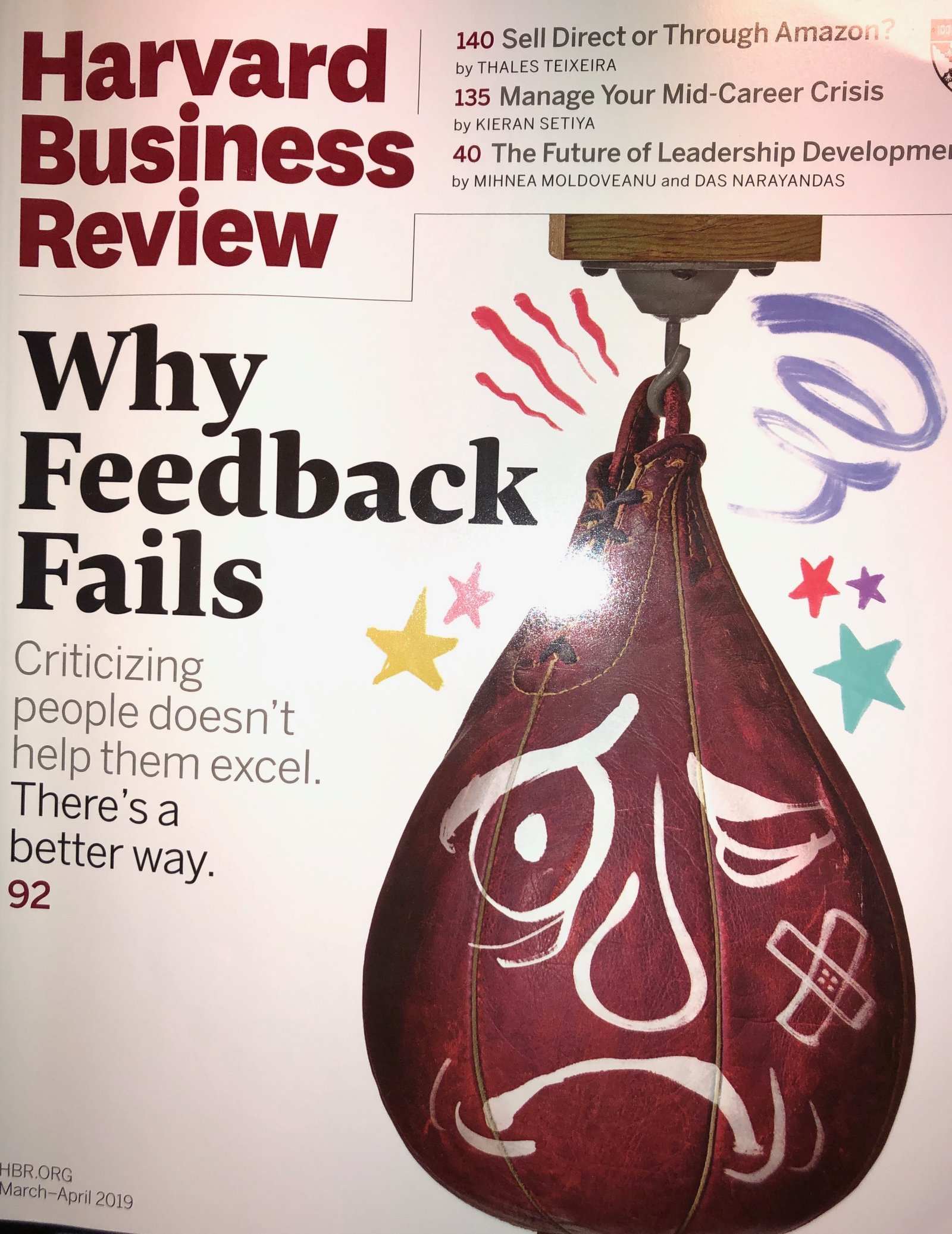
OMG, I just had a mental melt-down. Feedback doesn’t work as we thought for the last 100 years. Markus Buckingham and Ashley Goodall rock the boat.

I was reading the HBR (april 2019) and had to read this article 3 times, some parts even more. The claim: Feedback does not realise performance nor learning! “Telling people what we think of their performance doesn’t help them thrive and excel, and telling people how we think they should improve actually hinders learning.”

Isn’t feedback always useful? Don’t we want to help people to thrive and excel?  Yes we do, and it turns out that telling people what we think of their performance and how they should do it better – feedback – doesn’t work as think it does.

Our assumptions:

1. Others are more aware of our weaknesses, feedback helps clarifying this.
2. Learning allows us to acquire competencies through others teaching us.
3. Great performance can be analysed and transferred to us.

The HBR findings:

1. Humans cannot rate other humans, because they always base it on their understanding, never on our understanding. The “idiosyncratic rater effect”, more than 50% of their rating reflects only their own characteristics. Feedback is more distortion than truth.

2. Learning takes mostly place in areas of greater ability (our strengths), and getting attention to our strengths from others catalyzes learning.

3. Excellence is idiosyncratic. It is not the opposite of failure! In fact, excellence and failure have a lot in common (here really starts my mental melt-down). 

The point here is:
Since excellence is idiosyncratic and cannot be learned by studying failure, we can never help another person succeed by holding her performance up against a prefabricated model of excellence, giving her feedback on where she misses the model, and telling her to pug the gaps.

How to help people excel

  1. Look for outcomes. Excellence is an outcome, so take note of when a prospect leans into a sales pitch, a project runs smoothly, or an angry customer suddenly calms down. Stop the flow of work for a moment and pull your colleague’s attention back toward something he just did that really worked. “YES, That!”
  2. Replay your instinctive reactions. Describe what you experienced when his moment of excellence caught your attention. There is nothing more believable and more authoritative than sharing what you saw from him and how it made you feel.
  3. Never lose sight of your highest-priority interrupt. If someone screws up something, deal with it! But remember, this is merely remediating, it inhibits learning and does not get you closer to excellence. Just make it a personal learning experience. However, if you see someone doing something that really works, make that your high-priority interrupt. Stop him/her and the rest of the team and dissect the success. Not only he/she will grow and learn, everybody will.
  4. Explore present, past and future. When someone asks for a solution for a problem, start with the now. What is working for you right now? Relate this to asking to create new solutions. Then relate it to the past, when you had a similar problem before, what did you do (what worked)? Finally, ask for the future. What you already know you need to do? Maybe share one or two of your own experiences. Assume the person already knows the answers, help recognizing to.
  5. Focus on “WHAT”. Don’t focus too much on the why. Why didn’t that work or why do you think you should do that? Instead, focus on the whats – What do you actually want to happen? What are a couple of actions you could take right now? These questions create concrete answers.

What to do?
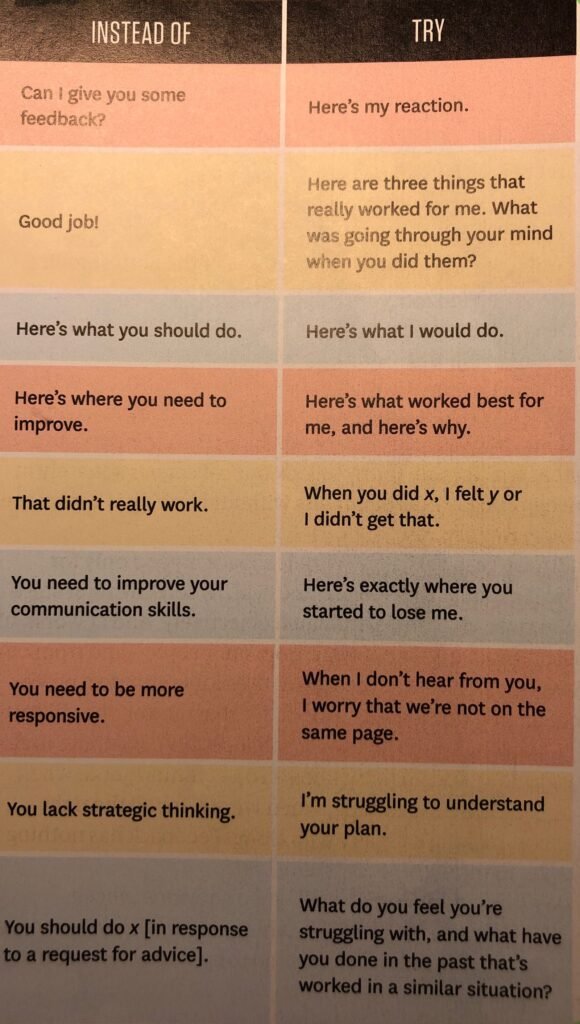
The right way to help colleagues excel try some of this language in stead

HBR conclusion:

“We humans do not do well when someone whose intentions are unclear tells us where we stand, how good we “really” are, and what we must do to fix ourselves. We excel only when people who know us and care about us tell us what they experience and what they feel, and in particular when they see something within us that really works.

Not mine, this is from the HBR magazine.

I think I need a meltdown first to rebuild my believe system with regards to the role of feedback in growth and the ability we humans have to project our thinking on others…


Tags:Excellencefeedbacklearningperformance
  • Share:
salomons.coach
Jan Salomons is a seasoned leader/executive who shares his knowledge and experience as an executive mentor/coach/trainer as well as a transformation and operations excellence expert. He has over 35 years of experience working with senior leaders across more than 55 countries, and is an elected member of the Harvard Business Review Advisory Council.

You may also like

Embrace strong emotions through reframing

  • 18 May 2023
  • by salomons.coach
  • in Emotional Intelligence
Embracing the Upside of Strong Emotions: A Practical Guide to Reframe Your Perspective Introduction Emotions are an integral part...
Harnessing the Power of Strong Emotions: Mastering Your Workplace Emotional Intelligence
18 May 2023
WFH & Managing Remotely – all HBR expertise put together
10 December 2022
Dealing with fear in an organization
27 November 2022

Leave A Reply Cancel reply

Your email address will not be published. Required fields are marked *

This site uses Akismet to reduce spam. Learn how your comment data is processed.

Categories

  • Agile (4)
  • AI (3)
  • Blog (151)
  • Books & Publications (7)
  • Change (4)
  • Change & Transformation (30)
  • Coaching (1)
  • Download (2)
  • Emotional Intelligence (2)
  • Innovation & Strategy (6)
  • Leadership (14)
  • Learning (4)
  • Learning & Development (12)
  • Mindfulness (2)
  • Organizations & Culture (40)
  • Performance Management (1)
  • Personal Development (7)
  • Purpose (1)
  • Remote Teams (1)
  • Self & Personal Growth (74)
  • Team Intelligence (2)
  • Teams & Collaboration (35)
  • Time Management (1)
  • Tools & Methods (38)
  • Uncategorized (4)
  • Video (16)
  • VUCA & Leadership (78)
  • Web Courses & Programs (4)
  • Workshops & Events (14)

Recent Posts

Businesswoman standing and presenting to colleagues around a glass-walled conference room table.
New Leader, Existing Team, Team Reset
16Oct,2026
Infographic titled 'What gets seen, gets repeated' showing two columns: left red section 'Visible. Immediate. Reactive.' with a red alert siren, a worker on the phone, factory silhouettes, and a '22:00' breakdown; caption 'IS A HERO.' Right green section 'Invisible. Deliberate. Proactive.' with a worker at a laptop displaying a rising graph and icons labeled 'Identify risk', 'Address causes', 'Prevent failure'; caption 'WEEKS EARLIER – PREVENTION' and 'IS ALMOST INVISIBLE.' Bottom banner reads 'Shift recognition. Reward prevention. Build resilient operations.' and shows salomons.coach.
What Gets Seen, Gets Repeated – Firefighters vs Preventers
26Sep,2026
Infographic titled STEER showing five circular steps (S, T, E, E, R) for crisis leadership on a dark blue background. Steps: Stabilise, Triage, Establish, Execute & inform, Review & refine.
Five Steps to Take Immediate Control of a Crisis
24Sep,2026

Tags

4R model (6) accountability (7) authenticity (5) behavior (8) career (12) change (29) coaching (51) communication (8) cross-cultural leadership (8) culture (16) decision-making (9) dersonal-development (6) emotions (6) executive-coaching (8) executive coaching (6) feedback (5) growth (6) leadership (68) leadership behavior (47) leadership coaching (8) leadership development (8) learning (10) mindset (5) psychological safety (31) redundancy (9) reflection (34) resilience (21) self-awareness (56) self-leadership (14) self-management (9) self-regulation (6) stress (10) team-dynamics (10) team alignment (5) team building (5) team coaching (10) teams (7) TED (5) Time Management (5) tools (19) transformation (6) trust (8) VUCA (37) VUCA leadership (39) work-life balance (5)
All posts - searchable table
Recent videos
the-adhd-watch-list-hero

The Best ADHD Videos for Leaders: Science, Stories, Strategy

In 14 July 2026
No Comment
Female speaker on stage delivering a TEDx talk, with a headset mic and gesturing, while a lower-third bio identifies her as a professor of organizational behaviour.

The Authenticity Paradox | Professor Herminia Ibarra 

Brooks – Harvard – on Happiness

Happiness as a Leadership Strategy

L360 youyrownjourney landing page L360

Find your true purpose

GET IN TOUCH

Salomons.Coach
KvK: 72129131
+31 6 53 89 75 67

jan@salomons.coach

The Netherlands

USEFUL LINKS

  • About
  • Privacy policy
  • Term & Conditions
  • Refund & Returns
  • Payment policy
  • Digital Policy
  • Methodology & Sources

LinkedIn

  • Linkedin
Receive blog updates

salomons.coach by J.K. Salomons Holding B.V., 2018-2026

  • Home
  • About Me
  • Blog
  • Shop
  • Downloads
    • Your Own Career Coach
    • Cross-Cultural Leadership Compass
    • Your stress Profile
    • Psychological Safety Field Guide
    • Energy Awareness Journal
    • The Executive Presenting Framework
    • The Executive Ownership Reinforcement Framework
    • The Evidence Base for Coaching Effectiveness
    • The Art of Time Boxing
    • VUCA Leadership WorkBook
    • VUCA Leadership Book
  • Services
  • Testimonials
  • Session Scheduler
  • Contact
  • Change language to Nederlands
Change language to Nederlands