salomons.coachsalomons.coach
  • Home
  • About Me
  • Blog
  • Shop
  • Services
  • Testimonials
  • Session Scheduler
  • Contact
  • Change language to Nederlands
Back
  • Home
  • About Me
  • Blog
  • Shop
  • Services
  • Testimonials
  • Session Scheduler
  • Contact
  • Change language to Nederlands
  • Home
  • Blog
  • Blog
  • Dealing with fear in an organization

Blog

27 Nov 2022

Dealing with fear in an organization

  • By salomons.coach
  • In Blog, Building high-performing leadership teams
Executive summary

Fear can become embedded in organisational behaviour when deadlines, poor results or authority make people reluctant to raise concerns. Under those conditions, silence may look like discipline while important information remains hidden.

This reflection draws on a management setting under operational pressure and considers how leaders can unintentionally reinforce defensiveness. The executive task is to maintain clear performance expectations while responding constructively to difficult facts and mistakes. People are more likely to help solve a problem when they can describe it without disproportionate personal risk. Trust is not a soft alternative to results; it is part of how teams learn and improve.

I was sitting in the meeting with a few senior managers. I could not take away my mind from the high pressure to deliver on our customer expectations, as we were lacking behind on them. At the same time, as a manager, I needed to bring up the delicate subject of people’s health. I had noticed many of the “overload” symptoms in my team, especially during the last few months.And to be honest, I also observed these symptoms with myself. There were simply too many things at the same time, we were feeling overwhelmed and not able to become in control. I also noticed difficulties in the coordination and communication with my colleagues, irritations popped-up easily and sometimes I even noticed severe concentration problems.

I remembered from some years ago, working as an operations manager in the transport industry, that fear to speak-up can lead to highly undesired situations. It actually came to a point where people felt being bullied, treated totally unfair and became disconnected from work, the organization and even from themselves. People just showed-up, did what they were told to do, but the ‘spirit’ was never there. Needless to say the performance went down the drain, managers were pressured to fix the performance and started pushing even harder. A dead spiral.

What I learned from those experiences? A lot, especially about myself. First of all I learned how important it is to stick to the values that are important to me. I experienced what positive impact that has for connecting with others. If you want to take fear out of the organisation, it starts with leaders being aware of themselves and what’s important for being trustworthy, to be highly predictable and consistent in your behaviour. It creates trust, the fundament for all connections and relations. Also the fundament for a healthy organization where people can thrive and will perform because they want to.

“When people fear the consequences of honesty, leaders receive reassurance instead of reality.”

Jan Salomons

How to recognize symptoms of fear in an organization?

If you find more than 3 of the symptoms below in an organization, you most likely are dealing with fear.

  • Micro-management, simple decisions not allowed to be taken at appropriate levels in the organization.
  • Time measurement instead  of measuring output, people being hesitating to leave when the boss still is at work
  • A unhealthy competitive atmosphere, up-to the level of stealing ideas from each other
  • People’s first response is based on distrust, they always consider potential impact first
  • Resistance to new ideas, as well as a lack of new ideas being put forward
  • Performance numbers rule how people are being judged
  • Often a “us” verses “them” culture
  • Most discussions take place outside of the meeting room (were taken before the meeting starts)
  • Political behavior is seen at all layers of the organization
  • Performance and quality can only be gained through direct supervision
  • Reluctant to admit mistakes, hiding mistakes, lying about mistakes, blaming others
  • Playing down or complete denial on issues brought forward
  • A “we know it all” atmosphere, often based on successes in the past (we know how to do this)

Dealing with

Tags:Organisational culturepsychological safetytrust
  • Share:
salomons.coach
Jan Salomons is a seasoned leader/executive who shares his knowledge and experience as an executive mentor/coach/trainer as well as a transformation and operations excellence expert. He has over 35 years of experience working with senior leaders across more than 55 countries, and is an elected member of the Harvard Business Review Advisory Council.

You may also like

The Ultimate Guide to the Impossible Operating Plan

  • 9 November 2026
  • by salomons.coach
  • in Blog
When an operating plan depends on overtime or deferred work, leaders need to check workload, capacity and who can...
Businesswoman standing and presenting to colleagues around a glass-walled conference room table.
New Leader, Existing Team, Team Reset
16 October 2026
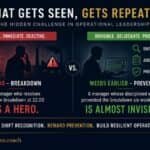
Infographic titled 'What gets seen, gets repeated' showing two columns: left red section 'Visible. Immediate. Reactive.' with a red alert siren, a worker on the phone, factory silhouettes, and a '22:00' breakdown; caption 'IS A HERO.' Right green section 'Invisible. Deliberate. Proactive.' with a worker at a laptop displaying a rising graph and icons labeled 'Identify risk', 'Address causes', 'Prevent failure'; caption 'WEEKS EARLIER – PREVENTION' and 'IS ALMOST INVISIBLE.' Bottom banner reads 'Shift recognition. Reward prevention. Build resilient operations.' and shows salomons.coach.
What Gets Seen, Gets Repeated – Firefighters vs Preventers
26 September 2026
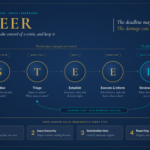
Infographic titled STEER showing five circular steps (S, T, E, E, R) for crisis leadership on a dark blue background. Steps: Stabilise, Triage, Establish, Execute & inform, Review & refine.
Five Steps to Take Immediate Control of a Crisis
24 September 2026

Leave A Reply Cancel reply

Your email address will not be published. Required fields are marked *

This site uses Akismet to reduce spam. Learn how your comment data is processed.

Categories

  • Blog (175)
  • Building high-performing leadership teams (25)
  • Closing leadership capability gaps (24)
  • Improving personal leadership effectiveness (46)
  • Leading across cultures and boundaries (15)
  • Leading through uncertainty and crisis (11)
  • Making better leadership decisions (4)
  • Making change stick (12)
  • Navigating leadership and career transitions (13)
  • Sustaining performance under pressure (15)
  • Turning strategy into operational results (10)
  • Video (16)

Recent Posts

The Ultimate Guide to the Impossible Operating Plan
09Nov,2026
Businesswoman standing and presenting to colleagues around a glass-walled conference room table.
New Leader, Existing Team, Team Reset
16Oct,2026
Infographic titled 'What gets seen, gets repeated' showing two columns: left red section 'Visible. Immediate. Reactive.' with a red alert siren, a worker on the phone, factory silhouettes, and a '22:00' breakdown; caption 'IS A HERO.' Right green section 'Invisible. Deliberate. Proactive.' with a worker at a laptop displaying a rising graph and icons labeled 'Identify risk', 'Address causes', 'Prevent failure'; caption 'WEEKS EARLIER – PREVENTION' and 'IS ALMOST INVISIBLE.' Bottom banner reads 'Shift recognition. Reward prevention. Build resilient operations.' and shows salomons.coach.
What Gets Seen, Gets Repeated – Firefighters vs Preventers
26Sep,2026

Tags

accountability (10) adaptability (5) AI & leadership (5) authenticity (10) Career transitions (11) Change execution (13) Coaching effectiveness (9) Coaching tools (18) communication (17) cross-cultural leadership (15) Cultural frameworks (12) decision making (6) Dialogue & conflict (7) emotional-intelligence (8) executive-coaching (15) Executive judgment (5) Executive presence (7) feedback (6) Focus & priorities (11) Global teams (5) Leadership behaviour (21) leadership development (16) Leadership transitions (5) learning culture (9) Neuroscience & learning (7) Operational excellence (7) Operational governance (5) Organisational culture (15) Organisational transformation (7) Ownership & delegation (6) Performance measurement (7) Personal resilience (10) psychological safety (14) Purpose & values (8) Recovery & wellbeing (7) Redundancy & outplacement (6) Research & evidence (8) self-awareness (43) Stress & coping (10) systems thinking (8) team alignment (6) Team effectiveness (15) trust (7) VUCA & uncertainty (9) Work-life boundaries (4)
All posts - searchable table
Recent videos
the-adhd-watch-list-hero

The Best ADHD Videos for Leaders: Science, Stories, Strategy

In 14 July 2026
No Comment
Female speaker on stage delivering a TEDx talk, with a headset mic and gesturing, while a lower-third bio identifies her as a professor of organizational behaviour.

The Authenticity Paradox | Professor Herminia Ibarra 

Brooks – Harvard – on Happiness

Happiness as a Leadership Strategy

L360 youyrownjourney landing page L360

Find your true purpose

Leadership thinking you can use

The Leadership Compass

For the decisions, conversations and changes you need to lead.

Receive articles grounded in executive experience, coaching and the realities of running an operation.

Read an example article ↗

Newsletter Form

Two short welcome emails in the first week, then articles about every two weeks. Unsubscribe at any time.

Privacy policy

GET IN TOUCH

Salomons.Coach
KvK: 72129131
+31 6 53 89 75 67

jan@salomons.coach

The Netherlands

USEFUL LINKS

  • About
  • Privacy policy
  • Term & Conditions
  • Refund & Returns
  • Payment policy
  • Digital Policy
  • Methodology & Sources

LinkedIn

  • Linkedin

salomons.coach by J.K. Salomons Holding B.V., 2018-2027

Change language to Nederlands