The Contracting Conversation: Why Some Yeses Hold and Others Evaporate
Marijke, a transformation director at a logistics firm, left a Tuesday meeting with exactly what she wanted. Joost, one of her team leads, had agreed to take over a systems integration that three other people had quietly let stall. He said yes. He even sounded relieved to be asked. Three weeks later, nothing had moved. No plan, no kick-off, no first call with the vendor.
Joost had not misled her. He agreed. He just never committed. And in the room, Marijke could not tell the two apart, because in the room they look identical. They sound identical. The difference only shows up later, in whether the work happens.
That gap, between agreement and commitment, is the whole reason a contracting conversation exists.
Two versions of the same phrase
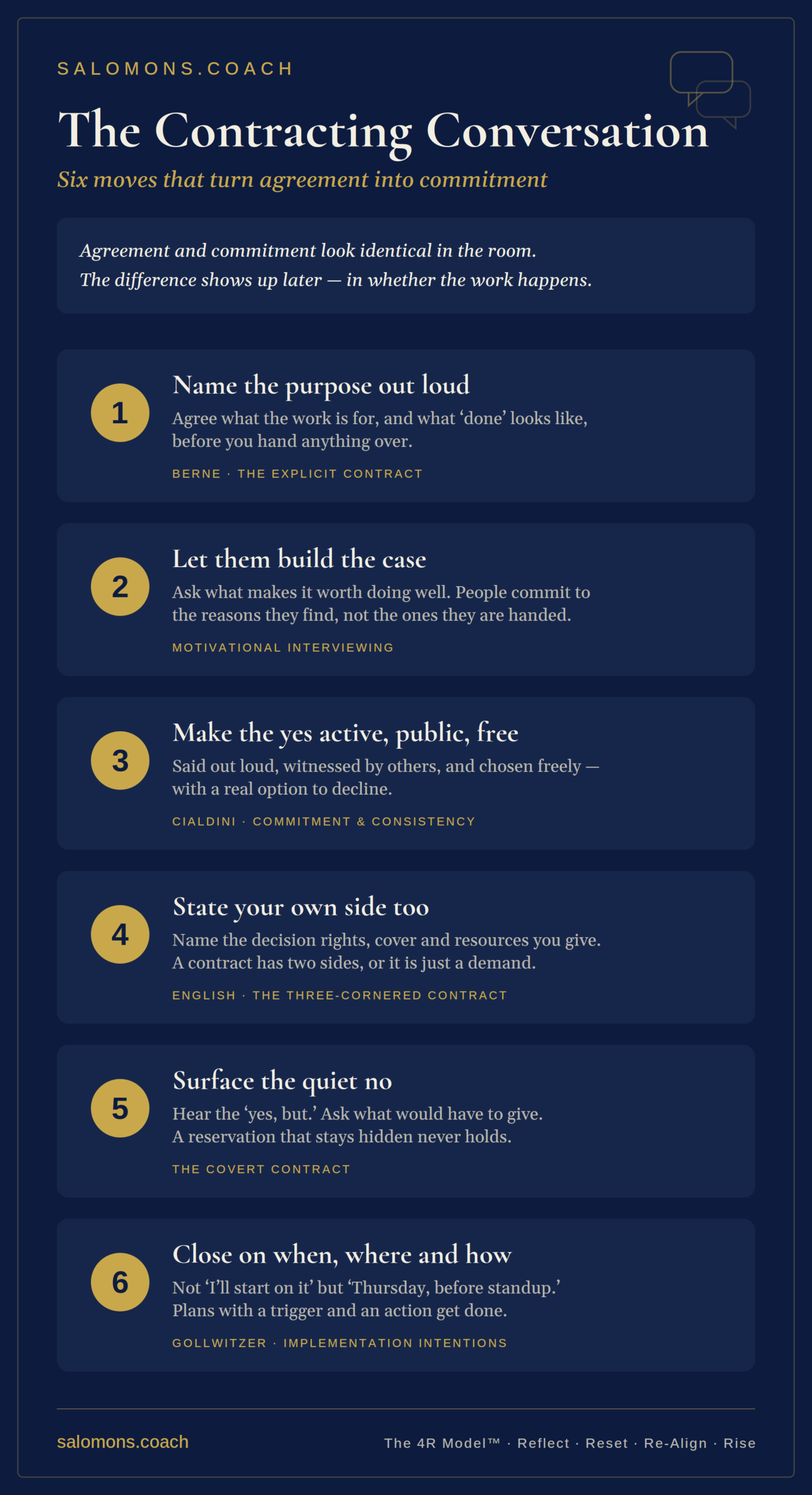
I first met the idea years ago as a training, taught as a method for making someone feel contracted: bound to a yes. Some versions of that training lean on compliance tactics borrowed from sales psychology. Secure a small agreement, then a larger one that stays consistent with it. Agree a scope or a price, then adjust it once the other person is already invested. Robert Cialdini documented why these work: once we make a commitment that feels active, public and freely chosen, we start generating our own reasons to defend it, and we keep defending it even after the original incentive disappears.
Those tactics do produce compliance. They are also the wrong instrument for a leader, for one practical reason. The commitment they manufacture belongs to you, not to the person who gave it. It holds while the pressure holds. The moment you look away, the yes quietly expires, which is precisely what happened to Marijke.
What follows is the other version. It uses the same psychology, but in the open and in service of the other person’s ownership rather than your leverage. A contracting conversation in this sense is not how you get a yes. It is how you build a yes that survives your absence.
A purpose both of you can say out loud
Eric Berne, who first put the word contract at the centre of this kind of work, defined it as an explicit, two-sided agreement on a well-defined course of action. The operative word is explicit. Most workplace agreements fail this test. They are assumed, half-stated, inferred from tone. The professional coaching bodies have a blunt way of describing the cost: a coach who skips the contracting conversation tends to discover around the fourth session that they have been working toward a goal the client never actually signed up for.
So the first move is unglamorous. Before anything is assigned, both people name what the work is for and what its finished state looks like. Not the task, the outcome.
Marijke’s mistake was asking Joost to “take over the integration.” When she ran the conversation again, she asked a different question first: what would it mean for this to be genuinely back on track by the end of the quarter? They ended up with a concrete picture, the vendor re-engaged and a tested data migration, that neither of them had been holding at the start. Joost was now agreeing to something real instead of a label.
Let them build the case, not you
There is a finding from motivational interviewing that should change how every leader runs these conversations. When researchers analysed what actually predicts whether someone follows through, the strongest single signal inside the conversation was not the helper’s argument. It was how much the other person argued for the change in their own words. The method works by handing the case for change over to the person who has to live it.
This lines up with what senior leaders already know about influence but rarely apply to their own teams. People commit to the reasons they discover, not the reasons they are handed.
In practice it means resisting the urge to pitch. Marijke wanted to explain to Joost why the integration mattered. Instead she asked what would make it worth doing well, from where he sat. He talked for a while, and somewhere in it he said the thing that mattered to him, that he was tired of being the person who cleaned up after other people’s half-finished projects and wanted one he could put his own name on. That sentence was worth more than any business case she could have delivered. It was his.
Make the commitment active, public and freely chosen
Cialdini’s research is specific about what makes a commitment stick. Three conditions do most of the work. The commitment is active, meaning it is spoken aloud or written down rather than nodded at. It is public, witnessed by someone whose regard the person values. And it is voluntary, chosen freely, with a real option to decline.
Notice that the manipulative version of contracting exploits exactly these levers while removing the third. It engineers the active and public parts and disguises the absence of genuine choice. The honest version keeps all three intact, which means you have to be willing to hear no.
The simplest expression of this is how you end the meeting. Marijke used to summarise commitments on behalf of the room, which felt efficient and left everyone passive. Now she does the opposite. She asks each person to say, in their own words, what they are taking on, and she does it in front of the others. With Joost, she also did something that felt risky: she told him he could still pass on it, that the offer was real and so was the exit. He stayed. The staying was the point.
Name what you will put in
A contract has two sides, or it is not a contract, it is a demand wearing a contract’s clothes. The conversation only earns the name when you are explicit about your own side of it.
Fanita English extended Berne’s idea into what she called the three-cornered contract, to handle the fact that most workplace agreements have a hidden third party: the sponsor, the budget holder, the boss’s boss. Their expectations sit in the room whether or not anyone names them, and unnamed they tend to derail things later.
When Marijke and Joost contracted properly, she stated what she would provide, the decision rights he would actually hold, the cover she would give him when the integration ran into the politics that had stalled it before, and the two standing meetings she would protect. They also surfaced the third corner. The divisional director had his own view of what success looked like, and they agreed how and when to test it rather than letting it ambush the work in month three.
Surface the quiet no
The most useful skill in a contracting conversation is hearing the yes that is actually a no. Manfred Kets de Vries calls it the velvet-gloved refusal, the “yes, but” that presents itself as openness while quietly closing the door. Transactional analysis has long held that alongside the spoken contract there runs a covert one, the real and unstated terms, and that work fails at the seam between the two.
A commitment that hides a reservation will not hold, because the reservation is the truth and the commitment is the performance.
Joost’s tell, the first time around, had been “sure, I can fit that in.” Marijke had heard agreement. What he meant was that he could not see where the hours would come from and did not want to look unwilling by saying so. The second time, she caught it and asked the plain question: what would have to give for this to be realistic? It turned out two of his other responsibilities needed to move. That was not resistance to be overcome. It was the actual condition of the work getting done, and naming it was what made the yes solid.
Close on when, where and how
The last move is the one most people skip, and it is the one with the strongest evidence behind it. Peter Gollwitzer’s research on what he termed implementation intentions found that goals attached to a specific if-then plan, a stated when, where and how, are far more likely to be reached than goals held as good intentions. Across a large body of studies the effect is substantial. The mechanism is almost mundane: deciding the trigger and the action in advance removes the in-the-moment negotiation with yourself that quietly kills most intentions.
So a contracting conversation does not end on “I’ll get started on it.” It ends on something a calendar could verify. Joost did not leave saying he would begin the integration. He left having said that on Thursday morning, before standup, he would send Marijke the revised plan and the first vendor email. The difference between those two sentences is the difference between the work happening and the work being something he meant to get to.
Back in the room
Run those six moves and you will notice what the conversation actually did. It surfaced what was really being asked and what was quietly being withheld. It cleared the vague intention and the polite no. It built an agreement both people owned rather than one person imposed. And it ended on a first concrete action. That is the same arc the 4R Model™ traces, Reflect, Reset, Re-Align, Rise, compressed into a single conversation. You do not need to announce the model for it to be working.
A contracting conversation takes ten minutes longer than handing out an instruction. Those ten minutes are the cheapest insurance a leader has against the most expensive failure there is: work that everyone agreed to and no one did.

The people and situations described here are composites drawn from coaching work, with details changed to protect confidentiality. They illustrate patterns rather than depict any individual client.

You may also like


An Obeya Room Is Not a Wall Full of KPIs