Stress is Personal, Cooping is Collective
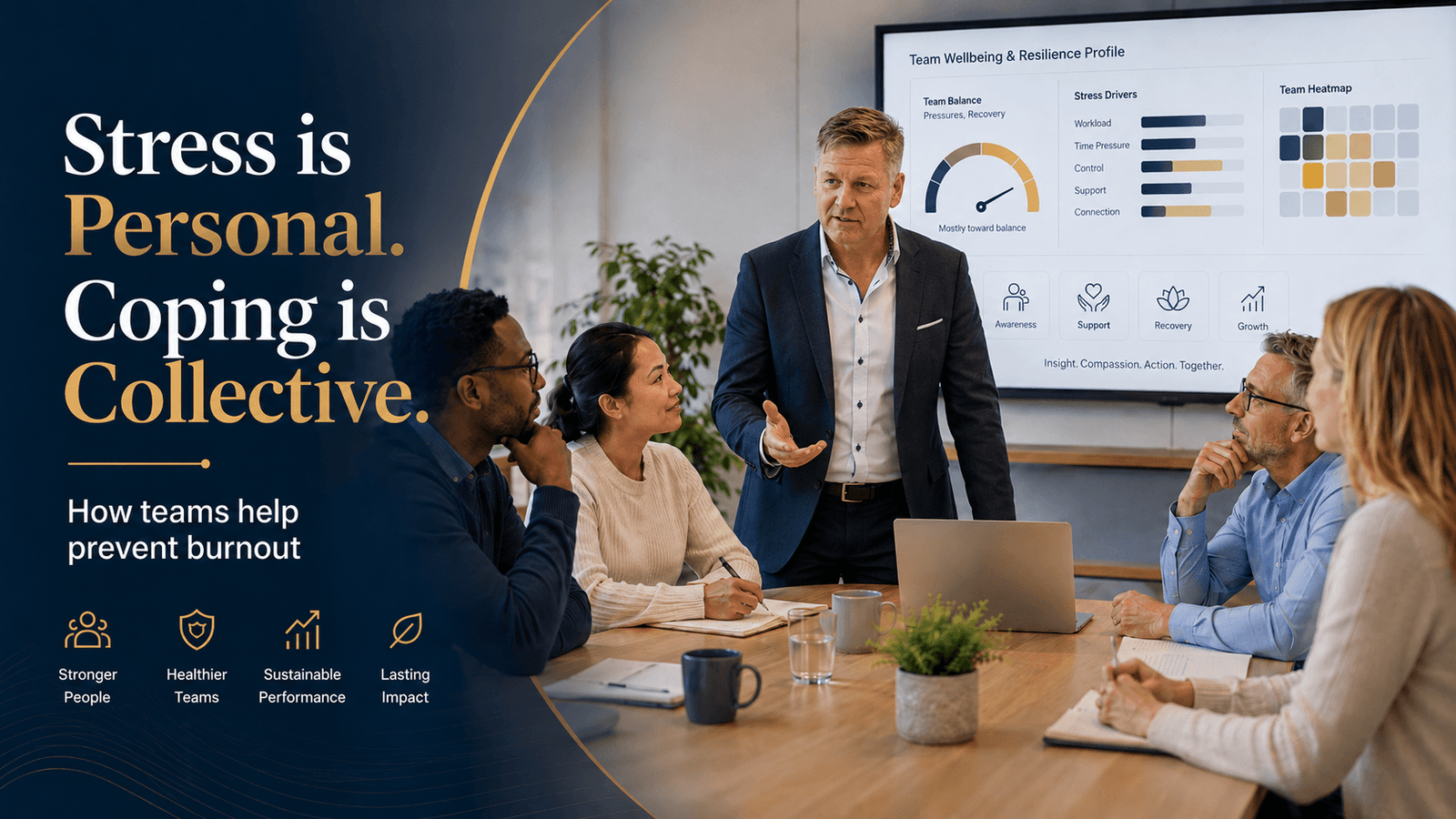
Stress Is Personal. Coping Is Collective.
Why teams can be the deciding factor in helping members cope with individual stress — before pressure turns into burnout risk.
Stress is often treated as an individual problem. We ask people to become more resilient, set better boundaries, recover better and ask for help earlier. All of that matters. But it is incomplete.
In real organisations, stress rarely lives only inside the individual. It is created, amplified or reduced by the system around the person: the team, the leadership context, the decision rhythm, the quality of collaboration, the level of clarity and the way people respond when pressure starts to rise.
That is why team stress deserves much more attention.
A person may experience stress individually, but the ability to cope is strongly influenced by the team environment. A team can normalise overcommitment, silence and heroic behaviour. Or it can make pressure visible, create psychological safety, share practical support and help people recover before performance starts to deteriorate.
The better question is: “How well does this team notice, discuss and manage pressure before it becomes chronic?”
Burnout is not simply “being tired”. The World Health Organization describes burnout as an occupational phenomenon resulting from chronic workplace stress that has not been successfully managed. It is specifically related to the work context and is characterised by exhaustion, mental distance or cynicism, and reduced professional efficacy.
A recent team case: stress in a distributed professional home base
I recently worked with a team of experienced Program Managers in a complex manufacturing environment.
This was not a conventional team working together every day on one shared backlog. The team functioned more as a professional network. Members were embedded in different business projects and programs for longer periods of time: sometimes six months, sometimes two years. Several worked across two or three assignments at the same time.
Most of these “projects” were actually programs: multiple workstreams, several stakeholder groups, complex governance, shifting priorities and high expectations from sponsors and senior management.
This matters because the source of stress was not only the team itself. A large part of the pressure came from outside their home base: project and program governance, business stakeholders, unclear ownership, sponsor behaviour, dependency on other teams, multiple deadlines, competing meetings, urgent requests and the invisible expectation that “change” can be delegated to the change manager.
This is a specific context, but the lesson applies broadly. Many modern professionals belong to one team, while their actual stress is created across several other systems. That is why individual resilience alone is not enough.
The five most important stressors for people working in teams
Based on recent work with teams and on broader research into work stress, collaboration and team behaviour, I see five recurring team stressors that can contribute to burnout risk.
1Fragmented demand and constant priority switching
One of the most underestimated stressors in modern organisations is fragmentation. People are not simply busy. They are pulled into multiple streams of work that each behave as if they are the priority.
For Organizational Change Managers, this often means being embedded in several projects or programs simultaneously. Each has its own rhythm, governance, stakeholders, deadlines and escalation points. The stress is not only caused by the amount of work, but by the constant switching between contexts.
2Collaborative overload
In many organisations, the most capable people become the most overloaded people. Not because they are formally assigned the most work, but because everyone knows they are helpful, responsive and good at solving problems.
They are asked to join meetings, review slides, advise colleagues, support stakeholders, prepare sponsors, facilitate workshops, look at communication plans, join “just one call” and help with “just one issue”.
This is the essence of collaborative overload. For change professionals, this is especially relevant. Their work is relational by nature. They create value through influence, connection, facilitation and challenge. But that same value can turn them into a hub for too many people, too many decisions and too many requests.
3Blurred accountability
This is one of the strongest stressors in change work. Business leaders want change. Sponsors approve change. Project and program managers govern change. Line managers need to lead behavioural change. Change professionals facilitate, structure and enable change.
But in practice, accountability often drifts. Stakeholders start expecting the change professional to “make the change happen”. Project managers delegate adoption risk. Sponsors become visible only at steering committee moments. Line managers assume communication equals implementation.
The change professional then steps in. Not because the role formally owns the business change, but because the work matters and the person feels responsible.
4Weak recovery after peak pressure
Many teams know how to accelerate. Far fewer know how to recover.
After a deadline, launch, escalation, crisis or steering committee, the next demand often arrives immediately. The team moves on before it has learned, restored energy or reset expectations. That is risky.
Recovery is not laziness. Recovery is part of performance. In project and program environments, recovery is often complicated by uneven work phases. One member may be in a pressure peak while another is in a project slowdown. One may be rebuilding capacity. Another may be entering a new assignment.
5Late help-seeking
Many capable professionals ask for help too late. They do not want to bother others. They think they should be able to handle it. They assume everyone else is busy. They are used to being the reliable one. They do not want to appear weak. They believe support should be reserved for “real problems”.
So they continue. Until pressure becomes visible through missed deadlines, emotional exhaustion, irritability, withdrawal or loss of perspective.
Personal coping and team coping: both matter
Stress management often focuses on personal coping mechanisms. These remain important: noticing early stress signals, reframing pressure, breaking ambiguity into next actions, asking for support earlier, protecting recovery, setting boundaries, saying no or renegotiating commitments, reflecting after demanding periods and distinguishing what is yours to own from what belongs elsewhere.
But personal coping is only half the story. Teams also have coping mechanisms. A team’s coping mechanisms are the routines, norms and conversations that help people respond to pressure together.
Personal coping
- Notice early stress signals.
- Reframe pressure as challenge, not only threat.
- Ask for support earlier.
- Protect recovery and boundaries.
- Clarify what is yours to own.
Team coping
- Weekly capacity checks.
- Explicit trade-off rules.
- Peer consultation and case clinics.
- After-action reviews and recovery resets.
- Role-contracting with stakeholders.
The role of the Team Stress Profile
A Team Stress Profile creates a shared mirror. It does not diagnose individuals. It does not rank people. It does not reduce team members to scores. It does not replace leadership responsibility.
What it does is create structured visibility.
Current Pressure
Current load, overload, transition phases and pressure peaks.
Resilience Resources
Mindset, action, perspective, connection, recovery and boundaries.
Protective Responses
Temporary distancing habits that may help briefly but become risky when overused.
A good Team Stress Profile looks at current load, stress mindset, action orientation, perspective, connection, protective habits, recovery, boundaries and overall resilience balance. The most important insight is often not the average score. It is the variation.
Different people can be in very different pressure situations, with different coping resources and different work phases. The central development task is therefore not to make everyone the same, but to create habits that make changing capacity visible, respect recovery and turn complementary strengths into shared team capacity.
Eye-openers from a Team Stress Profile
The average can hide the real risk
A team average may look healthy while several individuals are already in negative balance. Ask where pressure and resources are unevenly distributed.
Strong action can hide weak recovery
Teams that mobilise quickly often feel effective. But action without recovery can become a depletion cycle.
Connection is a resilience resource
Connection is not just good relationships. It is whether people use the team when pressure rises.
Accountability drift creates stress
When ownership is unclear, committed professionals often absorb ambiguity and compensate with extra effort.
Collaboration can become overload
Not every request is equally valuable. Does the person need your knowledge, your network or your time?
How teams can support members coping with individual stress
The practical work starts when the team stops asking only, “How can this person become more resilient?” and starts asking, “What team conditions would make resilience easier?”
| Team habit | Core question | Why it helps |
|---|---|---|
| Capacity visibility | What is taking most of my capacity now? | Makes pressure visible before it becomes overload. |
| Trade-off rule | What will stop, move or reduce if this new work is accepted? | Prevents silent accumulation of commitments. |
| Accountability contract | Who owns the business outcome, and what should the expert not absorb? | Reduces role overload and misplaced accountability. |
| Peer consultation | Where do I need a thinking partner, challenge or support? | Turns individual strain into shared learning. |
| Recovery reset | What do we need to restore before we accelerate again? | Makes recovery part of sustainable performance. |
How to get started with a Team Stress Profile and workshop
Step 1: Start with individual reflection
Each team member completes a short profile covering current load, stress mindset, action, perspective, connection, protective habits, recovery, boundaries, personal triggers and desired improvements. The combination of scores and written reflections is important. Numbers show patterns. Text explains context.
Step 2: Create the team profile
The team profile should show team averages, variation between members, strongest shared resources, lowest shared resources, current pressure, balance between pressure and resources, common stressors from written responses, potential blind spots and opportunities for mutual support.
Step 3: Discuss the results in a facilitated workshop
A good workshop does not simply present the report. It helps the team make meaning from it. Useful questions include: What do we recognise immediately? What surprises us? Where does the average hide different realities? Which strengths do we underuse? Where do we ask for help too late? What pressure is self-created? What pressure is created by the system? Where is accountability unclear?
Step 4: Choose three habits, not ten actions
Most teams create too many improvement actions. That becomes another source of stress. Choose three. For example: weekly capacity and support check, trade-off rule for new demand and monthly case and resilience clinic. Small repeated habits change team behaviour more reliably than large action plans nobody revisits.
Step 5: Run a 90-day pulse check
After 90 days, do not ask whether people “liked the workshop”. Ask whether behaviour changed. This turns stress management from a one-off intervention into a learning cycle.
- I have a realistic view of my combined workload.
- I know which commitment has priority when demands conflict.
- I ask for help early enough.
- Trade-offs are made explicit when new work arrives.
- Business leadership owns the business change.
- I can recover after peak periods.
- Collaboration requests are sustainable.
- The team uses peer support deliberately.
Final thought
Stress is inevitable in meaningful work. Especially in complex organisations, with multiple stakeholders, shifting priorities and high expectations, pressure will not disappear.
The goal is not to create a stress-free team. The goal is to create a team that knows how to work with pressure.
A team that sees stress early. Talks about it honestly. Uses each other’s strengths. Protects role clarity. Makes trade-offs explicit. Recovers after peak periods. And refuses to turn every structural problem into an individual resilience issue.
Ready to make team stress discussable?
A Team Stress Profile and workshop can help your team understand how pressure is created, how members currently respond, and which habits will make resilience more collective and sustainable.
Start the conversationReferences and further reading
World Health Organization. Burn-out an occupational phenomenon. WHO.
Crum, A. J., Salovey, P., & Achor, S. (2013). Rethinking stress: The role of mindsets in determining the stress response. Journal of Personality and Social Psychology. DOI.
McGonigal, K. (2013). How to make stress your friend. TED Talk.
Cross, R., Rebele, R., & Grant, A. (2016). Collaborative overload. Harvard Business Review. HBR.
Edmondson, A. C. (2012). Teaming: How Organizations Learn, Innovate, and Compete in the Knowledge Economy. Jossey-Bass.

You may also like

An Obeya Room Is Not a Wall Full of KPIs
- 18 July 2026
- by salomons.coach
- in Blog

ADHD Leadership Videos