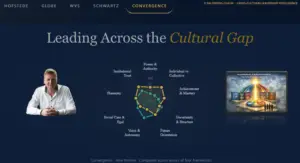
Je leiderschapskompas voor intercultureel management

You Think You Know How to Lead Across Cultures. The Data Says Otherwise.
Most cross-cultural leadership problems are invisible until they cost you something. That is why a new tool has been developed, bringing together four academic frameworks, so you can better understand – and more importantly – lead with this in mind. In the end, the Cross-Cultural Leadership Compass will change your leadership behavior! Not because of the theories, because of the the practical guidance the tool provides.
A delayed project. A team that nods but doesn’t commit. A brilliant report who keeps missing the point of your feedback. A manager who seems unimpressed despite results you’re proud of. A peer relationship that started well and quietly went cold.
None of these feel like cultural problems in the moment. They feel like personality clashes, bad timing, or just the friction of work. But underneath most of them, if you look carefully, is a structural gap between two cultural operating systems running on different assumptions about what good leadership actually looks like.
The research makes this uncomfortable. The Hofstede, GLOBE, World Values Survey, and Schwartz frameworks, four independently validated academic datasets, have been mapping cultural gaps across more than 60 countries for decades. The pattern they reveal is consistent: most leaders are not aware of the specific dimensions on which their culture diverges most sharply from the cultures they’re leading in. And the gaps that do the most damage are usually not the ones you expect.
Here are the ten pain points that show up most persistently in the data, and in the leadership conversations I have with senior professionals navigating cross-cultural environments every day.
- Your competence is invisible because you’re signaling it the wrong way
- You’re building trust in the wrong sequence
- Your feedback is either too direct or completely missing
- Your meetings are producing agreement, not commitment
- You’re managing hierarchy in both directions incorrectly
- Your high-context communication is producing low-context noise
- You’re not seeing the Flemish-Dutch difference – and it’s costing you
- You’re misreading your Dutch manager’s silence
- Your relational investment is going to the wrong people in the wrong amounts
- You have no map for the gaps that actually matter in your specific situation
1. Your competence is invisible because you’re signalling it the wrong way
In high-context cultures like China, Japan, much of the Middle East and South Asia, professional capability is demonstrated through collective attribution, deference to seniority, and the quality of outcomes over time. In low-context individualist cultures like the Netherlands, Germany, the US, Australia, competence is demonstrated through explicit, first-person, direct assertion of your analysis and your conclusions.
If you have been operating in a Dutch or German professional environment and wondering why your capability doesn’t seem to register, this is probably why. Hofstede IDV scores show a gap of Δ60 between China and the Netherlands, one of the largest individualism gaps in the dataset. That gap is not abstract. It shows up in every meeting, every status update, and every performance conversation.
The fix is not to become someone else. It is to translate your capability into the vocabulary the context can read.
2. You’re building trust in the wrong sequence
Trust architecture varies enormously across cultures, and most leaders apply their home culture’s trust logic everywhere, then wonder why it doesn’t work.
In Chinese and many Southern European professional cultures, trust must be established before effective collaboration can begin. You invest relationally first; the work follows. In Dutch, German, and Scandinavian professional cultures, it works in precisely the opposite direction: you work together, demonstrate competence and reliability, and trust develops as a byproduct of that collaboration. Social investment before demonstrated competence, in the Dutch system, reads as either naïve or manipulative.
The World Values Survey Survival–Self-Expression gap between China and the Netherlands is Δ46. That number represents a fundamentally different worldview about what professional relationships are for. Applying Chinese trust-building logic in a Dutch professional context produces warm acquaintances and no professional trust. Applying Dutch trust logic in a Chinese context produces delivered results and no relationship.
3. Your feedback is either too direct or completely missing
Feedback is one of the most culturally variable professional behaviours measured. What registers as direct, honest, and respectful in one cultural system reads as aggressive, inappropriate, or incomprehensibly rude in another; and what reads as diplomatic and considerate in one system simply doesn’t register as feedback at all in another.
Dutch professionals (Hofstede MAS: 14, the lowest in the world) give and expect direct, specific, behavioural feedback with minimal social softening. Chinese professionals (MAS: 66) operate in a context where direct public correction is a face-threat that damages relationships. The Δ52 gap on Masculinity between China and the Netherlands is not just about achievement orientation, it shapes every feedback conversation between a Dutch manager and a Chinese direct report.
The specific failure mode: a Chinese professional managing Dutch reports softens feedback to the point where it doesn’t register as feedback. The Dutch team member hears a general comment, not a request for change. Nothing changes. The manager concludes the direct report is resistant. The direct report concludes the manager is unclear. Both are right, and both are wrong.
4. Your meetings are producing agreement, not commitment
Meeting culture is one of the sharpest expressions of cultural difference in professional life – and one of the least discussed.
Dutch meeting culture: the meeting is where decisions are made, disagreement surfaces, and commitments are taken. Silence means assent. The expectation is that all participants contribute directly and challenge openly. Flemish Belgian meeting culture: disagreement is managed outside the room. Concerns are raised bilaterally before or after the meeting, not during it. The meeting confirms what was already aligned. Belgium’s Hofstede UAI score of 94 , the highest in Western Europe, creates a structural need for pre-meeting alignment that Dutch meeting culture doesn’t recognize as legitimate.
And Chinese meeting culture: the meeting should confirm consensus that has already been built through the relational fabric. Visible disagreement in the room is a social failure.
Put Chinese, Dutch, and Flemish professionals in the same project meeting and you have three incompatible theories of what the meeting is for. Someone is going to leave thinking a decision was made that wasn’t.
5. You’re managing hierarchy in both directions incorrectly
Power Distance, the degree to which a culture accepts and expects unequal distribution of power, is one of the most consequential dimensions in the Hofstede dataset, and one of the most misread.
China scores PDI 80. The Netherlands scores PDI 38. That Δ42 gap means: the deference, respect, and upward status management that are professional virtues in Chinese management culture read as passivity, lack of confidence, or even dishonesty in the Dutch professional context. Dutch managers don’t want deference, they want your professional opinion, including when it contradicts theirs.
In the opposite direction: Dutch managers who give direct feedback to Chinese direct reports may be doing significant damage to the professional relationship they think they’re managing well. The subordinate is not experiencing directness; they are experiencing a public status threat.
The hierarchy you’re managing is always two-directional, and the calibration has to be right in both directions simultaneously.
6. Your high-context communication is producing low-context noise
China is one of the world’s highest-context communication cultures. The Netherlands is one of the world’s lowest. This is the communication gap that underlies almost every other gap in this list.
In high-context communication, meaning is embedded in relationship, tone, context, and what is deliberately not said. The listener is expected to infer. In low-context communication, meaning must be stated explicitly in words, by the speaker. Ambiguity is not courtesy, it is a communication failure.
After years of living and working in a low-context environment, most high-context professionals believe they have made the adjustment. They have, on the surface. The residue shows up in exactly the moments that matter most: under pressure, in politically sensitive situations, when there’s a face-risk in play. In those moments, the high-context default reasserts itself – and the low-context listener misses the signal entirely.
7. You’re not seeing the Flemish-Dutch difference – and it’s costing you
Belgium is not the Netherlands. This sounds obvious. It is consistently missed by leaders managing mixed Belgian-Dutch teams.
Flemish Belgian professionals are more hierarchical than Dutch (PDI 65 vs 38), dramatically more uncertainty-averse (UAI 94 vs 53), more status-conscious (MAS 54 vs 14), and more formal in professional relationships. They need more documentation, more explicit decision confirmation, and more bilateral relationship maintenance than their Dutch colleagues. They are also significantly less likely to raise concerns in open group settings, not because they don’t have concerns, but because the open room feels too exposed.
A management approach calibrated for Dutch professionals will consistently under-serve, and occasionally alienate, Flemish team members, even though they appear to share a language, a professional context, and much of the same organizational culture. The GLOBE Uncertainty Avoidance gap between the Netherlands and Belgium (Flemish) is operationally significant across every dimension of project management: scoping, decision-making, stakeholder communication, and change management.
8. You’re misreading your Dutch manager’s silence
Dutch managers are not long on positive feedback. Dutch professional culture does not organise professional life around visible recognition, formal acknowledgement of achievement, or the social markers of status and seniority. Netherlands Masculinity – MAS: 14. In a culture that scores the lowest on Masculinity in the entire Hofstede dataset, the absence of explicit praise does not mean anything is wrong.
But the absence of raised eyebrows when you name a problem does mean something. In Dutch management culture, the willingness to disclose problems early, before you’ve solved them, before they’ve become crises, is one of the primary signals of professional trustworthiness. A direct report who only brings solutions reads as either a poor communicator or someone who is managing what information the manager receives. Neither interpretation helps your career.
Most Chinese professionals in Dutch-managed environments are making the right calls and not getting credit for them. They’re also protecting their manager from information the manager needs and doesn’t know he’s missing.
9. Your relational investment is going to the wrong people in the wrong amounts
The Schwartz Embeddedness dimension measures the degree to which a culture expects individuals to maintain obligations to their social group, preserve traditions, and subordinate personal goals to collective continuity. China scores 78. The Netherlands scores 28. Δ50.
That gap represents a fundamentally different expectation about the social obligations of professional relationships. In Chinese professional culture, the relational fabric requires maintenance; you invest in it continuously, reciprocate, and stay connected even when the project rationale for contact has passed. In Dutch professional culture, relationships are task-adjacent: when the task ends, the active relational obligation ends with it. Moving on without social maintenance is not coldness, it is simply the structure of how Dutch professional relationships work.
Most senior professionals with a Chinese background who have spent years in the Netherlands describe a persistent sense that something is wrong when Dutch colleagues move on without the relational continuity they expect. Nothing is wrong. The architecture is different.
10. You have no map for the gaps that actually matter in your specific situation
This is the most expensive pain point on the list, because it makes all the others harder to address.
Most cross-cultural leadership development is generic. It covers cultural difference at the level of principle, high-context vs low-context, individualist vs collectivist, without ever doing the specific work of mapping your cultural baseline against the specific professional context you are operating in, across the dimensions that have most operational relevance to your actual role.
The difference between knowing that China and the Netherlands are culturally distant and knowing that the Δ60 IDV (individualism) gap is going to reassert itself under pressure specifically in meetings where you are not the chair, or that your Flemish team members need bilateral pre-briefing for the same reason your Dutch manager actively does not; that level of specificity is where leadership development becomes useful. Generic awareness produces interesting conversations. Situational precision produces behavior change.
What changes when you have the map
The Cross-Cultural Leadership Compass exists because most senior leaders navigating cross-cultural environments have access to good intentions and not much else.
The Compass integrates four independently validated academic frameworks: Hofstede, GLOBE, World Values Survey, and Schwartz, across eleven leadership dimensions that matter in real professional life: managing up and down, meeting facilitation, feedback, trust-building, peer dynamics, and communication. It runs a cross-framework convergence analysis to identify where all four frameworks independently confirm the same gap, the highest-confidence signals in the dataset. And it does this for any country pair you choose to examine.
The tool is free to use at salomons.coach. Select your country pair, run the four-framework analysis, and see where the structural gaps are in your specific professional pairing. Full context-specific leadership reports, like the China-Netherlands analysis that informed this article ,are available for leaders who want the situational depth: a report written for your role, your team composition, your management relationship, and your specific cultural background.
Most of the problems described in this article don’t feel like cultural problems when you’re inside them. They feel like difficult colleagues, unclear managers, unmotivated teams, and frustrating professional dynamics that resist every sensible intervention you try.
The frameworks don’t make those problems disappear. But they make them legible. And once you can see the structure underneath the friction, you can do something deliberate about it.
That’s what the Compass is for.
The Cross-Cultural Leadership Compass is available with a free preview at Cross-Cultural Leadership Compass LP – salomons.coach. You will get a full personalized leadership report, written for your specific country pair, professional role, team, and management context. All available via one tool.