Wie is verantwoordelijk voor verandering - Een nieuw besturingsmodel
Waarom dit onderwerp me nog steeds dwars zit
Al meer dan dertig jaar ben ik betrokken bij organisatorische veranderingen, soms leid ik die, soms adviseer ik die en soms ruim ik die op. Ik heb gewerkt met leidinggevenden die er echt om gaven, projectteams die precies leverden wat er gevraagd werd en lijnmanagers die er alles aan deden om de activiteiten draaiende te houden terwijl ze de zoveelste verandering “absorbeerden”.
En toch heb ik hetzelfde patroon zichzelf zien herhalen.
Wanneer verandering moeizaam verloopt, is de verklaring vaak eenvoudig: “De lijn pikte het niet op.”
Of: “Het project leverde op, maar de organisatie was er nog niet klaar voor.”
Af en toe: “Mensen verzetten zich.”
Wat zelden in vraag wordt gesteld, is de onderliggende veronderstelling achter dit alles: dat veranderingsmanagement iets is wat een lijnmanager of projectmanager kan, of zou moeten, doen naast hun echte werk.
Ik heb dat zelf op verschillende momenten in mijn carrière geloofd. Vooral toen resultaten belangrijk waren, tijdschema's krap waren en het toevoegen van “nog een rol” voelde als onnodige overhead. Maar ervaring leert je waar je eigen sluiproutes niet meer werken.
In de loop der jaren begon ik iets ongemakkelijks op te merken. In organisaties waar verandering deed plakken, waar nieuwe manieren van werken de eerste crisis, de eerste piek, de eerste leiderschapsverandering overleefden, was er bijna altijd een onzichtbaar systeem aan het werk. Geen glanzend veranderingsplan. Geen stortvloed aan communicatie. Maar een weloverwogen manier van denken over eigenaarschap, leiderschapsgedrag, versterking en de rol van managers in het begrijpen van wat er gebeurde.
In organisaties waar verandering mislukte, deden we vaak het tegenovergestelde. We schoven de verantwoordelijkheid naar beneden, namen aan dat het vermogen op de een of andere manier wel zou komen en noemden dat “eigenaarschap”. Als het niet werkte, gaven we de uitvoering de schuld.
Deze blog is mijn poging om die reflex af te remmen.
Niet om te beweren dat lijnmanagers of projectmanagers slecht werk leveren, integendeel. Maar om ons af te vragen of we hen vragen te slagen in een systeem dat nooit ontworpen is om verandering te laten slagen.
In de loop der jaren heb ik geleerd dat verandering niet mislukt omdat mensen er niets om geven. Het mislukt omdat adoptie wordt verondersteld in plaats van ontwikkeld.
En dat is waar deze blog echt over gaat.
Ik heb in de loop der jaren veel boeken en artikelen over dit onderwerp gelezen, en in combinatie met mijn ervaringen vond ik dat het tijd werd om de twee te combineren. Deze blog is mijn kijk op verandermanagement zoals ik het heb geleerd, en het besturingsmodel dat ik organisaties nu adviseer te implementeren en uit te voeren.
Maar laten we eerst beginnen met de gebruikelijke aannames op dit gebied.
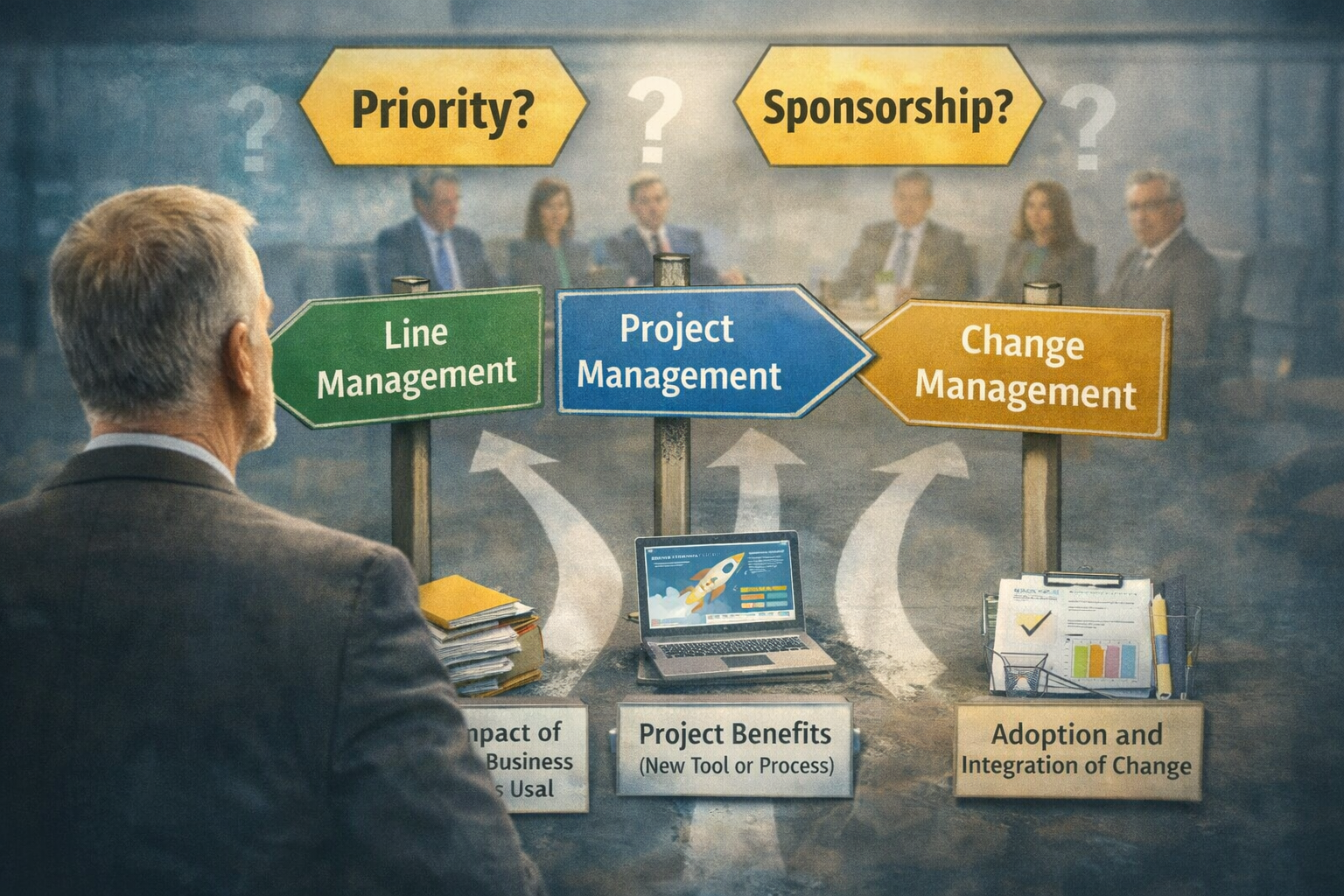
Verandermanagement wordt vaak behandeld als “iets dat de lijnmanager of projectmanager gewoon kan doen”.”
In veel organisaties wordt verandermanagement gezien als zachte overhead. Iets dat je kunt “inbedden” in de lijn, of kunt “toevoegen” aan de taak van de projectmanager. De logica klinkt redelijk:
- de lijn is eigenaar van de prestaties, dus de lijn moet eigen verandering
- de project bouwt de oplossing, dus het project moet ook de adoptie “beheren
- toegewijde verandering van rol voelt als extra kosten en we hebben het al druk
En toch zullen dezelfde organisaties (een paar maanden later) zeggen:
“We leverden het project... maar het landde niet.”
Dat gat, opgeleverd maar niet overgenomen, is precies waar het onderzoek heel praktisch wordt. Want een groot deel van het falen van organisatorische verandering gaat niet over het ontwerpen van de oplossing; het gaat over het creëren van de voorwaarden voor consistent, toegewijd gebruik.
1) De categoriefout: adoptie is geen levering
Een fundamenteel onderscheid in de literatuur is dat implementatiesucces afhangt van mensen die de nieuwe manier van werken daadwerkelijk “gepast en consistent” gebruiken, en niet alleen van het feit dat de oplossing bestaat.
Klein & Sorra definiëren implementatie als ervoor zorgen dat leden een innovatie op de juiste manier en met toewijding gebruiken, en toonde aan dat twee dingen onevenredig belangrijk zijn:
- Klimaat voor implementatie - ervaren mensen dat gebruik wordt verwacht, ondersteund en beloond?
- Waarden-fit - Komt de verandering overeen met wat mensen belangrijk vinden? 1
Dit is waar veel organisaties de fout in gaan: ze behandelen verandering als een probleem met projectartefacten (plannen, communicatie, training) terwijl het vaak een probleem werkomgeving (signalen, prikkels, managementaandacht, versterking, lokale vertaling).
Projectmanagement levert het “ding”. Verandermanagement bouwt de voorwaarden voor “gebruik”.”
De benchmarkresultaten van Prosci2, Hoewel praktijkgericht, wordt dit consequent herhaald:
succes correleert met:
(a) actieve sponsoring,
(b) specifieke veranderingscapaciteit, en
(c) nauwe integratie met de projectoplevering.
2) Waarom de veronderstelling “de lijnmanager zal het wel doen” half waar is, en nog steeds gevaarlijk
Ja, de lijnmanager staat centraal. Mensen ervaren verandering via hun directe manager. Maar het onderzoek naar middenmanagers is heel duidelijk: ze zijn niet zomaar “communicatiekanalen”. Ze zijn intermediairs veranderen die strategie vertalen naar lokale betekenis en actie.
- Het werk van Balogun laat zien hoe middenmanagers krachtige “veranderingsintermediairs” kunnen worden wanneer ze worden ondersteund en doelbewust worden gepositioneerd.
(Van de schuld geven aan het midden naar het benutten van het potentieel: Het creëren van tussenpersonen voor verandering) - Rouleau beschrijft de micropraktijken van sensemaking en sensegiving-Hoe managers verandering interpreteren en “verkopen” via alledaagse gesprekken en routines.
(Micro-Praktijken van Strategische Sensemaking en Sensegiving: Hoe middenmanagers dagelijks verandering interpreteren en verkopen, Tijdschrift voor managementstudies) - Huy's onderzoek benadrukt een ongemakkelijke waarheid: succesvolle verandering vereist emotioneel werk. Middenmanagers maken vaak de emotionele afweging tussen continuïteit en radicale verandering, omdat ze dichtbij genoeg staan om de werkelijke temperatuur van de organisatie te kunnen lezen.
(Emotioneel balanceren tussen organisatorische continuïteit en radicale verandering: De bijdrage van middenmanagers, Administrative Science Quarterly)
Dus ja: lijnmanagers zijn belangrijk. Maar de gevaarlijke sprong is deze:
“Omdat managers belangrijk zijn, kunnen we verandering uitbesteden aan managers.”
Dat lukt niet omdat het managers meestal ontbreekt:
- bandbreedte (operaties winnen altijd)
- vaardigheid (sensemaking, omgaan met weerstand, coaching, versterking)
- autoriteit (lokale macht om belemmeringen weg te nemen)
- een systeem (cadans, metriek, bestuur, escalatieroutes)
Met andere woorden: verantwoording afleggen zonder mogelijk te maken.
3) Waarom de aanname “projectmanager doet het wel” voorspelbare faalwijzen creëert
Projectmanagers worden gemeten op scope, planning en budget. Zelfs excellente PM's vallen terug op wat het systeem beloont: leveringszekerheid.
Maar het onderzoek naar ontvangers van verandering laat zien dat reacties op verandering worden gevormd door factoren zoals waargenomen eerlijkheid, vertrouwen, steun en persoonlijke impact.
(Reacties van ontvangers van verandering op organisatorische verandering: Een 60-jarig overzicht van kwantitatieve onderzoeken, The Journal of Applied Behavioral Science).
Ook belangrijk: bereidheid is niet hetzelfde als “geen weerstand bieden”. Armenakis et al. bedachten bereidheid tot verandering als overtuigingen/attitudes/intenties die voorafgaan aan steun of weerstand - en, wat belangrijk is, bereidheid kan worden beïnvloed door bewuste acties van veranderingsagenten en leiders. (SAGE-tijdschriften)
Dus de voorspelbare faalwijze is:
- de PM communiceert en traint
- de org is nog steeds niet klaar
- lokale leiders zijn niet uitgerust om
- mensen keren terug onder druk
Dit is geen incompetentie. Het is een structurele mismatch van rollen en stimulansen.
4) Wat goed presterende veranderorganisaties doen: ze bouwen een operationeel model, geen toolkit
Organisaties die veranderingen goed implementeren “voegen er geen verandermanagement aan toe”. Ze institutionaliseren, Vaak in stilte, door middel van een duidelijk besturingsmodel:
Het belangrijkste ontwerpprincipe
- De lijn is eigenaar van de adoptieresultaten.
- Veranderingsvermogen maakt adoptie mogelijk.
- Project/programma beheert de levering van oplossingen.
- Sponsor is eigenaar van prioriteit en versterking.
Dit komt sterk overeen met Prosci's terugkerende bevindingen dat actieve en zichtbare sponsoring de grootste bijdrage levert aan succes en dat het ondersteunen van managers belangrijk is. (proscieurope.nl)
Het praktische mechanisme: implementatieklimaat
Goede presteerders geven opzettelijk vorm aan het “implementatieklimaat”, d.w.z. de gedeelde perceptie dat het gebruik van de verandering wordt verwacht, ondersteund en beloond. (tijdschriften.aom.org)
In de praktijk betekent dat:
- leiders maken de verandering niet-optioneel door keuzes en afwegingen
- managers worden gecoacht om lokale sensibilisering
- obstakels worden snel uit de weg geruimd (proces, IT, beleid, personeel)
- versterking is ingebouwd in het ritme (KPI's + beoordelingen + erkenning)
5) De “ontbrekende laag” die de meeste organisaties niet benoemen: verander leiderschapsgedrag
Veel gesprekken over verandering gaan over communicatie en plannen. Maar leiderschapsgedrag is vaak de verborgen variabele.
Higgs & Rowland bestudeerden gedragingen van succesvolle veranderingsleiders en toonden aan dat hoe leiders verandering leiden er wezenlijk toe doet - niet alleen wat ze communiceren. (SAGE-tijdschriften)
En Herold et al. ontdekten dat transformationeel leiderschap sterk gerelateerd is aan betrokkenheid bij verandering - vooral wanneer de persoonlijke impact groot is. (PubMed)
Botweg gezegd:
Wanneer de impact groot is, is “goede communicatie” niet genoeg. Mensen kijken naar leiders voor signalen van veiligheid, betekenis en ernst.
6) Weerstand: stop met moraliseren, begin met diagnosticeren
Veel organisaties praten over weerstand alsof het een gebrek is bij werknemers. Het onderzoek is genuanceerder.
Oreg ontwikkelde en valideerde een schaal die aantoont dat dispositionele weerstand varieert per persoon (routine zoeken, emotionele reactie, cognitieve starheid, korte-termijn focus). (PubMed)
Maar reacties van ontvangers worden ook bepaald door de context: vertrouwen, rechtvaardigheid, steun, waargenomen behoefte en persoonlijke impact. (SAGE-tijdschriften)
Vertaling voor leiders:
- Sommige weerstanden zijn persoonlijkheidsgebonden
- Een groot deel is door context aangemaakt (hoe de verandering wordt geleid en ervaren)
Dus in plaats van “weerstand overwinnen”, behandel je het als een signaal:
- waarden-pas probleem?
- Probleem met eerlijkheid?
- capaciteitsprobleem?
- competentieprobleem?
- vertrouwensprobleem?
7) Een eenvoudige diagnose die je je lezers kunt geven
Als verandering wordt “opgedrongen” aan lijnmanagers of projectmanagers, stel dan deze vijf vragen:
- Wie is de eigenaar van de adoptiemetriek? (geen projectmijlpalen)
- Wat is het wekelijkse gedrag van de sponsor? (niet hun kickoff speech) (proscieurope.nl)
- Wat is het manager enablement plan? (vaardigheden + tijd + gereedschap)
- Hoe wordt het implementatieklimaat vormgegeven? (signalen, beloningen, barrières verwijderd) (PMC)
- Waar bevindt de verandercapaciteit zich? (CoE, embedded BP's, change leads)
Als je deze vragen niet kunt beantwoorden, dan heb je geen aanpak voor verandering - dan heb je hoop.
Afsluiting: de sterkste conclusie die je kunt maken
Organisatieveranderingsmanagement is geen “nice-to-have” functie en geen communicatielaag. Het is de discipline van het bouwen adoptievoorwaardenBereidheid, sensibilisering, versterking en een implementatieklimaat dat ervoor zorgt dat de nieuwe manier beklijft.
Dus ja: lijnmanagers zijn essentieel. Projectmanagers zijn essentieel. Maar geen van beide kan een veranderingsmodel vervangen.
Succesvolle organisaties “wijzen verandering niet toe”. Ze ontwikkelen het.
Referenties die je kunt citeren (geloofwaardige ruggengraat)
- Klein, K.J. & Sorra, J.S. (1996). De uitdaging van innovatie-implementatie. (tijdschriften.aom.org)
- Prosci (2018). Beste praktijken in verandermanagement, Prosci Benchmarkrapport Samenvatting
- J. Balogun (2003). Van de schuld geven aan het midden naar het benutten van het potentieel: Het creëren van tussenpersonen voor verandering). Britisch tijdschrift voor management.
- Weiner, B.J. et al. (2011). De betekenis en meting van implementatieklimaat. (PMC)
- Armenakis, A.A., Harris, S.G., & Mossholder, K.W. (1993). Bereidheid creëren voor organisatorische verandering. (SAGE-tijdschriften)
- Oreg, S. (2003). Weerstand tegen verandering: Het ontwikkelen van een maat voor individuele verschillen. (PubMed)
- Oreg, S., Vakola, M., & Armenakis, A. (2011). Reacties van ontvangers van verandering op organisatorische verandering: Een 60-jarig overzicht. (SAGE-tijdschriften)
- Balogun, J. (2003). Van het geven van de schuld aan het midden naar het benutten van het potentieel ervan: veranderingsbemiddelaars creëren. (Lancaster University onderzoeksgids)
- Rouleau, L. (2005). Micro-praktijken van strategische sensemaking en sensegiving. (Wiley Online Bibliotheek)
- Huy, Q.N. (2002). Emotioneel evenwicht... de bijdrage van middenmanagers. (SAGE-tijdschriften)
- Higgs, M. & Rowland, D. (2011). Wat is er nodig om verandering succesvol te implementeren? (SAGE-tijdschriften)
- Herold, D.M. et al. (2008). Transformationeel/veranderingsleiderschap en inzet voor verandering. (PubMed)
- Samenvattingen van Prosci-benchmarks over sponsoring en ondersteuning door managers (praktijkgericht bewijs, veel gebruikt). (proscieurope.nl)