What Am I No Longer Hearing Because of the Power I Hold?
Why executive leadership requires dissent, restraint and responsibility for the human consequences of power
Leadership inevitably comes with power. The higher you rise in an organisation, the more influence you have over priorities, resources, careers, culture and, ultimately, the daily reality of other people. Decisions that take only a few minutes in an executive meeting can change the workload of hundreds of people, determine which behaviours get rewarded and influence whether people still feel able to speak up.
That is why power should never be discussed without also discussing restraint.
Manfred Kets de Vries, distinguished clinical professor of leadership development at INSEAD – who is enhancing leadership & organizational change, makes this point rather provocatively in his essay The Horsemen of Silicon Valley. His focus is on some of the world’s most powerful technology leaders, but the underlying issue is much broader. What happens when repeated success starts to become evidence, in the leader’s own mind and in the minds of others, that their judgement is somehow exceptional?
Success builds confidence, and rightly so. But success also increases influence. And influence tends to reduce the number of people who are willing to tell you that you may be wrong. Over time, the difference between confidence and certainty can become surprisingly small.
Kets de Vries describes the danger as the belief that exceptional competence can become moral authority, that extraordinary achievement can justify extraordinary freedom from constraint, and that those with the greatest power may start to believe they have the least need for restraint.
This is not only a Silicon Valley issue. It is very recognisable in executive leadership.
Success changes the environment around a leader
Most executives do not decide that normal rules no longer apply to them. It happens more subtly.
People start listening differently. They challenge less. A suggestion from the CEO is rarely heard as just a suggestion. A preference can quickly become a priority. A comment about speed can become pressure several levels down. An assumption made in one meeting can reappear a week later as if it were already a decision.
This is one of the less comfortable realities of senior leadership: the more power you have, the less reliable the feedback around you can become.
People learn to read the room. They know which subjects create irritation and which arguments are welcomed. They start to anticipate what the leader wants. Sometimes they soften bad news. Sometimes they simply stop raising an issue because they no longer believe it will make much difference.
I have seen this several times in coaching. One senior executive described his organisation as highly aligned. His management team rarely challenged the strategic direction, decisions were made quickly and meetings were efficient. Yet in individual conversations with team members, a different picture emerged. They had learned that once he had formed an opinion, challenging it rarely changed the outcome. They were not necessarily aligned. They had largely stopped investing energy in disagreement. The executive saw commitment. The team had adapted.
In another coaching conversation, an executive complained that his people were not taking enough ownership. As we explored the issue, it became clear that he regularly stepped into decisions when things moved more slowly than he wanted. His intention was understandable. He wanted to help and keep momentum. But the team had learned something else. Important decisions would eventually move upwards anyway, particularly when the leader felt uncomfortable with the direction being taken. His own behaviour was reinforcing the dependency he disliked. Neither leader had bad intentions. Both were experienced, intelligent and committed to the organisation. But their behaviour carried more weight than they realised.
That is what happens with power.
The human consequences of executive decisions
Executives naturally spend much of their time thinking about strategy, performance, customers, investment and results. They should. But organisations are also human systems. A restructuring is not only an organisational design. A productivity programme is not only a financial intervention. A transformation is not only milestones and governance. A new operating model is not just boxes and reporting lines. Eventually these decisions arrive in somebody’s working day.
They affect workload, uncertainty, status and relationships. They influence what people think is safe to say, how much initiative they take and whether they believe leadership is genuinely interested in what happens further down the organisation.
I once coached a leader who was under considerable pressure to deliver a difficult transformation. He cared about the business and about his people. But as the pressure increased, his communication became shorter, more directive and more transactional. He saw it as focus. His team experienced it differently. Questions started to feel like resistance. Concerns could be interpreted as lack of commitment. People began bringing him solutions rather than problems, especially when the problem might call one of his assumptions into question. The organisation became faster in some respects, but the information reaching the leader became poorer.
That is a serious executive risk. Under pressure, leaders can unintentionally suppress the information they most need. None of this means avoiding difficult decisions. Leadership sometimes means closing a site, reducing headcount, replacing someone, stopping an investment or pushing an organisation significantly harder than people would choose themselves.
The issue is not whether the decision is difficult. It is whether the leader still sees and takes responsibility for its human consequences.
Do not wait for dissent. Organise it.
This is where executive leadership needs to go further than simply saying challenge is welcome. Do not wait for dissent to appear naturally. Organise it.
Bring people into the conversation who are likely to see something different. Ask someone to test the assumptions. Invite the operational expert who understands what implementation will really mean. Bring in the customer voice that does not fit neatly into the strategy. Ask the executive who disagrees with the investment case to argue it properly rather than smoothing over the differences for the sake of alignment.
This is not about creating opposition for its own sake. It is about compensating for hierarchy. The higher you are in an organisation, the more likely it is that information has already been filtered, softened or interpreted before it reaches you.
I worked with one executive team where the leader genuinely believed he encouraged dissent. He regularly asked, “Does anyone see this differently?” …. Usually nobody did.
When we discussed this with the team, several members said they already knew where he stood before he asked the question. They also knew what would happen if they challenged him: a long discussion in which he would argue his position strongly until the room moved back towards his original view.
Nobody had been told not to disagree. It had simply become tiring.
This is why psychological safety is not created by asking for challenge. It is created by what happens when somebody actually challenges you. A leadership team with very little dissent may be aligned. It may also have learned that dissent does not change much. Executives need people around them who are willing to say no. Not people who oppose everything, but credible people who will test the argument, raise uncomfortable consequences and say, when necessary, “I think we are getting this wrong.”
Good leaders do not only tolerate those people. They deliberately keep them close.
Restraint is not indecision
Some executives associate restraint with caution, bureaucracy or lack of decisiveness. I do not see it that way. Restraint is not about being unable to act. It is about remaining deliberate when you have enough authority to act without asking anybody else. It means allowing someone to tell you that your assumption is wrong and actually listening before you respond. It means separating disagreement from disloyalty. It means remembering that silence in a meeting is not necessarily agreement.
This is where coaching can be particularly useful at executive level. A coach is often one of the relatively few people in the leader’s environment who has little organisational reason to agree. That creates space for questions which may have become harder to ask inside the organisation: Who still tells you that you are wrong? Who has stopped challenging you? What happens when somebody pushes back and you are under pressure? Which decisions are genuinely delegated, and which are delegated until you dislike the answer? Who do you deliberately bring into an important decision because you know they see it differently?
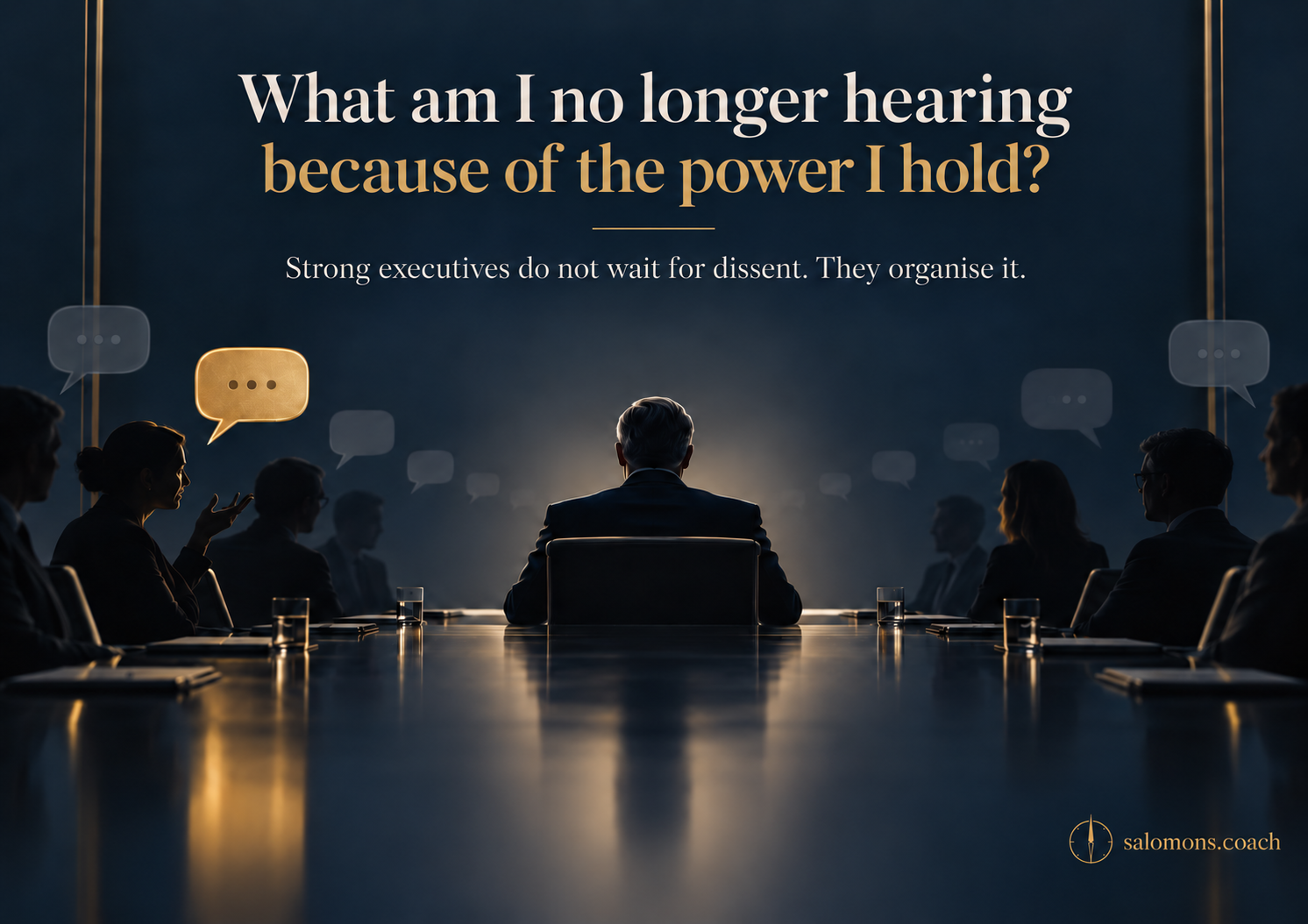
And perhaps most importantly: What am I no longer hearing because of the power I hold?
Responsibility grows with authority
Kets de Vries ends his essay with an uncomfortable question about power: can people who hold extraordinary power also tolerate restraint? Can they accept limits they did not design themselves, or rules imposed by people they may not particularly respect? His conclusion is that restraint is not necessarily the enemy of freedom. Sometimes it is what makes freedom possible.
For executives, formal governance provides part of that restraint. Boards, supervisory structures, compliance and risk management all matter. But they are not enough. Leaders also need behavioural boundaries around them. They need colleagues who will disagree, teams that surface uncomfortable information, decision processes that test assumptions and enough self-awareness to notice when confidence is starting to replace curiosity.
The strongest leaders I have worked with were usually very clear about the authority they had. They did not need to demonstrate it constantly. What made them different was that they understood the effect that authority could have on other people, and they also understood that power could slowly change their own behaviour and judgement.
Executive leadership is therefore not only about direction, decisions and performance. It is also about remaining accountable for how authority is used and making sure there are still enough people, mechanisms and boundaries around you to stop confidence turning into certainty.
The real test of leadership begins when others can no longer stop you.

You may also like


What Gets Seen, Gets Repeated – Firefighters vs Preventers
Five Steps to Take Immediate Control of a Crisis