Hold the Line: The Hardest Stress Coping Skill and How To Practise it
Most of the people I work with are good at handling things. That’s exactly why their stress doesn’t show up until it’s expensive. Here’s how I run a workshop that makes the hardest skill, saying no, something a team can actually get better at.
The problem in the room
When I’m asked to run a stress workshop, the team in front of me is rarely falling apart. Usually it’s the opposite. They’re capable, conscientious, and they deliver. They’re the people others lean on. And that’s the problem, not because capability is bad, but because it hides the cost.
Highly competent people absorb. A request comes in that isn’t really theirs to own, and they take it anyway, because they can, and because saying no feels like letting someone down. Multiply that across a quarter and you get the pattern I see again and again: shortened fuses, racing thoughts at 11 pm, the inability to fully switch off, a quiet sense that the load keeps climbing while the day stays the same length. Nobody in the room would describe themselves as not coping. They’d describe themselves as busy. Stress in these teams is almost always under-reported, because the people carrying it are the ones who pride themselves on carrying it.
So the first job of a good workshop isn’t to teach relaxation. It’s to make the invisible visible, to give a capable team an honest, shared picture of where the pressure is actually landing.
What stress actually is
It helps to be precise about the word, because “stress” gets used to mean everything from a hard week to a clinical condition.
The most useful definition I know comes from the appraisal model developed by Lazarus and Folkman. Stress isn’t the event. It’s the gap between what’s being asked of you and what you feel you have to meet it. The same deadline that energises one person flattens another, not because the deadline differs, but because the perceived gap between demand and resources differs. Two people, same situation, different appraisal, different stress.
That definition is liberating, because it tells you exactly where the levers are. If stress is a gap, then stress management is closing the gap, and there are only a few honest ways to do that. You can change the demand (less coming in, or differently shaped). You can expand the resources (skills, support, recovery, time). Or you can change the appraisal (how you read the demand in the first place). Everything we call “coping” is one of those three moves. Coping is simply what you do to close the gap.
Which raises the obvious question: which moves does this particular person, and this particular team, actually have available, and which ones are missing?
The stress profile: a mirror, not a diagnosis
Before the workshop, everyone completes a stress profile questionnaire. It’s a short self-report instrument that maps how each person currently carries pressure across nine dimensions:
- Mindset, whether pressure reads as threat or as fuel
- Load, how heavy the demand currently feels
- Active coping, tackling problems directly
- Reframing, finding a workable angle on a setback
- Social coping, talking things through with others
- Avoidant coping, distraction and suppression
- Recovery, genuine rest and detachment
- Boundaries, protecting time and energy, and switching off
- Reaching out, the instinct to handle it alone, or to bring others in
I’m careful about how I introduce the results. The profile is a mirror, not a diagnosis. It doesn’t tell anyone they’re doing it wrong; it shows them, in their own words, where their gap currently sits and which coping moves they reach for by default. That distinction matters. The moment a tool feels like a verdict, capable people defend; the moment it feels like a mirror, they get curious.
What’s striking is how consistent the team-level pattern is. High-performing teams are almost always strong on active coping and on mindset, they attack problems and they read pressure as a challenge. And they’re almost always thin in the same two places: boundaries and reaching out. They’re brilliant at doing and poor at declining and asking. The profile makes that pattern undeniable, on a single page, for the whole room. That’s the moment the real work can start.
Coping has families, and one is always missing
Coping isn’t one thing. Drawing on Carver’s research, it sorts into recognisable families: active coping, reframing, drawing on social support, avoidant coping, recovery, boundaries. Healthy people use a range, they match the move to the moment. The problem is rarely that someone has no coping strategies. It’s that they over-rely on one or two and have let the others go quiet.
For the capable teams I work with, the quiet one is almost always the boundary. Saying no. Protecting the floor of quality and the floor of recovery. And it’s quiet for a reason: it’s the hardest coping skill there is, because it carries social cost. Active coping makes you look good. Reframing is private. But declining a request means, in the moment, disappointing a real person who is standing in front of you. So the boundary erodes first, and quietly.
That’s the dimension we make practical in an exercise I call Hold the Line.
The Hold the Line exercise
Here’s the insight the exercise is built on, and it’s one I had to learn by getting it wrong. You cannot fix a boundary problem by telling people to “set better boundaries.” And in most modern teams, you can’t set boundaries collectively either, people are spread across different projects, different stakeholders, different programmes. There’s no shared gatekeeper they could jointly refuse. The no stays individual. Each person says it alone, in their own context.
But three things can be shared, and they’re what make an individual no survivable:
- A shared standard, a common bar for what’s genuinely your work versus a gap you’re quietly filling. When everyone holds roughly the same line, a no stops reading as one difficult individual and starts reading as how the function operates.
- Shared words, the actual phrasing, rehearsed out loud with peers before the hard conversation, so you’re not improvising under pressure.
- A shared route, where an out-of-scope request gets escalated, so the function pushes back rather than the person.
The exercise itself is simple and runs in about half an hour.
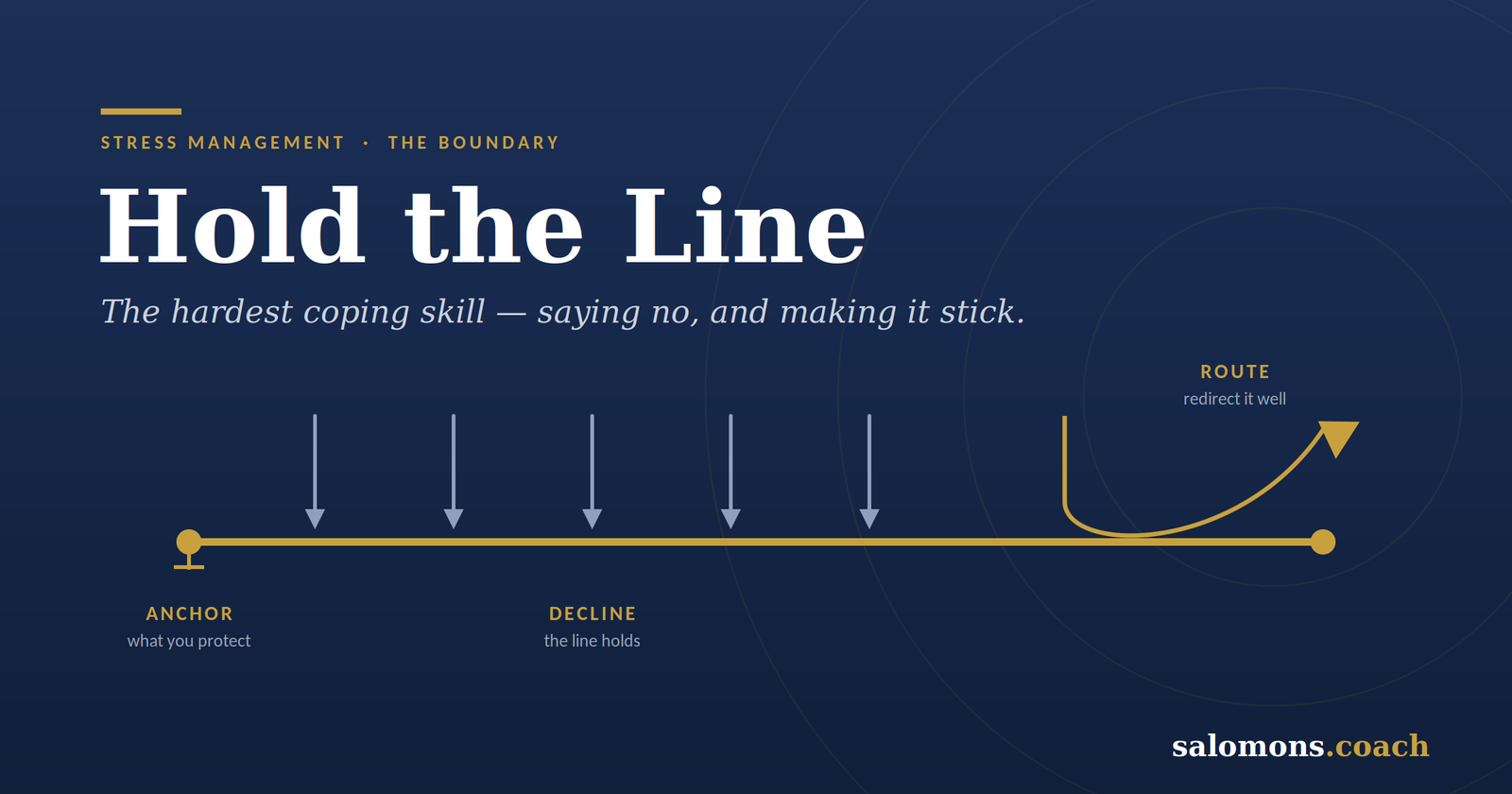
First, reframe the no. A flat refusal is rarely the strong move. The version that protects both the work and the relationship has three parts, an anchor, a decline, and a route:
To protect [your priority], I can’t take [this], what I can do is [an alternative, or the right owner].
Then everyone finds a real no: one current request they took on but shouldn’t have, or one heading their way now. They name the trade-off in a single line, if I take this on, what slips?
Then they work it in threes, rotating through three roles for a few minutes each:
- The Requester makes a real, slightly-too-much request, and pushes gently when they hear a soft no, because the pressure has to be realistic.
- The Refuser anchors on what they’re protecting, declines the request rather than the person, and offers a route.
- The Witness watches for the two failure modes, did the no soften into a yes? and was there an apology and over-justifying, or an actual route?, and feeds it back kindly in thirty seconds.
We close by harvesting what made a no land well (it almost always names a trade-off, stays warm, offers a route, and drops the apology), and each person commits to one boundary they’ll hold that week, plus the line the team agrees to hold in common.
The phrase I want people to leave with is this: decline the request, not the person. A no with a reason and a route protects the work and the relationship. It’s the difference between being difficult and being clear, and capable people, once they feel that difference in their body, rarely go back.
Bring it to your team
Hold the Line is one exercise in a half-day workshop built for exactly the kind of team I described at the start: capable, conscientious, quietly overloaded, and far better at doing than at declining.
In three to four hours with your team, we:
- map your collective stress profile across the nine dimensions, so the pattern is visible and shared
- locate the one or two coping moves that would give your team the most leverage, usually boundaries and asking
- run live, practical exercises like Hold the Line, so people leave with words they’ve actually rehearsed, not just principles they agree with
- agree the shared standards and routes that make individual boundaries hold
It’s practical, evidence-based, and built around your team’s real friction, not a generic stress talk. People leave with something they can use the same week.
If your team is strong, busy, and carrying more than it lets on, let’s talk about running this session. Book a free call or get in touch, and we’ll shape a workshop around what your team actually needs.

You may also like
Five Steps to Take Immediate Control of a Crisis

Most Leadership Teams Lack Dialogue