AI Can Coach Your Career. It Can’t Coach You.
AI Can Coach Your Career.
It Can’t Coach You.
A recent HBR piece lists seven things generative AI does brilliantly for your career. Read closely, every one of them marks the edge of what it cannot touch.
Tomas Chamorro-Premuzic recently argued in Harvard Business Review that generative AI has become a credible career coach: accessible, tireless, and, at roughly $272 an hour for the human alternative, a great deal cheaper. He is right, and I want to begin by saying so plainly, because what follows is not a defence of my profession against a machine. It is an attempt to be honest about where the machine ends.
His article is genuinely useful. It maps seven things AI does well: helping you find career direction, sharpening a CV and a LinkedIn profile, structuring a job search, rehearsing interviews and salary talks, advising on leadership moves, building a personal brand, and talking through the everyday friction of working life. For all of these, AI is a superb thought partner. Use it. I do.
Chamorro-Premuzic even concedes something the coaching industry rarely admits in public: that low barriers to entry and a general lack of training make rigorous, evidence-based coaching the exception rather than the rule. He is correct about that too. And it is precisely there, in his honesty, that the interesting question opens up.
The quiet substitutionThe category error hiding in the prompts
Look again at the seven uses. Find clarity. Optimise the CV. Strategise the search. Rehearse the answer. Draft the email. Build the brand. Each is real and valuable. And each is, at root, information, advice, drafting, or rehearsal.
That is not coaching. That is mentoring and consulting, the transfer of knowledge and the production of artefacts. It is enormously helpful, and it is exactly the kind of work that scales beautifully through a model that has read more career advice than any human ever could. The article describes this work superbly. It just calls it the wrong thing.
Coaching, properly understood, is not the delivery of answers. It is the disciplined business of helping a person see what they could not see alone, and become someone they could not become alone. The distinction matters, because the moment you separate the two, you can see clearly which part AI takes, and which part it structurally cannot.
The first line it can’t crossIt coaches the person. It can’t see the system.
Ask AI “what should I do about my difficult manager,” and it will give you a thoughtful, well-structured answer about your manager and about you. That is the non-systemic question, and it gets a non-systemic answer.
But a leader is never a closed unit to be optimised. They are a node in a web of roles, pressures, loops, and expectations. A great deal of what presents as a personal failing is a property of the position someone occupies, the same chair would strain almost anyone the same way. The micromanaging manager is often caught in a loop you are also feeding. The conflict you keep escalating is frequently a third party absorbing tension that belongs to two others. The behaviour that looks irrational is usually a sensible response to what the system quietly rewards.
Your team is producing exactly what it is built to produce. If you want a different result, you change the structure, not the willpower of the people inside it.
AI optimises the individual in isolation. It cannot map the field of forces acting on you, because you cannot see that field clearly enough to describe it in a prompt, that incapacity to see your own system is the very thing you came for help with. A systemic coach works the other way round: not “what is wrong with you,” but “what is your system producing, and what is your part in producing it?” That reframing is the leverage. It rarely arrives by typing.
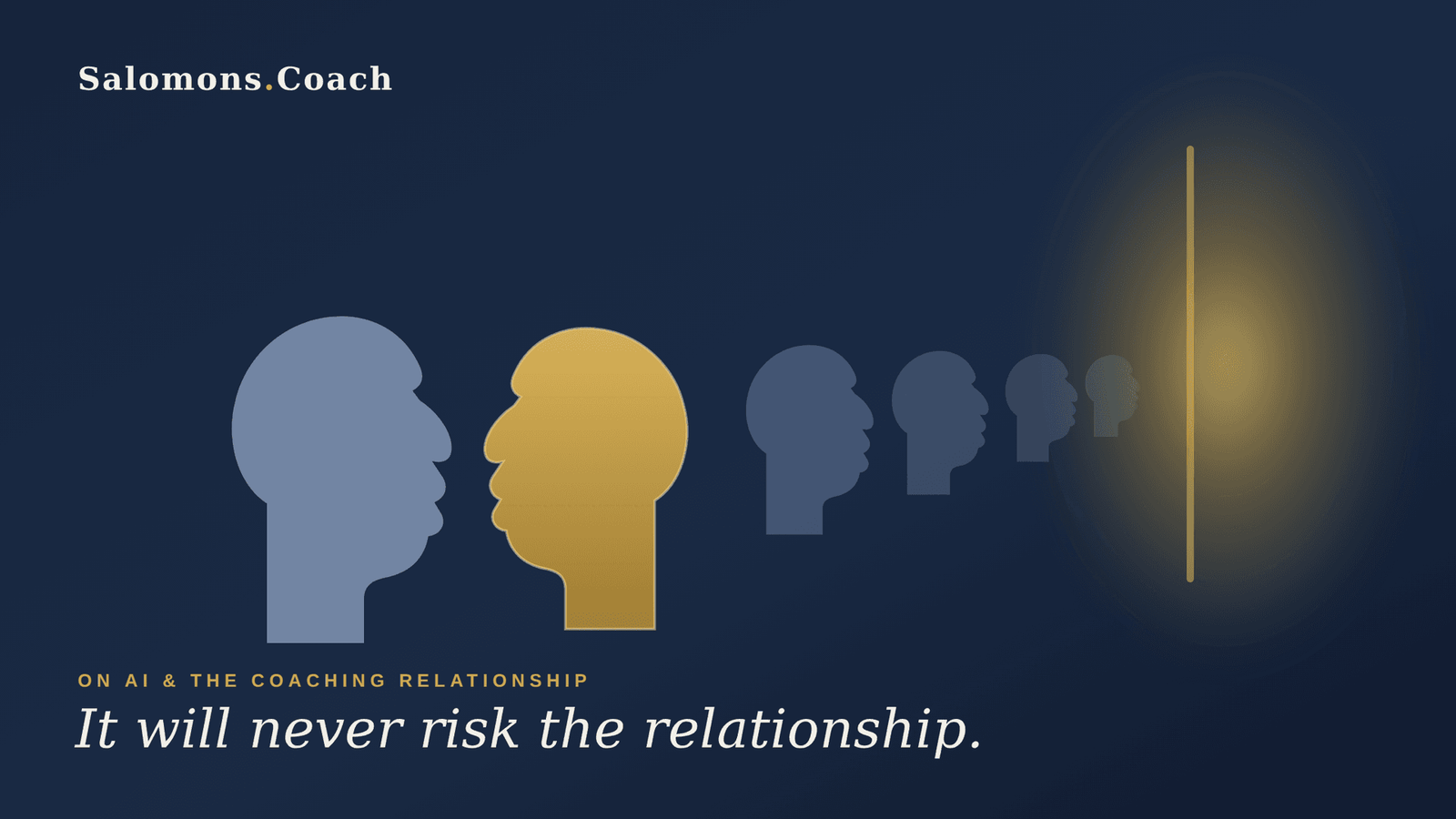
The second line it can’t crossIt will never risk the relationship
Here is the most provocative thing I can say about your AI career coach, and I mean it precisely: it is the most accomplished over-functioner you will ever meet. It rescues. It validates. It fills every silence. It hands you the polished answer before you have done the difficult thinking. And it is engineered, at a deep level, to keep you engaged and to win your approval.
That is a fatal flaw in a coach. Because real growth lives on the far side of discomfort, the discomfort AI is specifically built to remove.
My own practice draws heavily on provocative and experience-based coaching. That means I will, when it serves you, play devil’s advocate against the story you are most attached to. I will let a silence sit until it becomes productive rather than comfortable. I will decline to rescue you, because the struggle is the intervention. I will, on occasion, say the thing you came hoping someone would finally say. None of this is cruelty; it is care with a spine. And all of it depends on one thing AI can never offer: I am willing to risk the relationship in service of your development. AI is not. It will agree with you, endlessly and pleasantly, right up to the edge of your blind spot — and then agree with you there too.
What AI asks
“What would you like me to help you with?”
What a coach asks
“What are you avoiding by asking me that?”
The third line it can’t crossIt has read everything and lived nothing
The mentoring layer of my work runs on lived judgement. Across thirty-five years — two managing-director roles, leadership work in fifty-five countries, the particular loneliness of being the person who finally has to decide — I have stood in rooms AI has only read about. It has absorbed every leadership book ever written and has never had to deliver bad news to someone it respected, never carried a business through a crisis, never felt a culture turn against a necessary change.
Experience is not nostalgia. It is pattern recognition earned at cost, the ability to feel, early, that a situation is heading somewhere a model trained on averages will not flag until it is too late. AI gives you the consensus of everything written. A mentor gives you the one thing the consensus missed, because they were once standing exactly where you are and it cost them something to learn it.
The element beneath all threeA non-anxious presence has no off-switch for AI
A leader’s emotional state is contagious; it cascades through a team faster than any memo. Which is why, in a system under strain, a coach’s most valuable contribution is often not insight at all but regulation, staying steady, connected, and non-reactive while everything around the client is not. From that steadiness the client borrows the capacity to do the same. We call it differentiation, and it is the quiet engine of most durable leadership growth.
AI cannot offer this, because it has no self to stay steady from. It mirrors your state back to you, fluently and amplified. Bring it your anxiety and it will organise your anxiety with great competence. It cannot be the calm in your system, because it is not in your system. It is a surface you are talking to.
The reframeAI doesn’t threaten coaching. It threatens fake coaching.
So I am not worried, and I am not defensive. AI does not endanger real coaching, it endangers the coaching that was never coaching: the repackaging of generic advice, the comfortable validation, the answers anyone could have looked up. That work should be automated. Let it be.
What remains is harder, more human, and more necessary than before. If AI now does the informational layer better than an average coach, then the bar for a human coach rises sharply: be more systemic, more provocative, more genuinely experienced, or be replaced, and rightly. Chamorro-Premuzic notes that you are less likely to lose your job to AI than to a person who uses it well. The same is true of my profession. I intend to be that person.
Use AI for the seven things. Come to a human for the work that only happens because someone is willing not to give you what you asked for.
There is a reason the Reflect phase of my 4R Model insists on a sequence that no prompt can shortcut — slow down, then attention, then analysis — as the precondition for genuine reflection. AI collapses that sequence into an instant, fluent reply. It is wonderful when you need an answer. It is exactly the wrong instrument when what you actually need is to see.
Your AI career coach will never risk losing you. That is precisely why it can never change you.

You may also like


An Obeya Room Is Not a Wall Full of KPIs