The Reliability Paradox: 5 Habits of Reliable Operations
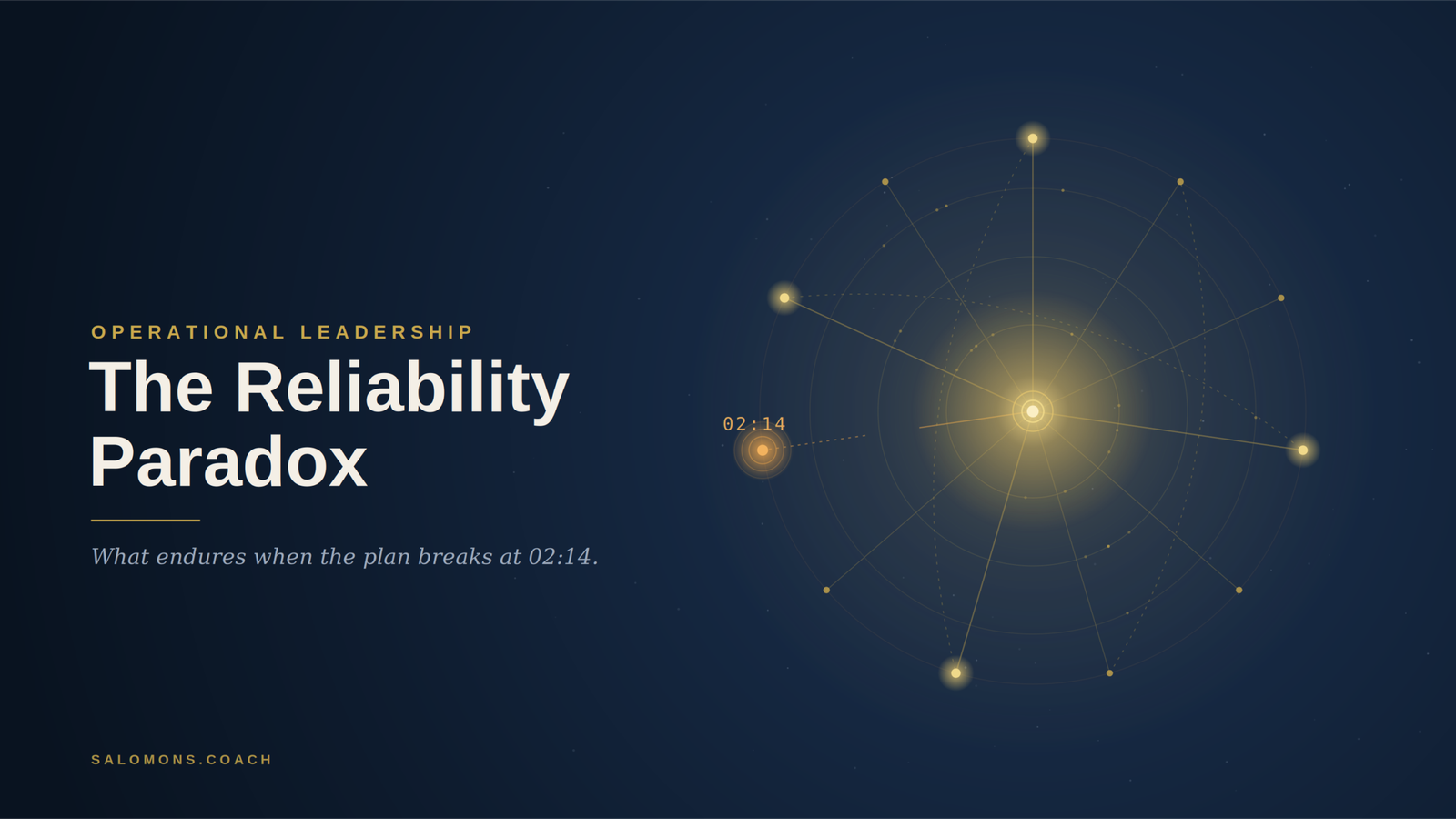
Every operations leader knows the feeling. The plan is a thing of beauty, until 02:14, when one inbound slips, the weather turns, and the whole choreography is suddenly in question. The clean nights teach you nothing. It’s the night the plan breaks that tells you what kind of operation you have actually built.
In Managing the Unexpected, Karl Weick and Kathleen Sutcliffe studied a strange category of organization: aircraft carriers, nuclear plants, air traffic control, in short systems where a single error is catastrophic, yet failure is astonishingly rare. They called the shared trait collective mindfulness. And here is the uncomfortable part for anyone raised on operational excellence: almost every habit that makes these organizations reliable is a small, deliberate inefficiency.
That is the paradox. We are trained to chase efficiency, standardization, predictability. Reliability under the unexpected asks for nearly the opposite. Five principles, and each one cuts against an instinct that efficiency culture has spent years rewarding.
PRINCIPLE 01Preoccupation with failure
The normal operation celebrates the flawless night. A high-reliability operation gets nervous when nothing goes wrong, because a quiet operation is often one that has stopped noticing weak signals. The near-miss is treated as data, not luck. The contradiction is cultural: you have to make the person who reports the small problem more valuable than the person who delivers the perfect number.
PRINCIPLE 02Reluctance to simplify
Scale runs on simplification, dashboards, categories, “it’s just a routing issue.” But the easy label is exactly where the next surprise is hiding. Reliable operations hold more interpretations open than feels comfortable. The simplification that let you scale is the same one that blinds you.
PRINCIPLE 03Sensitivity to operations
The real operation lives on the floor – at the dock, the sort, the gate – not in the plan. Leaders who lose contact with the frontline lose the operation itself. And the trap is structural: the higher you rise, the more pre-digested your information becomes, precisely when you most need it raw.
PRINCIPLE 04Commitment to resilience
You cannot anticipate everything, so reliable systems invest not only in prevention but in recovery – slack, redundancy, people trained to improvise when the plan is gone. Every buffer you cut to look efficient is resilience you have quietly spent in advance.
PRINCIPLE 05Deference to expertise
When it breaks, the decision has to migrate to whoever knows the most, not whoever ranks the highest. Hierarchy is built for normal times; expertise is for the unexpected. This is the hardest one, because the org chart that gives a leader control on a calm night is the very thing that has to dissolve in a crisis, and most leaders cannot let it go.
Read together, these are not a checklist. They are a posture, and an uncomfortable one, because each principle is an inefficiency held in reserve against the day efficiency is not enough.
Case Study · Hub Leadership Team
What this looked like on a real hub floor.
I watched this posture take hold in the central sort hub of one of Europe’s largest integrators, a time-critical operation where a single missed scan ripples downstream into the entire network. The mandate from senior management was the familiar trio: stronger performance, a healthier culture, and a real capacity for change, all at once, without losing the operational discipline that makes the business work. The instinct in that situation is always the same: tighten controls, add process, demand more. It produces compliance, not ownership.
So the leadership and culture program we built for the hub leadership team rested on a single premise Weick would recognise immediately: culture is not a separate initiative from performance, it is the system by which performance actually happens.
A premise like that only works if the people in the room can carry it, and this team could, because of how it was built. At its core were operations managers who had run hubs like this for twenty-five years and more, people who could read the floor at a glance. In the last few years a handful of newer leaders had joined, bringing what deep tenure cannot manufacture: the outside-in question, the willingness to ask why a thing was still done the way it had always been done. The easy move is to treat one as signal and the other as noise. This team did the opposite. It built the mutual respect that recognised the enormous value of both, and the moment experience and fresh challenge stopped competing and started to compound, the team grew past what it had believed possible. From there, three of the five principles surfaced almost on their own.
Reluctance to simplify. Scan compliance – the obvious “just follow the procedure” metric – was reframed by the team as a systemic issue rather than an individual failure. The easy label was exactly where the real problem had been hiding.
Deference to expertise. Supervisors stopped being treated as the execution layer and became part of the leadership system. Decisions and signals were redesigned to cascade, manager to supervisor to floor, so that judgement lived where the knowledge actually was.
Preoccupation with failure. This was the one that proved the work had landed. By the final workshop, with the performance trend clearly upward and targets in sight, the team revised its own score on “we deliver hub performance” downward (!). Their reasoning: good enough is not yet good enough. Senior management read the lower number exactly as Weick would have, not as a setback, but as a signal of ownership. A team that had stopped mistaking a good run for a finished job.
None of it would have held without two things from the top. Executive management backed the development work visibly: not just a sponsor’s signature, but momentum that told the team this mattered. And with that backing came the most counter-cultural idea in any zero-defect operation: that failure is part of progress, part of how people actually develop. That permission is not a soft touch. It is the precondition for all five principles, none of them survive in a culture that punishes the messenger.
Culture is not a separate initiative from performance. It is the system by which performance actually happens. Salomons.Coach · Program Principle
And it was measured, not by participant enthusiasm, but against an interview-based behavioural diagnostic taken before the first workshop, a more honest reference point than a first-day survey.
(+2.16 on a 10-point scale)
to think in change”
No regressions.
Across ten leadership goals every score rose — yet the most important movement on the page was the one that went down.
None of these principles improves the good night. All of them decide the bad one. Which is the real measure of operational leadership: anyone looks competent when the operation runs clean. The question is what is still standing at 02:14, when the plan breaks and the choreography is gone, and whether the team has already decided, like that hub team scoring itself down, to keep noticing.
A reliable operation is not one that never fails. It is one that has decided, in advance, how it will notice.
Jan Salomons is an executive coach and leadership development specialist, and the founder of Salomons.Coach. He designs and facilitates leadership and culture programs for teams leading under volatility, uncertainty, and operational pressure.

You may also like
Five Steps to Take Immediate Control of a Crisis

Most Leadership Teams Lack Dialogue