The Five-Minute Reset: What One Stanford Study Changed About How I Coach
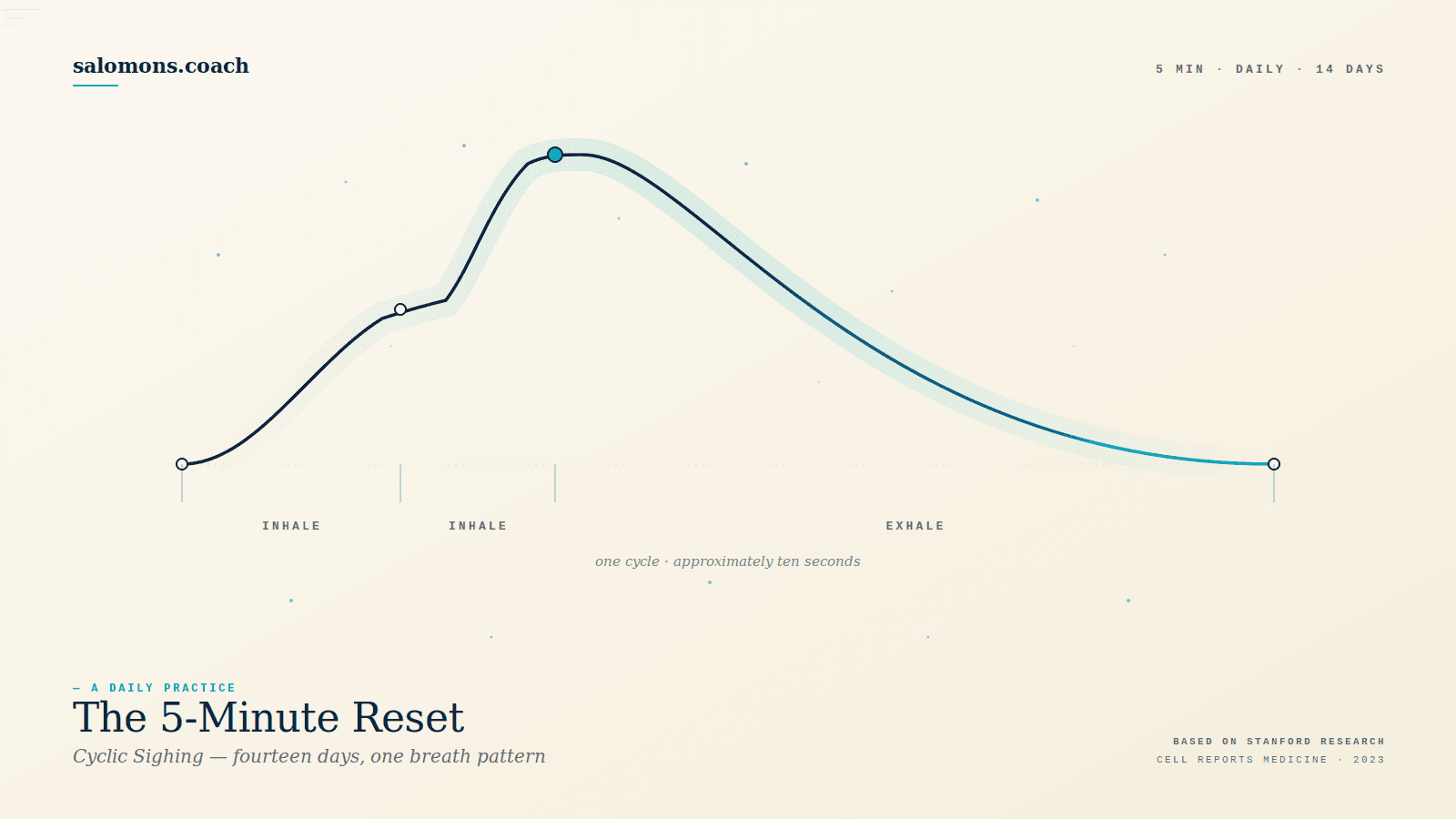
A 2023 randomized trial pitted four breathing techniques against each other. The winner takes five minutes a day. Here’s what it taught me and how I built it into my coaching practice.
Most of the people I coach don’t push back on the idea that stress is hurting them. They push back on the time cost of doing something about it.
- “I’m not adding a yoga class to my calendar.”
- “I tried meditation. It didn’t take.”
- “When am I supposed to do this?”
These are reasonable objections. Most stress-management advice quietly assumes that time is available, that consistency is easy, that the practice itself doesn’t have to compete on effectiveness with the other thirty things claiming attention on a given day. For senior leaders, none of those assumptions hold.
Then in January 2023, a team at Stanford published a study that changed the conversation. The technique they tested takes five minutes a day. It outperformed three other approaches, including mindfulness meditation, on the measures that matter most under pressure: mood, anxiety, resting heart rate, and breathing rhythm.
The technique is called cyclic sighing. Below is the research, the result, why both matter, and how I’ve built it into my coaching practice.
The study
The work was led by neurobiologist Andrew Huberman, psychiatrist David Spiegel, and lead investigator Melis Yilmaz Balban at Stanford School of Medicine. The paper – Brief structured respiration practices enhance mood and reduce physiological arousal – appeared in Cell Reports Medicine in January 2023, open access for anyone who wants to read it directly: link to article.
The design was deliberately rigorous. One hundred and eleven volunteers were randomly assigned to one of four protocols, each requiring the same commitment: five minutes a day, for one month. Before and after every session, as well as across the full thirty days, the researchers tracked mood (using the Positive and Negative Affect Schedule), anxiety (using the State Anxiety Inventory), respiratory rate, heart rate, and heart rate variability.
What sets this trial apart from most breathwork research is the comparison it set up. Most studies pit a technique against doing nothing, which tells you whether the technique helps but not whether it helps more than other reasonable alternatives. This trial answered the harder question.
The four conditions
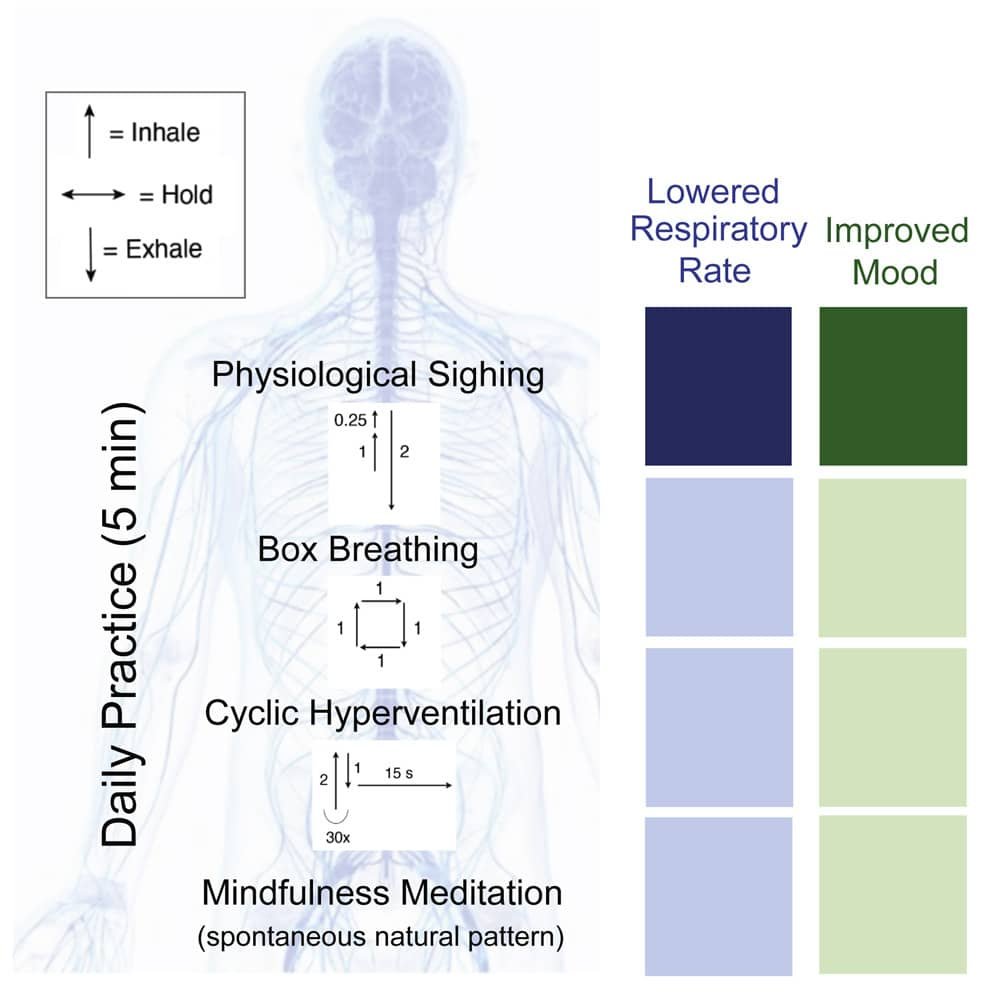
Each participant practised one of four protocols for the full month:
1.Cyclic sighing. A long, slow exhale focus. You inhale halfway through your nose, take a second short top-up inhale to fully fill your lungs, then exhale slowly through your mouth — the exhale longer than the inhales. Repeat for five minutes.
2. Box breathing. Equal durations of inhale, breath retention, exhale, and second retention. Familiar to anyone who has done meditation training, military breathing, or many sports-performance protocols.
3. Cyclic hyperventilation with retention. Longer inhales than exhales, with breath holds. Loosely inspired by Wim Hof–style protocols, designed to increase alertness rather than calm.
4. Mindfulness meditation. A non-controlled comparison: passively observing the breath, with no attempt to alter its rhythm. The active control condition.
Same five minutes. Same thirty days. Same measurement protocol. Different breathing.
What won, and by how much
The headline finding was clear. Cyclic sighing, the exhale-focused practice, produced the largest improvements in mood and the largest reductions in physiological arousal. The effects sustained across the full month, suggesting the practice trained something rather than producing a one-off relief.
A few specific results worth knowing:
- All three breathwork groups outperformed mindfulness meditation on mood improvement. The act of deliberately controlling the breath produced more positive affect than passively observing it.
- Cyclic sighing reduced participants’ resting respiratory rate over the thirty-day period — a sign that the practice was changing baseline physiology, not just producing in-the-moment calm.
- Heart rate and heart rate variability also shifted in favourable directions, particularly in the cyclic-sighing group.
- The effect appeared to compound. People who practised more consistently across the month saw bigger improvements.
The mindfulness comparison is the part most people miss when they hear about this study. Mindfulness meditation didn’t fail. It simply lost to something more specific. Both groups saw mood improvements; the breathwork groups saw bigger ones.
Why this finding matters
Stress research is full of techniques that work, to some degree, in some populations, under some conditions. What’s been missing is rigorous head-to-head comparison: when an executive only has five minutes, what should they actually do with them?
This study answers that question for the first time with proper methodology. Randomized controlled trial, active comparison conditions, sustained measurement, mainstream peer-reviewed publication. That combination is rare in breathwork research, which has historically been dominated by smaller studies with weaker designs.
The mechanism is also reasonably well understood. The long exhale activates the parasympathetic nervous system: the body’s brake. The double inhale appears to reopen partially collapsed alveoli in the lungs, allowing more efficient oxygen and carbon-dioxide exchange. The combination produces a measurable shift toward physiological calm within seconds, and the daily practice appears to lower the baseline over weeks.
Why it lands with executives
When I introduce this technique to a coachee, the questions I get are different from the ones I used to get when I introduced meditation. They’re operational rather than philosophical:
- “How do I remember to do it?”
- “Can I do it between meetings?”
- “What do I tell my team about the door being closed for five minutes?”
These are the right questions. They mean the technique has cleared the bar that most stress interventions fail to clear: it’s fitted into a working day rather than fighting against one. Five minutes. No equipment. No location requirements. No cushion, no app, no special clothes. The barrier to entry is so low that the resistance becomes about scheduling, not about identity.
There’s also a credibility advantage. When an executive tells me they’re skeptical about wellness practices, I can hand them a peer-reviewed paper from Stanford. That doesn’t always close the case, but it changes the register of the conversation. We’re no longer debating whether self-care is worthwhile. We’re discussing implementation.
How I use this in coaching
I rarely introduce a technique cold. By the time cyclic sighing comes up in a coaching conversation, the coachee has usually told me, in some form, that their nervous system is running too hot, like racing thoughts at 11 pm, the inability to fully drop into family time after work, the sense that their fuse has shortened over the last quarter.
When that pattern is clear, I describe the study in plain terms: Stanford, 2023, five minutes a day, beat meditation in a randomized trial. Then I describe the technique. Then I name the size of the commitment. Two weeks of consistent practice is enough to know whether it has earned a place in their day. If it hasn’t, we drop it and try something else.
What I find useful as a coach is that the practice gives us something concrete to work with between sessions. It produces observable data, like does the coachee feel calmer at the end of five minutes than at the start, on a one-to-ten scale? Does it work better in the morning, between meetings, or before sleep? Which moments did it reach first? These are coachable questions in a way that “are you less stressed?” usually isn’t.
The 14-day programme
To make the practice easier to stick with, I built a structured program inside Quenza,the coaching platform I use with clients. It runs for fourteen days. Each day a short prompt arrives, asking the coachee to spend five minutes on the practice and to note their before/after settling on a simple scale.
The program has three milestone touch-points: Day 1, Day 7, and Day 14, that frame the work, invite a midpoint reflection, and close with an integration prompt: of the fourteen days, what surprised you, and where in your week does this technique earn a permanent home? The other days are deliberately light. The point is consistency, not intensity.
I built it as a fourteen-day program rather than thirty because executive attention spans for new practices are shorter than the original study’s design. Two weeks is enough to know whether the technique fits a particular life. Coachees who find it helpful continue independently; those who don’t, don’t. Either outcome is useful information.
A closing thought
Most of the breathwork advice circulating online makes large promises and offers little evidence. The cyclic-sighing literature is the opposite: a quietly rigorous result, modestly stated, hidden inside a peer-reviewed paper most people will never read. The technique itself is almost embarrassingly simple.
That combination, rigorous evidence, simple practice, low time cost, is rare. When I find it, I build coaching around it. The 14-day program is the most direct application I’ve found of this particular finding, and the response from coachees who complete it has been more consistent than from any other stress-related intervention I’ve offered.
If you’re curious enough to try it, I’m happy to point you to either the original Stanford paper or the structured programme. Both are on offer.
The paper referenced above: Balban, M.Y., Neri, E., Kogon, M.M., Weed, L., Nouriani, B., Jo, B., Holl, G., Zeitzer, J.M., Spiegel, D., & Huberman, A.D. (2023). “Brief structured respiration practices enhance mood and reduce physiological arousal.” Cell Reports Medicine, Vol. 4, Issue 1. DOI: 10.1016/j.xcrm.2022.100895.

You may also like
Five Steps to Take Immediate Control of a Crisis

Most Leadership Teams Lack Dialogue