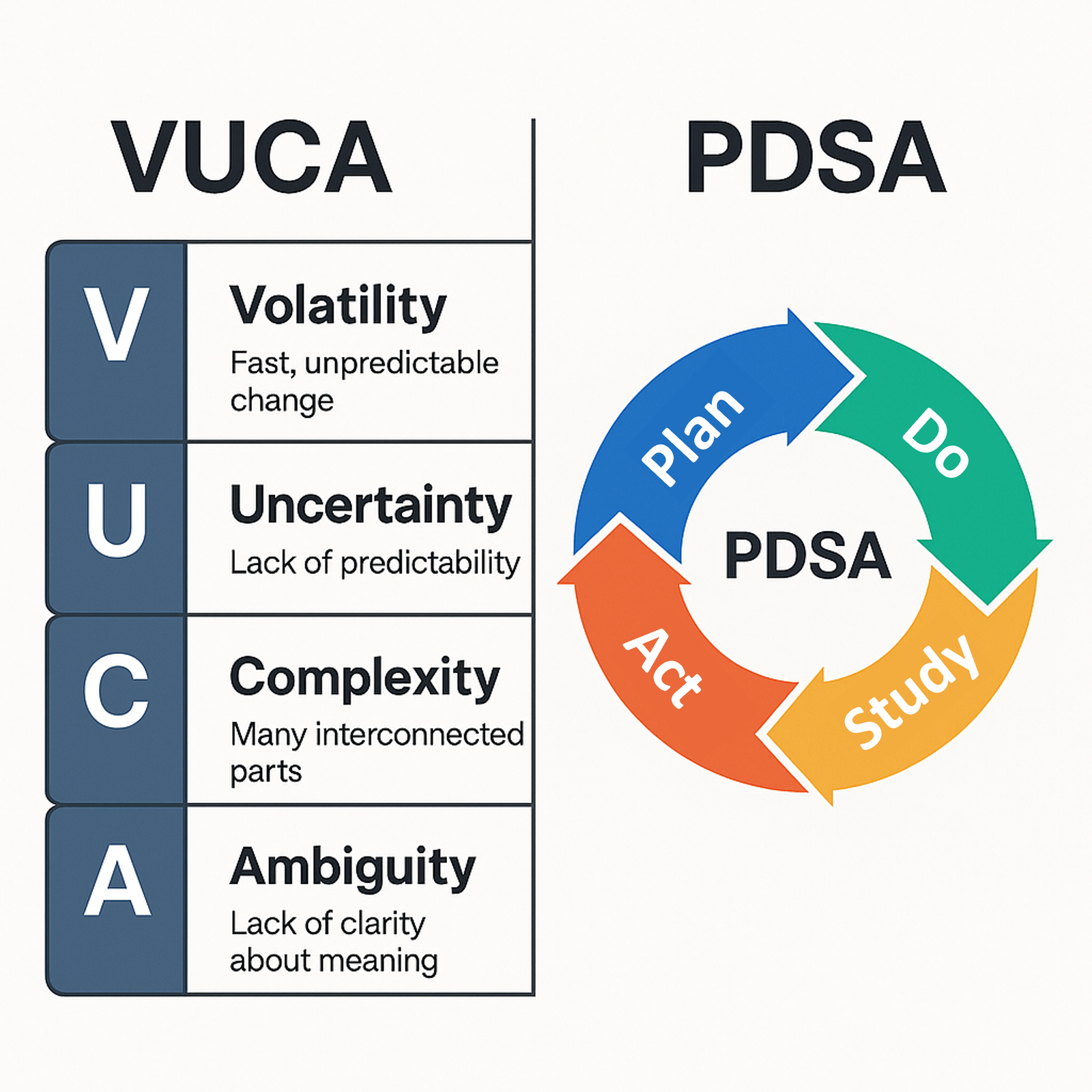
In a world defined by volatility, uncertainty, complexity, and ambiguity, leaders can no longer rely on fixed plans or past experience. VUCA describes the challenge — but PDSA provides a practical way to respond through fast learning cycles. My early years as a teacher, working with Kolb’s experiential learning model, taught me that people grow through experimentation, reflection, and adaptation. Decades later, the same learning loop has become essential for leaders: the ability to test, adjust, and learn faster than the environment changes.
When TNT’s global network went dark during the NotPetya cyberattack, every system failed — but people didn’t. In this story, Jan Salomons shares how leadership, trust, and adaptability kept Europe’s largest logistics network running manually for days. It’s a story of crisis leadership in a VUCA world — where volatility, uncertainty, complexity, and ambiguity tested every level of society, organization, and individual behavior. As old hierarchies crumbled, new leaders emerged, purpose became crystal clear, and collaboration turned chaos into order. A powerful lesson in resilience, trust, and human connection under pressure.
Change doesn’t fail because of poor plans — it fails because people haven’t made the psychological transition. In this article, Jan Salomons explores his formula for successful change, combining shared vision, urgency, leadership, learning, and capacity. Drawing on his decades of experience and his VUCA leadership approach, he explains how leaders can guide teams through endings, transitions, and new beginnings while maintaining trust and connection. Learn why managing change isn’t enough — leading transition is what truly drives sustainable transformation.
Busyness has become a badge of honor, but it rarely leads to impact or well-being. In this post, Jan Salomons explores why being busy is more often a habit than a necessity — and how leaders can shift from managing time to managing focus. In a VUCA world, where speed and complexity dominate, clarity and reflection become the real leadership differentiators. Learn how to move from motion to meaning through self-awareness, attention, and purpose, and discover why slowing down might be the smartest move you can make.
Fear can quietly take over organizations — through silence, control, and pressure — until trust disappears and performance collapses. In this article, Jan Salomons explores how fear-based leadership emerges and what leaders can do to reverse it. He shares five practical ways to rebuild trust, including how to reframe control, invite openness, and restore team rhythm. In a VUCA world, where change and uncertainty trigger anxiety, leaders who recognize and address fear become the real stabilizers of culture. Learn how awareness, consistency, and courage can turn fear into focus and connection.
Feedback is often misunderstood as something to endure rather than embrace. Yet in my years as an executive and leadership coach, I’ve learned that growth doesn’t come from giving the perfect feedback—it comes from receiving it well. When we move beyond defensiveness and see criticism as potential coaching, feedback turns from a threat into a tool for learning. The moment we shift our mindset from “What’s wrong with me?” to “What can I learn here?”, we unlock one of the most powerful levers of leadership growth: the ability to find the coaching in criticism.
VUCA—volatility, uncertainty, complexity, and ambiguity—defines today’s fast-changing business world. Leaders face rapid change, unclear outcomes, and interconnected challenges daily. Recognizing VUCA in action helps leaders respond effectively. By understanding its components and adopting agile strategies, leaders can make better decisions, build clarity, and guide their teams through uncertainty with confidence.
On November 1, we hosted our first “VUCA@Work” web event, an engaging 90-minute session aimed at helping leaders navigate Volatility, Uncertainty, Complexity, and Ambiguity. The event featured real-world examples, interactive discussions, and essential coping strategies, such as scenario planning, data-driven decision-making, and fostering psychological safety. Attendees left with practical tools for emotional resilience, agile decision-making, and transparent communication. This successful session underscored the importance of preparation, interactivity, and feedback for future events, ensuring leaders are equipped to thrive in VUCA environments. Join our VUCA Leadership Community for more insights and upcoming events!
Brené Brown’s TED Talk, "The Power of Vulnerability," is a powerful exploration of human connection, courage, and the discomfort we feel when we open ourselves up to others. Brown, a research professor, is known for her work on shame, courage, and vulnerability, and this talk is perhaps her most famous. Here’s a breakdown of its key ideas and why embracing vulnerability is critical, not only in our personal lives but also in leadership.
In today’s fast-paced business environment, leaders face constant Volatility, Uncertainty, Complexity, and Ambiguity (VUCA). I offer tailored VUCA leadership workshops, drawing from two years of experience working with organizations like ASML. These workshops, ranging from 2 hours to full-day programs, help leaders build resilience, agility, and strategic vision to navigate challenges. Join an upcoming workshop or book a customized session to equip your team with the skills needed to succeed in a VUCA world.