salomons.coachsalomons.coach
  • Home
  • About Me
  • Blog
  • Shop
  • Downloads
    • Your Own Career Coach
    • Cross-Cultural Leadership Compass
    • Your stress Profile
    • Psychological Safety Field Guide
    • Energy Awareness Journal
    • The Executive Presenting Framework
    • The Executive Ownership Reinforcement Framework
    • The Evidence Base for Coaching Effectiveness
    • The Art of Time Boxing
    • VUCA Leadership WorkBook
    • VUCA Leadership Book
  • Services
  • Testimonials
  • Session Scheduler
  • Contact
  • Change language to Nederlands
Back
  • Home
  • About Me
  • Blog
  • Shop
  • Downloads
    • Your Own Career Coach
    • Cross-Cultural Leadership Compass
    • Your stress Profile
    • Psychological Safety Field Guide
    • Energy Awareness Journal
    • The Executive Presenting Framework
    • The Executive Ownership Reinforcement Framework
    • The Evidence Base for Coaching Effectiveness
    • The Art of Time Boxing
    • VUCA Leadership WorkBook
    • VUCA Leadership Book
  • Services
  • Testimonials
  • Session Scheduler
  • Contact
  • Change language to Nederlands
  • Home
  • Blog
  • Blog
  • PDSA and VUCA: Why Leaders Need Both to Navigate Today’s Reality

Blog

24 Oct

PDSA and VUCA: Why Leaders Need Both to Navigate Today’s Reality
  • By salomons.coach
  • In Blog, Tools & Methods, VUCA & Leadership

Most leaders recognize the world around them is changing faster than traditional management tools can handle. Markets shift overnight. Technology accelerates beyond our planning cycles. Teams face more interdependencies, more uncertainty, and more pressure than ever.

In other words:
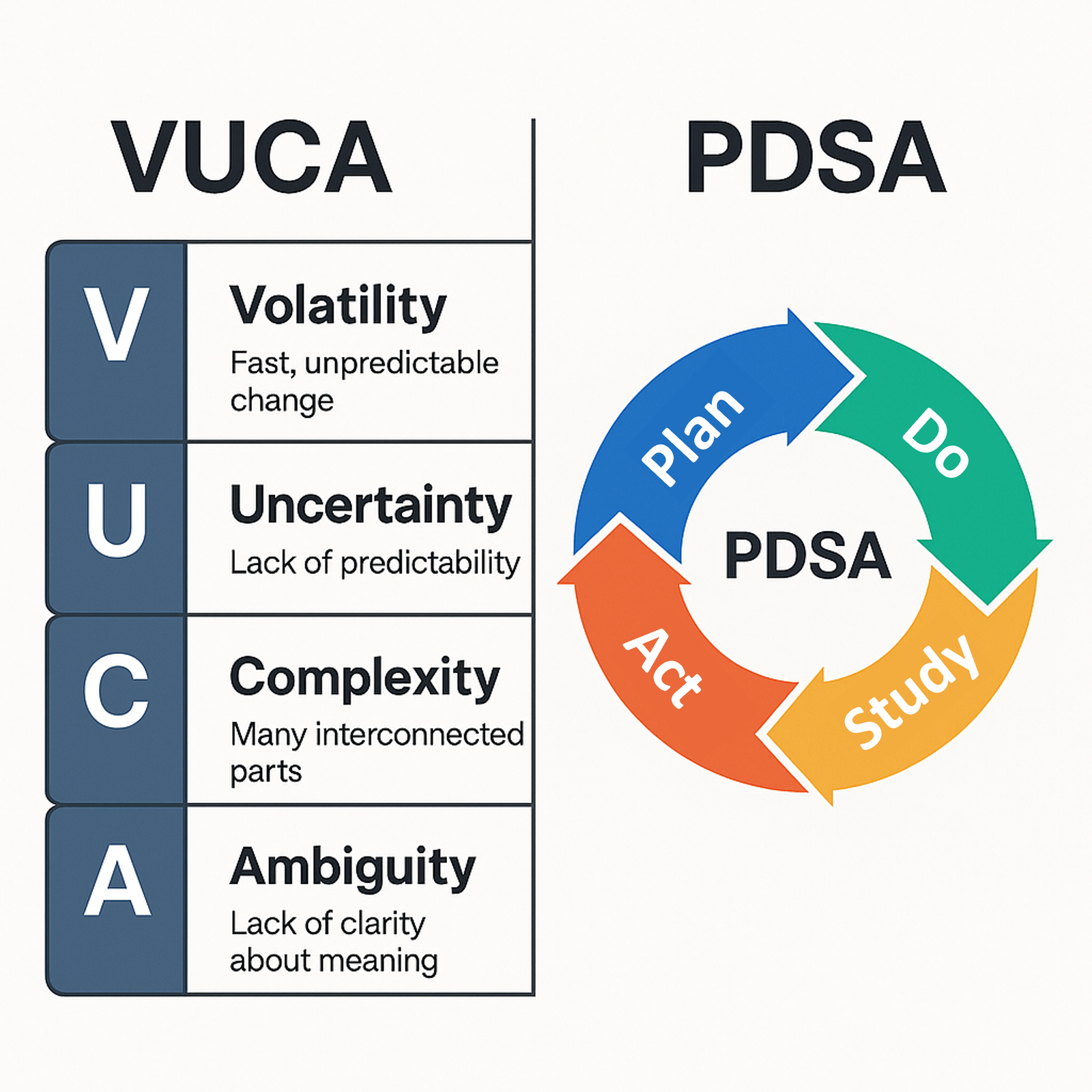
We are all leading in a VUCA world; one marked by Volatility, Uncertainty, Complexity, and Ambiguity.

At the same time, leaders and teams are searching for practical methods that help them make progress without having all the answers. That’s where the PDSA cycle comes in: Plan – Do – Study – Act, a simple yet powerful approach to continuous improvement.

What many leaders don’t realize is this:

PDSA and VUCA are deeply connected.
One describes the environment.
The other provides a way to navigate it.

Let’s explore how.

A personal note: How Kolb shaped my approach to learning and leadership

My connection to continuous learning started long before I entered the world of leadership development.
It began when I graduated as a teacher in electro-engineering, stepping into a classroom filled with students who were curious, impatient, easily distracted, and eager to understand how the world worked.

Very quickly, I learned that lecturing was not enough.
Students only truly understood when they experienced, tested, reflected, and applied what they learned.
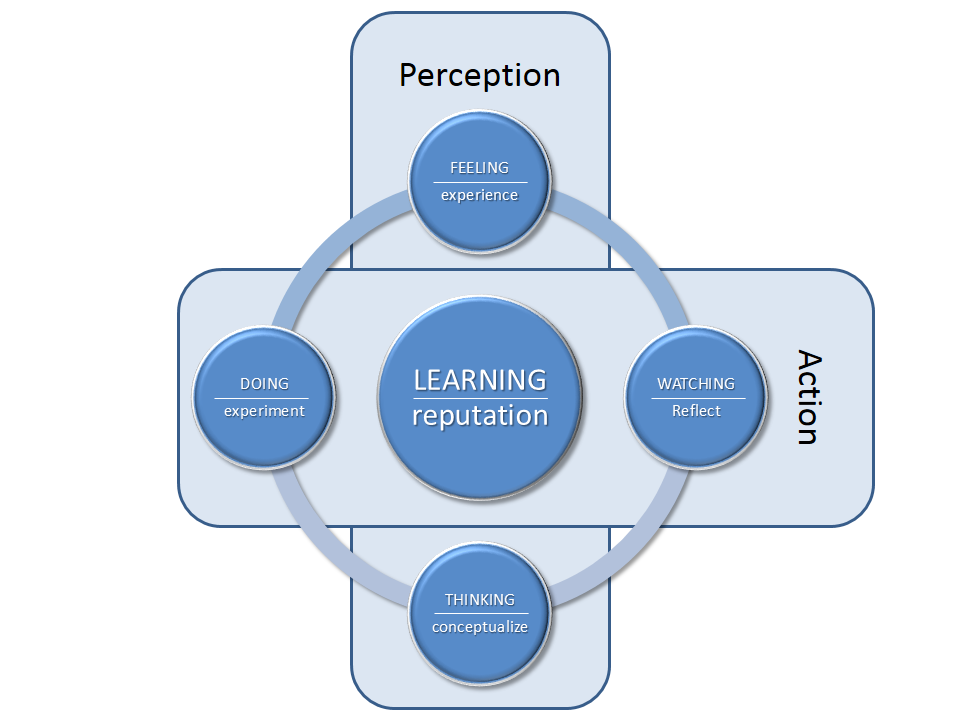
Kolb Model in my layout

This is where I was first introduced to Kolb’s Experiential Learning Cycle, a four-step model:

  1. Concrete Experience
  2. Reflective Observation
  3. Abstract Conceptualisation
  4. Active Experimentation

Without realizing it at the time, I was already working in learning loops, creating small experiments in my teaching approach, observing what worked, adjusting, and trying again.
It was PDSA in an educational setting.

Those early years taught me something fundamental:

People learn fastest when they can experience something, reflect on it, and immediately try a better version.

Decades later, this lesson remains central in my work with leaders and teams.
Kolb gave me the mindset.
PDSA gave me the structure.
VUCA gives us the context.

And in today’s world, we need all three.

VUCA: the leadership challenge of our time

VUCA isn’t just jargon. It describes what leaders experience every day:

  • Volatility: Rapid, unpredictable change
  • Uncertainty: The absence of clear answers
  • Complexity: Many moving parts influencing each other
  • Ambiguity: No single “right” solution; multiple interpretations possible

In such an environment, classic linear planning becomes fragile. Large-scale solutions take too long. Leaders can no longer rely on experience alone, because yesterday’s patterns don’t always repeat themselves.

To lead effectively, we need new ways of thinking, and new ways of learning.

PDSA: A simple method for making progress in uncertain times

The PDSA cycle invites leaders and teams to work in small, fast learning loops:

  1. Plan: Define the goal and design a small test
  2. Do: Execute on a limited scale
  3. Study: Reflect on the results and learn
  4. Act: Adapt, adopt, or abandon — then repeat

Instead of committing to massive, risky initiatives, PDSA builds progress through experimentation, reflection, and adjustment.

This rhythm fits the reality of VUCA perfectly.

How PDSA responds to VUCA — directly and practically

Here’s where the two frameworks meet:

1. Volatility → PDSA stabilises through shorter cycles

When the world shifts quickly, yearly plans become outdated in weeks.
PDSA keeps teams flexible by working in short learning loops.
You adjust as the environment changes, instead of being paralysed by outdated plans.

2. Uncertainty → PDSA reduces guessing

In unclear situations, people often assume, debate, or postpone decisions.
PDSA replaces debate with data — even if it’s small-scale data.
A short experiment reveals more than hours of discussion.

3. Complexity → PDSA breaks it down

Complex systems overwhelm. Everything is connected to everything.
PDSA isolates one change at a time so teams can see what truly works.

4. Ambiguity → PDSA encourages curiosity

When there is no obvious solution, the safest path is exploration.
PDSA gives teams permission to test, learn, and adjust — without needing certainty upfront.

In this way, PDSA becomes a practical leadership behaviour, not just a process improvement tool.

PDSA Builds the Leadership Skills VUCA Demands

Working with PDSA develops essential leadership capabilities:

  • Comfort with not knowing
  • Experimentation instead of control
  • Reflective, data-driven decision-making
  • Psychological safety for learning and failure
  • System awareness and critical thinking

And for me personally, it connects straight back to Kolb:
experience → reflection → insight → new action.

This is how people grow.
This is how teams mature.
This is how organisations adapt.

The Real Connection: Learning Faster Than the Environment Changes

When you combine VUCA and PDSA, one insight becomes clear:

In a VUCA world, the most competitive organisations are the ones that learn faster than their environment changes.

PDSA creates that learning cadence.
VUCA demands it.
Kolb explains why it works at a human level.

Together, they form a powerful leadership framework:

  • VUCA raises awareness of the environment.
  • PDSA offers a disciplined way to respond.
  • Kolb explains how people internalise and apply the learning.

This is where transformation truly begins — not through big designs and perfect plans, but through a continuous cycle of experimenting, learning, and adjusting.

In Summary

VUCA is the challenge. PDSA is one of the most effective responses. Kolb shows how learning becomes behaviour.

Leaders who understand all three — and who teach their teams to work in continuous learning loops — build resilience, adaptability, and momentum in even the most unpredictable environments.

They don’t wait for clarity. They create it.

Tags:changekolbleadershipleadership behaviorleadership coachinglearning organizationPDSAVUCAVUCA leadership
  • Share:
salomons.coach
Jan Salomons is a seasoned leader/executive who shares his knowledge and experience as an executive mentor/coach/trainer and transformation consultant. He has over thirty-five years of experience working with with senior leaders across more than sixty countries, and is an elected member of the Harvard Business Review Advisory Council.

You may also like

Two professionals in a coaching session discuss a stuck conversation, with a glowing pyramid diagram between them; 'When Conversations Get Stuck' text on dark blue background.

Why Conversations Get Stuck

  • 17 August 2026
  • by salomons.coach
  • in Blog
When leadership conversations become repetitive or defensive, the real problem may not be the content. This post explores how...
Leadership coaching banner: a giant iceberg halves above and below water with the title 'The Leadership Iceberg' and subtitle 'What really drives behaviour and communication?'
The Leadership Iceberg
17 August 2026
Dark blue stage scene showing a gold executive chair on a circular pedestal, facing gold-framed panels and glowing circuit lines, with the headline “Power Deafens: Why Leaders Stop Hearing the Truth.”
Power Deafens: Here is How to Avoid it
8 August 2026
Time Management
7 August 2026

Leave A Reply Cancel reply

Your email address will not be published. Required fields are marked *

This site uses Akismet to reduce spam. Learn how your comment data is processed.

Categories

  • AI (3)
  • Blog (143)
  • Books & Publications (7)
  • Change & Transformation (29)
  • Download (2)
  • Innovation & Strategy (5)
  • Learning & Development (12)
  • Organizations & Culture (35)
  • Self & Personal Growth (70)
  • Teams & Collaboration (31)
  • Tools & Methods (36)
  • Video (16)
  • VUCA & Leadership (71)
  • Web Courses & Programs (4)
  • Workshops & Events (14)

Recent Posts

Two professionals in a coaching session discuss a stuck conversation, with a glowing pyramid diagram between them; 'When Conversations Get Stuck' text on dark blue background.
Why Conversations Get Stuck
17Aug,2026
Leadership coaching banner: a giant iceberg halves above and below water with the title 'The Leadership Iceberg' and subtitle 'What really drives behaviour and communication?'
The Leadership Iceberg
17Aug,2026
Dark blue stage scene showing a gold executive chair on a circular pedestal, facing gold-framed panels and glowing circuit lines, with the headline “Power Deafens: Why Leaders Stop Hearing the Truth.”
Power Deafens: Here is How to Avoid it
08Aug,2026

Tags

4R model (6) accountability (5) authenticity (5) behavior (8) career (12) change (28) coaching (49) communication (8) cross-cultural leadership (8) culture (15) decision-making (8) dersonal-development (6) emotions (6) executive-coaching (8) executive coaching (6) feedback (4) growth (6) HBR (4) leadership (64) leadership behavior (47) leadership coaching (8) leadership development (8) learning (9) mindset (5) psychological safety (27) redundancy (9) reflection (34) resilience (21) self-awareness (55) self-leadership (14) self-management (9) self-regulation (6) stress (10) team-dynamics (9) team alignment (5) team coaching (7) teams (7) TED (5) Time Management (5) tools (19) transformation (5) trust (7) VUCA (37) VUCA leadership (35) work-life balance (5)
All posts - searchable table
Recent videos
the-adhd-watch-list-hero

The Best ADHD Videos for Leaders: Science, Stories, Strategy

In 14 July 2026
No Comment
Female speaker on stage delivering a TEDx talk, with a headset mic and gesturing, while a lower-third bio identifies her as a professor of organizational behaviour.

The Authenticity Paradox | Professor Herminia Ibarra 

Brooks – Harvard – on Happiness

Happiness as a Leadership Strategy

L360 youyrownjourney landing page L360

Find your true purpose

GET IN TOUCH

Salomons.Coach
KvK: 72129131
+31 6 53 89 75 67

jan@salomons.coach

The Netherlands

USEFUL LINKS

  • About
  • Privacy policy
  • Term & Conditions
  • Refund & Returns
  • Payment policy
  • Digital Policy
  • Methodology & Sources

LinkedIn

  • Linkedin
Receive blog updates

salomons.coach by J.K. Salomons Holding B.V., 2018-2026

  • Home
  • About Me
  • Blog
  • Shop
  • Downloads
    • Your Own Career Coach
    • Cross-Cultural Leadership Compass
    • Your stress Profile
    • Psychological Safety Field Guide
    • Energy Awareness Journal
    • The Executive Presenting Framework
    • The Executive Ownership Reinforcement Framework
    • The Evidence Base for Coaching Effectiveness
    • The Art of Time Boxing
    • VUCA Leadership WorkBook
    • VUCA Leadership Book
  • Services
  • Testimonials
  • Session Scheduler
  • Contact
  • Change language to Nederlands
Change language to Nederlands