salomons.coachsalomons.coach
  • Home
  • About Me
  • Blog
  • Shop
  • Downloads
    • Your Own Career Coach
    • Cross-Cultural Leadership Compass
    • Your stress Profile
    • Psychological Safety Field Guide
    • Energy Awareness Journal
    • The Executive Presenting Framework
    • The Executive Ownership Reinforcement Framework
    • The Evidence Base for Coaching Effectiveness
    • The Art of Time Boxing
    • VUCA Leadership WorkBook
    • VUCA Leadership Book
  • Services
  • Testimonials
  • Session Scheduler
  • Contact
  • Change language to Nederlands
Back
  • Home
  • About Me
  • Blog
  • Shop
  • Downloads
    • Your Own Career Coach
    • Cross-Cultural Leadership Compass
    • Your stress Profile
    • Psychological Safety Field Guide
    • Energy Awareness Journal
    • The Executive Presenting Framework
    • The Executive Ownership Reinforcement Framework
    • The Evidence Base for Coaching Effectiveness
    • The Art of Time Boxing
    • VUCA Leadership WorkBook
    • VUCA Leadership Book
  • Services
  • Testimonials
  • Session Scheduler
  • Contact
  • Change language to Nederlands
  • Home
  • Blog
  • Blog
  • Results are never the problem. They are the mirror.

Blog

02 Jan

Results are never the problem. They are the mirror.

  • By salomons.coach
  • In Blog, Change & Transformation, Organizations & Culture, Self & Personal Growth, Teams & Collaboration, VUCA & Leadership, Workshops & Events

When teams or leaders engage me, the conversation usually begins with familiar language: trust, engagement, resilience, culture, communication.

Important concepts. But never my starting point. I start with results.

Not because leadership is only about numbers, but because leadership without outcomes is the same as having good intentions. Organizations do not exist to feel aligned; they exist to deliver value. To customers, to employees, shareholders and to society.

Peter Drucker captured this bluntly:

“Plans are only good intentions unless they immediately degenerate into hard work.”
— Peter Drucker

Results are where leadership stops being theoretical. And that is exactly the reason I choose results as the starting point of the work I do with teams and individuals.

Results are the lagging indicator of leadership

In my work, disappointing results are rarely caused by a lack of effort, intelligence, or commitment. More often, they are the lagging indicator of leadership patterns that have become normalized. Harvard Business Review has made this point repeatedly. As Ram Charan wrote:

“Execution is not just tactics. It is a discipline and a system.”

Execution failures are not operational accidents. They reflect leadership choices, explicit or implicit, about focus, trade-offs, and accountability. That is why I always begin with questions such as:

  • What must be measurably different in 6–12 months?
  • Which outcomes are persistently not being achieved?
  • Where does the organization say one thing but reward another?

Only when results are clear do we work backwards.

Leadership is revealed under pressure, not intentions

In stable environments, almost any leadership style appears effective.
In volatile, uncertain, complex, and ambiguous conditions (VUCA), leadership is seriously exposed. This is where many teams struggle. They are experienced. Capable. Well-intended. And still stuck.

Because pressure reveals patterns:

  • Speed replaces judgment
  • Harmony replaces accountability
  • Activity replaces impact
  • Expertise replaces leadership

As Ronald Heifetz put it in HBR:

“Leadership is not about answers. It is about taking responsibility for tough questions.”

Those questions are often uncomfortable:

  • What decisions are being avoided?
  • Where is ownership blurred?
  • Which conflicts are disguised as alignment?
  • What is no longer fit for purpose, but still protected?

This is not a culture issue first. It is a leadership issue.

Working backwards to what really matters

When we trace results back to their sources, a small set of leadership fundamentals consistently emerges:

  • Clarity before motivation
    People cannot commit to what they do not understand.
  • Direction before empowerment
    Autonomy without boundaries creates noise, not ownership.
  • Accountability before harmony
    Trust is not the absence of tension; it is the presence of honest follow-through.
  • Reflection before acceleration
    As HBR reminds us:

“Experience alone does not create learning. Reflection on experience does.”
— Chris Argyris

This is why my work is rarely about adding frameworks, tools, or competencies. Senior leaders already have enough of those. The real work is subtraction:

  • Fewer priorities
  • Fewer implicit assumptions
  • Fewer unspoken rules
  • Fewer behaviors that once worked, but no longer do

Because complexity is rarely solved by addition.

Individuals and teams: same logic, different scale

With individual leaders, the work often centers on:

  • Where control replaces trust
  • Where identity is tied too closely to expertise
  • Where pace becomes avoidance

With leadership teams, the work often reveals:

  • Artificial alignment masking unresolved differences
  • Strong opinions without shared commitment
  • Structural ambiguity that fuels personal friction

In both cases, the question is the same:

What leadership behavior must change for results to change?

Why this approach is demanding as well as effective

Starting with results removes hiding places. It prevents leadership development from becoming abstract, therapeutic, or performative. It anchors reflection in responsibility. As HBR has stated succinctly:

“The ultimate test of leadership is sustained performance.”

That does not mean neglecting people. It means taking them seriously enough to lead in ways that actually work.

This is the work I do with leaders and teams:
Not to make leadership sound better, but to make it matter more.

Don’t miss new blog posts!

We don’t spam! Read our privacy policy for more info.
By subscribing you agree to receive weekly an overview of new blog posts as an email.
You agree with the privacy policy. You may unsubscribe at any time, every email has an unsubscribe link included.

Check your inbox or spam folder to confirm your subscription.

Tags:changecoachingfeedbackfeedback cultureleadershipleadership behaviorperformanceproblem-solvingresetteamworkVUCAVUCA leadership
  • Share:
salomons.coach
Jan Salomons is a seasoned leader/executive who shares his knowledge and experience as an executive mentor/coach/trainer as well as a transformation and operations excellence expert. He has over 35 years of experience working with senior leaders across more than 55 countries, and is an elected member of the Harvard Business Review Advisory Council.

You may also like

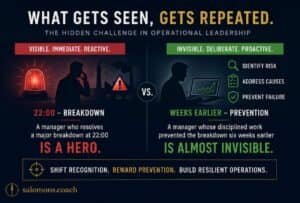
Infographic titled 'What gets seen, gets repeated' showing two columns: left red section 'Visible. Immediate. Reactive.' with a red alert siren, a worker on the phone, factory silhouettes, and a '22:00' breakdown; caption 'IS A HERO.' Right green section 'Invisible. Deliberate. Proactive.' with a worker at a laptop displaying a rising graph and icons labeled 'Identify risk', 'Address causes', 'Prevent failure'; caption 'WEEKS EARLIER – PREVENTION' and 'IS ALMOST INVISIBLE.' Bottom banner reads 'Shift recognition. Reward prevention. Build resilient operations.' and shows salomons.coach.

What Gets Seen, Gets Repeated – Firefighters vs Preventers

  • 26 September 2026
  • by salomons.coach
  • in Blog
A manager who fixes a breakdown at 22:00 is a hero. The manager whose work prevented it six weeks...
Infographic titled STEER showing five circular steps (S, T, E, E, R) for crisis leadership on a dark blue background. Steps: Stabilise, Triage, Establish, Execute & inform, Review & refine.
Five Steps to Take Immediate Control of a Crisis

24 September 2026
Infographic comparing Discussion (left) and Dialogue (right): clash graphic vs connected waves, with goal-focused comparisons and a shared outcomes section.
Most Leadership Teams Lack Dialogue
22 September 2026
Infographic poster with a dark blue background, large white headline reading “My team says it’s the workload,” and a diagram highlighting pressure factors (Ambiguity, Conflict, Overload) in orange.
It is not the workload. Stop calling it the workload.
18 September 2026

Leave A Reply Cancel reply

Your email address will not be published. Required fields are marked *

This site uses Akismet to reduce spam. Learn how your comment data is processed.

Categories

  • AI (3)
  • Blog (150)
  • Books & Publications (7)
  • Change & Transformation (30)
  • Download (2)
  • Innovation & Strategy (6)
  • Learning & Development (12)
  • Organizations & Culture (40)
  • Self & Personal Growth (74)
  • Teams & Collaboration (34)
  • Tools & Methods (38)
  • Video (16)
  • VUCA & Leadership (77)
  • Web Courses & Programs (4)
  • Workshops & Events (14)

Recent Posts

Infographic titled 'What gets seen, gets repeated' showing two columns: left red section 'Visible. Immediate. Reactive.' with a red alert siren, a worker on the phone, factory silhouettes, and a '22:00' breakdown; caption 'IS A HERO.' Right green section 'Invisible. Deliberate. Proactive.' with a worker at a laptop displaying a rising graph and icons labeled 'Identify risk', 'Address causes', 'Prevent failure'; caption 'WEEKS EARLIER – PREVENTION' and 'IS ALMOST INVISIBLE.' Bottom banner reads 'Shift recognition. Reward prevention. Build resilient operations.' and shows salomons.coach.
What Gets Seen, Gets Repeated – Firefighters vs Preventers
26Sep,2026
Infographic titled STEER showing five circular steps (S, T, E, E, R) for crisis leadership on a dark blue background. Steps: Stabilise, Triage, Establish, Execute & inform, Review & refine.
Five Steps to Take Immediate Control of a Crisis
24Sep,2026
Infographic comparing Discussion (left) and Dialogue (right): clash graphic vs connected waves, with goal-focused comparisons and a shared outcomes section.
Most Leadership Teams Lack Dialogue
22Sep,2026

Tags

4R model (6) accountability (7) authenticity (5) behavior (8) career (12) change (28) coaching (51) communication (8) cross-cultural leadership (8) culture (15) decision-making (9) dersonal-development (6) emotions (6) executive-coaching (8) executive coaching (6) feedback (4) focus (4) growth (6) leadership (66) leadership behavior (47) leadership coaching (8) leadership development (8) learning (9) mindset (5) psychological safety (29) redundancy (9) reflection (34) resilience (21) self-awareness (56) self-leadership (14) self-management (9) self-regulation (6) stress (10) team-dynamics (10) team alignment (5) team coaching (9) teams (7) TED (5) Time Management (5) tools (19) transformation (5) trust (7) VUCA (37) VUCA leadership (39) work-life balance (5)
All posts - searchable table
Recent videos
the-adhd-watch-list-hero

The Best ADHD Videos for Leaders: Science, Stories, Strategy

In 14 July 2026
No Comment
Female speaker on stage delivering a TEDx talk, with a headset mic and gesturing, while a lower-third bio identifies her as a professor of organizational behaviour.

The Authenticity Paradox | Professor Herminia Ibarra 

Brooks – Harvard – on Happiness

Happiness as a Leadership Strategy

L360 youyrownjourney landing page L360

Find your true purpose

GET IN TOUCH

Salomons.Coach
KvK: 72129131
+31 6 53 89 75 67

jan@salomons.coach

The Netherlands

USEFUL LINKS

  • About
  • Privacy policy
  • Term & Conditions
  • Refund & Returns
  • Payment policy
  • Digital Policy
  • Methodology & Sources

LinkedIn

  • Linkedin
Receive blog updates

salomons.coach by J.K. Salomons Holding B.V., 2018-2026

  • Home
  • About Me
  • Blog
  • Shop
  • Downloads
    • Your Own Career Coach
    • Cross-Cultural Leadership Compass
    • Your stress Profile
    • Psychological Safety Field Guide
    • Energy Awareness Journal
    • The Executive Presenting Framework
    • The Executive Ownership Reinforcement Framework
    • The Evidence Base for Coaching Effectiveness
    • The Art of Time Boxing
    • VUCA Leadership WorkBook
    • VUCA Leadership Book
  • Services
  • Testimonials
  • Session Scheduler
  • Contact
  • Change language to Nederlands
Change language to Nederlands