4R Model – Step 1 – Reflect
Introduction: Science as the Foundation of the 4R Approach
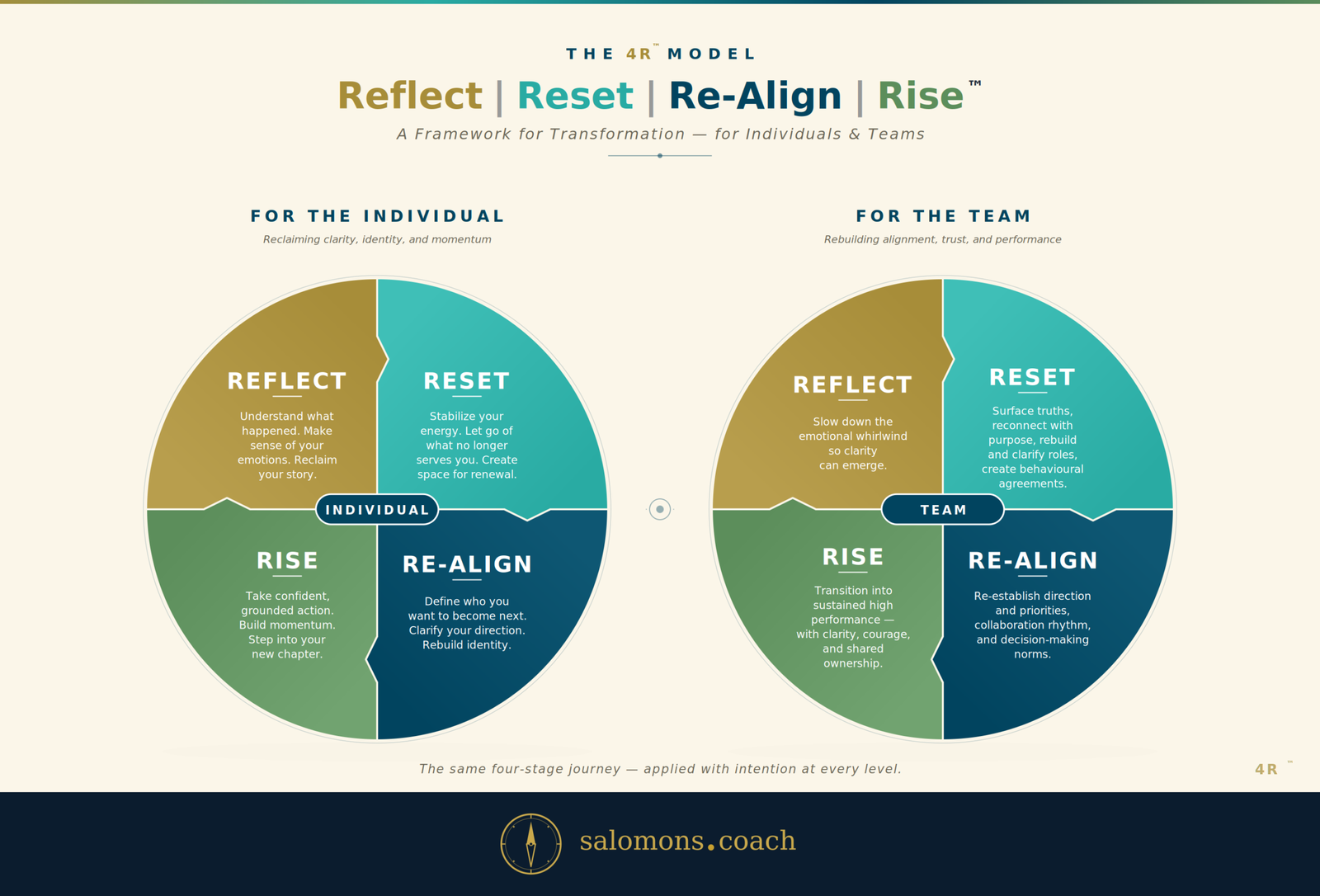
The 4R Model — Reflect, Reset, Re-Align, Rise™ — is not a theoretical construct designed behind a desk. It is a distillation of more than twenty years of hands-on executive coaching, combined with a rigorous review of the relevant scientific literature. This document brings together four articles, each connecting one R of the model to the strongest research findings from psychology, neuroscience, and organizational science.
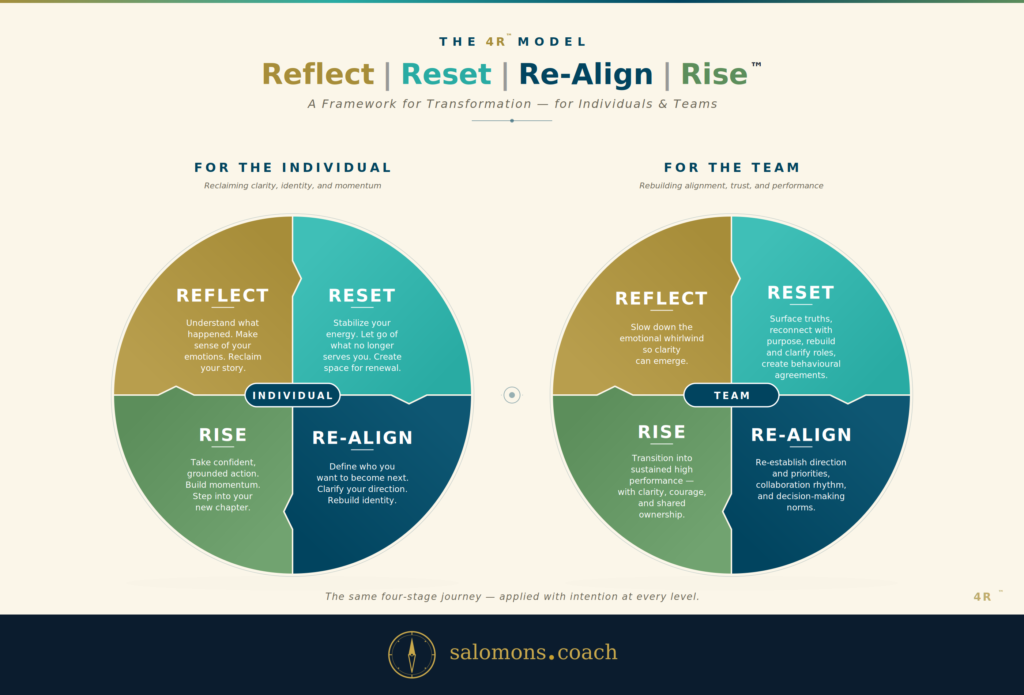
The central thesis is that leadership does not transform through information alone. Transformation requires a sequential process: first the courage to look at oneself honestly (Reflect), then the release of what no longer works (Reset), followed by a repositioning from authentic values (Re-Align), and finally sustainable high performance from a renewed foundation (Rise). Each of these steps is empirically grounded.
The four articles are written for a professional audience: senior leaders, HR directors, and fellow coaches who seek a scientifically founded approach to leadership development.
Step-1: Reflect
The Power of Self-Reflection: Why Leaders Don’t Know Themselves and How to Change That
It seems self-evident: those who wish to lead others must first know themselves. Yet research consistently shows that self-awareness among leaders is remarkably underdeveloped — and that this has measurable consequences for organizational performance, decision quality, and team culture. The first step of the 4R Model — Reflect — is not coincidentally the fundamental entry point of the entire transformation process.
The self-awareness gap: disturbing numbers
Tasha Eurich, organizational psychologist and author of the groundbreaking Insight (2018), studied more than five thousand people with her research team. The finding was startling: only 10 to 15 percent of adults are genuinely self-aware. Even more concerning: there is virtually no correlation between how self-aware people believe themselves to be and how self-aware they actually are.
| 📚 Eurich, T. (2018) — Insight: Why We’re Not as Self-Aware as We Think. Quantitative research with 5,000+ participants. Key finding: 95% of people believe they are self-aware, while only 10–15% actually are. Eurich distinguishes internal self-awareness (how we see ourselves) and external self-awareness (how others see us) as two independent dimensions, both critical for effective leadership. |
This finding is all the more relevant for senior leaders. As people rise in the hierarchy, the number of people who give them honest feedback decreases significantly. Past success reinforces confirmation bias, and the environment conforms to the leader’s perceptions rather than the other way around. The top is, paradoxically, the place where self-awareness is most needed and simultaneously most deficient.
The scientific basis of reflection as a learning process
Donald Schon introduced in 1983 the concept of the reflective practitioner — the professional who not only acts from knowledge, but simultaneously learns from that action through critical self-reflection. He made a fundamental distinction between reflection-in-action (during the act) and reflection-on-action (afterward, from a distance).
| 📚 Schon, D.A. (1983) — The Reflective Practitioner: How Professionals Think in Action. Landmark work in professional development literature. Schon argues that the most complex professional problems cannot be solved through technical knowledge alone, but require the professional to examine their own thinking process. Particularly relevant for coaching: the coach facilitates the switching between action and reflection. |
David Kolb built on this with his Experiential Learning Theory (1984), describing reflection as the essential link between experience and learning. His learning cycle — concrete experience, reflective observation, abstract conceptualization, active experimentation — demonstrates that without the reflection step, experiences are not converted into meaningful knowledge. Leaders who rush from action to action fundamentally learn less than their more reflective counterparts.
Metacognition and the Dunning-Kruger paradox
Flavell (1979) introduced the concept of metacognition: the ability to think about one’s own thinking. Leaders with strong metacognitive capacity recognize their own blind spots, know the limits of their knowledge, and regularly question their assumptions.
Kruger and Dunning (1999) demonstrated what happens when this capacity is absent: people with low competence in a domain consistently overestimate themselves, while highly qualified individuals underestimate their abilities. This effect — which has become widely known — is particularly persistent in leadership positions. The illusion of superior self-insight correlates negatively with actual effectiveness.
| 📚 Kruger, J. & Dunning, D. (1999) — Unskilled and Unaware of It (Journal of Personality and Social Psychology). Classic study across four experiments. Demonstrates that cognitive shortcomings not only lead to poor performance, but also to the absence of the ability to recognize one’s own incompetence. Metacognitive training — the core of the Reflect phase — is the most effective intervention. |
Mindfulness as a reflective practice
Jon Kabat-Zinn’s research on mindfulness-based stress reduction (MBSR) has demonstrated that systematic attention training enlarges the brain structures responsible for self-reflection and emotional regulation — particularly the insula and the prefrontal cortex. Langer (2014) links mindfulness in an organizational context directly to better decision-making and higher leadership effectiveness.
Hougaard and Carter (Harvard Business Review, 2018) studied more than 35,000 leaders and found that mindful leaders score significantly higher on assessments by direct reports across all dimensions of leadership effectiveness — including decision quality, empathy, and strategic thinking.
Coaching implications of the Reflect phase
What does all of this mean for coaching practice? The research literature points unambiguously in one direction: self-awareness does not develop spontaneously. It requires structured interventions, honest feedback from outside, and a psychologically safe context in which the leader dares to question their own self-image.
- Use 360-degree feedback data as a mirror, but process it in a coaching dialogue — not as a report.
- Introduce reflection routines: daily or weekly journaling, targeted self-evaluation questions after key decision moments.
- Make blind spots discussable using Eurich’s approach: ask not ‘why’ but ‘what’ — what do I want, what am I doing, what do I want to change?
- Create conditions for reflection-on-action: structured sessions after significant leadership moments.
“The most successful people, as well as the most successful organizations, have one striking thing in common: they’ve developed the capacity to see themselves clearly.” — Tasha Eurich, Insight (2018)

You may also like

Five Steps to Take Immediate Control of a Crisis

Most Leadership Teams Lack Dialogue