salomons.coachsalomons.coach
  • Home
  • About Me
  • Blog
  • Shop
  • Downloads
    • Your Own Career Coach
    • Cross-Cultural Leadership Compass
    • Your stress Profile
    • Psychological Safety Field Guide
    • Energy Awareness Journal
    • The Executive Presenting Framework
    • The Executive Ownership Reinforcement Framework
    • The Evidence Base for Coaching Effectiveness
    • The Art of Time Boxing
    • VUCA Leadership WorkBook
    • VUCA Leadership Book
  • Services
  • Testimonials
  • Session Scheduler
  • Contact
  • Change language to Nederlands
Back
  • Home
  • About Me
  • Blog
  • Shop
  • Downloads
    • Your Own Career Coach
    • Cross-Cultural Leadership Compass
    • Your stress Profile
    • Psychological Safety Field Guide
    • Energy Awareness Journal
    • The Executive Presenting Framework
    • The Executive Ownership Reinforcement Framework
    • The Evidence Base for Coaching Effectiveness
    • The Art of Time Boxing
    • VUCA Leadership WorkBook
    • VUCA Leadership Book
  • Services
  • Testimonials
  • Session Scheduler
  • Contact
  • Change language to Nederlands
  • Home
  • Blog
  • Uncategorized
  • The Formula for Successful Change

Uncategorized

12 Sep

The Formula for Successful Change
  • By salomons.coach
  • In Uncategorized

Don’t we all wish to have this? A way to approach change in organisations that guarantees success? We know better.

However, when I was musing about the many changes I have been part of in many organisations, and sometimes was responsible for, I see some common facts that always apply. So lets create this as a mathematical formula:
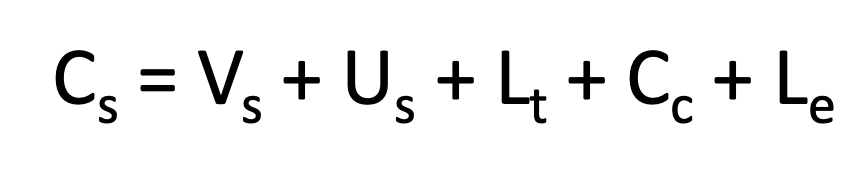
Cs Successful Change is accomplished when people have integrated the change into their comfort zones, which is created by:

  1. Vs – Shared Vision: without a clear shared vision, efforts to change are not channelled, aligned, nor supporting each other.
  2. Us – Sense of Urgency: what people need to feel inside, igniting the will and energy to change.
  3. Lt – Transition Leadership: Leaders in the organisation are capable of guiding their team and team member’s transition process
  4. Cc – Change Capacity: the capacity to change needs to be available, developed and maintained.
  5. Le – Learning from Experience: People need to be engaged as quickly as possible: create first actions that they can be part of. People believe and learn from what they experience.

Don’t get mislead by the formula, it’s just a model – an enormous simplification of the reality. Change is a complex process. An organisation is complex, because it is made up of people. An organisation behaves like an organism. People are complex beings and every individual is unique.

How wonderful! Therefore, the diversity of organisations has to be approached as pure strength. The key is how people work together, support each other, learn from each other! This is also why leadership is so crucial. But lets first look into change and transition a bit more.

Change is just an event that happens. Once it has taken place, it’s over. If we move house, the change has happened when we handover the key of our old housed we step through the door of our new house. We have moved. However, the change requires careful planning and execution.

When do we start to call our new house home? This will take a while and we need to actively create our new place, decorate it, get used to the size and shape of the rooms, e.g. finding your way off the stairs in the dark will take a while. The human and psychological process of adjusting to change is called transition (William Bridges). Once we have let go of our old home, when we have made a transition and in the end accepted our new home psychologically, we have made the transition. We feel comfortable (again), we feel at home in our new house. Does this also apply to change in organisations?

In organisations, we (hopefully) prefer to guide people through change – aiming to support their transition. Unfortunately, 75% of all change programs fail because of the lacking transition management capabilities – the people side of change (McKinsey). Transition and change are complex processes, with every person being a unique personality in this processes. Therefore we need to add another component to our model of change, which represents the psychological process.

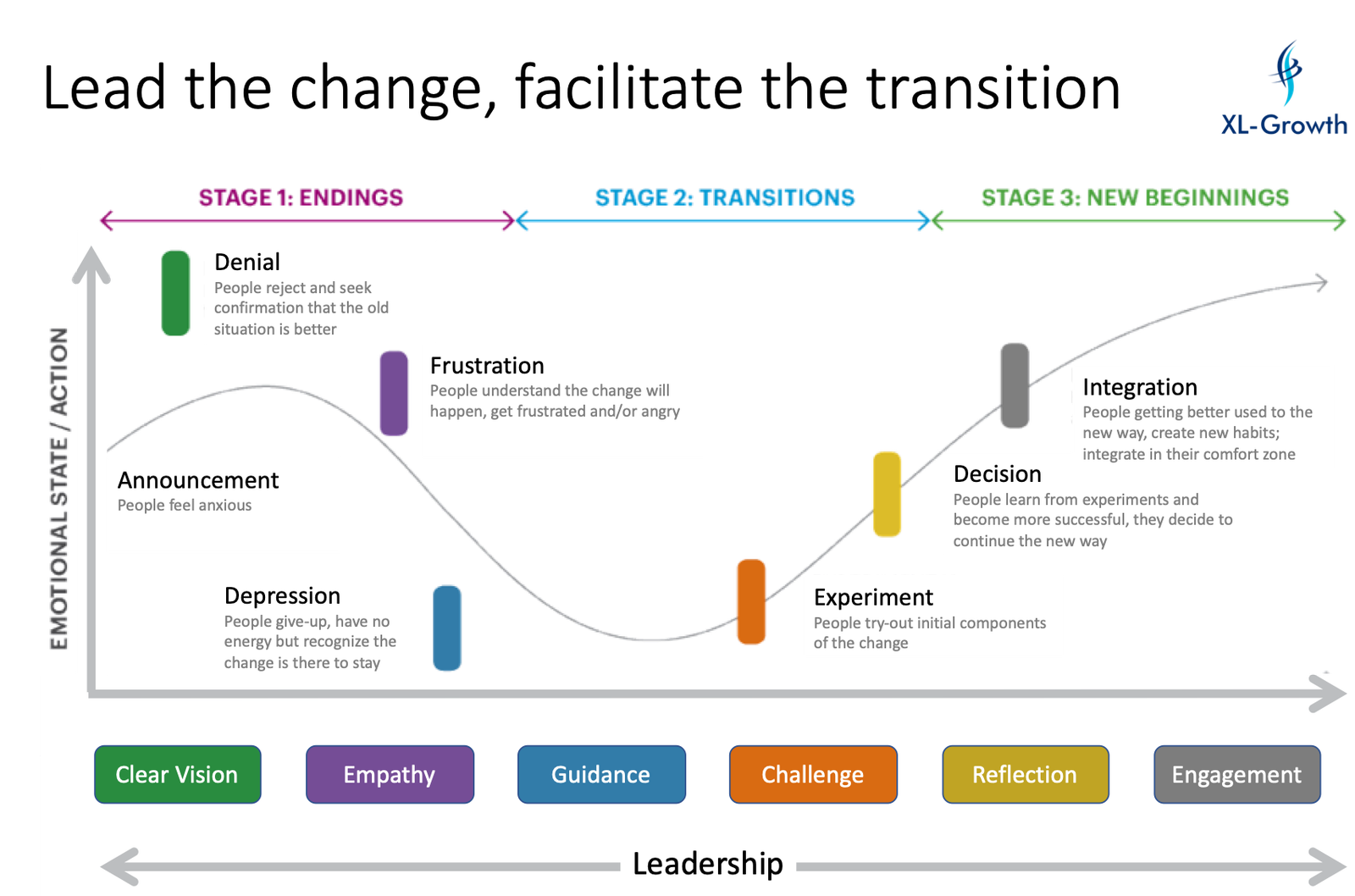
One of the most used models has been created by Elisabeth Kübler-Ross, although it originally was known (and still is) as the 5-phase grieve model: denial-anger-bargaining-depression-acceptance. It was William Bridges who brought this grieve-model into his approach of transition: endings-transitions-new beginnings. When we include this altogether, we get this model:
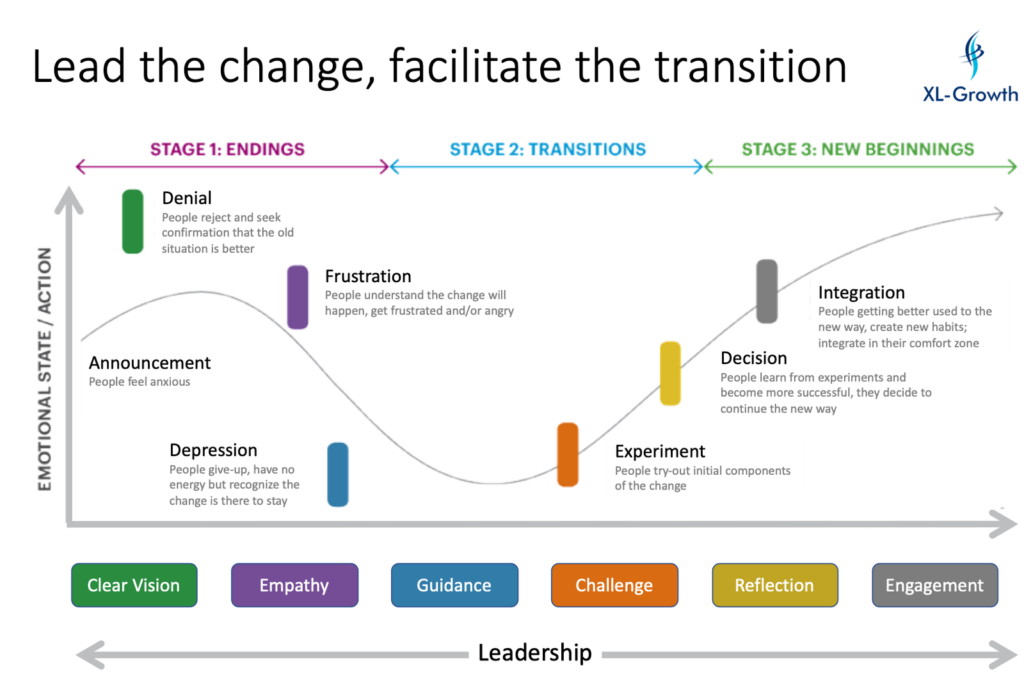
The key leadership actions to ensure people are able to go through the change curve are: understand and communicate a clear vision, have empathy for the feelings people have, provide guidance to create psychological safety to allow acceptance, challenge when actions can be taken, help reflect on outcomes so that learning takes place and ensure people remain engaged on new behaviour so they gradually integrate the new behaviour into their comfort zone – a new habit has been created.

Fundamentally, this is how we meet people where they are and – at the same time – allow them to meet us where we are. Leaders are part of the change and are in transition as well. Understanding this change process is of great help to leaders, team members, teams and the organisation.

Do you want to ensure all components of the formula for successful change are reviewed and developed if needed?

Do you have a change program to be implemented?

Are you in need of a fresh view on who and where your organisation should improve on change capabilities?

Are you seeking a way to measure your change program, also from the people side, from beginning till the end?

We provide a change toolbox and leadership program that we can tailor to your needs.

  • Share:
salomons.coach
Jan Salomons is a seasoned leader/executive who shares his knowledge and experience as an executive mentor/coach/trainer as well as a transformation and operations excellence expert. He has over 35 years of experience working with senior leaders across more than 55 countries, and is an elected member of the Harvard Business Review Advisory Council.

You may also like

Harnessing the Power of Strong Emotions: Mastering Your Workplace Emotional Intelligence

  • 18 May 2023
  • by salomons.coach
  • in Coaching
Introduction In the fast-paced and demanding world of work, it’s not uncommon to experience strong emotions that can either...
How to Measure your life?
25 January 2020
Leadership in the Twenties, Trend #1: AI runs the Business
11 January 2020

Leave A Reply Cancel reply

Your email address will not be published. Required fields are marked *

This site uses Akismet to reduce spam. Learn how your comment data is processed.

Categories

  • Agile (4)
  • AI (3)
  • Blog (151)
  • Books & Publications (7)
  • Change (4)
  • Change & Transformation (30)
  • Coaching (1)
  • Download (2)
  • Emotional Intelligence (2)
  • Innovation & Strategy (6)
  • Leadership (14)
  • Learning (4)
  • Learning & Development (12)
  • Mindfulness (2)
  • Organizations & Culture (40)
  • Performance Management (1)
  • Personal Development (7)
  • Purpose (1)
  • Remote Teams (1)
  • Self & Personal Growth (74)
  • Team Intelligence (2)
  • Teams & Collaboration (35)
  • Time Management (1)
  • Tools & Methods (38)
  • Uncategorized (4)
  • Video (16)
  • VUCA & Leadership (78)
  • Web Courses & Programs (4)
  • Workshops & Events (14)

Recent Posts

Businesswoman standing and presenting to colleagues around a glass-walled conference room table.
New Leader, Existing Team, Team Reset
16Oct,2026
Infographic titled 'What gets seen, gets repeated' showing two columns: left red section 'Visible. Immediate. Reactive.' with a red alert siren, a worker on the phone, factory silhouettes, and a '22:00' breakdown; caption 'IS A HERO.' Right green section 'Invisible. Deliberate. Proactive.' with a worker at a laptop displaying a rising graph and icons labeled 'Identify risk', 'Address causes', 'Prevent failure'; caption 'WEEKS EARLIER – PREVENTION' and 'IS ALMOST INVISIBLE.' Bottom banner reads 'Shift recognition. Reward prevention. Build resilient operations.' and shows salomons.coach.
What Gets Seen, Gets Repeated – Firefighters vs Preventers
26Sep,2026
Infographic titled STEER showing five circular steps (S, T, E, E, R) for crisis leadership on a dark blue background. Steps: Stabilise, Triage, Establish, Execute & inform, Review & refine.
Five Steps to Take Immediate Control of a Crisis
24Sep,2026

Tags

4R model (6) accountability (7) authenticity (5) behavior (8) career (12) change (29) coaching (51) communication (8) cross-cultural leadership (8) culture (16) decision-making (9) dersonal-development (6) emotions (6) executive-coaching (8) executive coaching (6) feedback (5) growth (6) leadership (68) leadership behavior (47) leadership coaching (8) leadership development (8) learning (10) mindset (5) psychological safety (31) redundancy (9) reflection (34) resilience (21) self-awareness (56) self-leadership (14) self-management (9) self-regulation (6) stress (10) team-dynamics (10) team alignment (5) team building (5) team coaching (10) teams (7) TED (5) Time Management (5) tools (19) transformation (6) trust (8) VUCA (37) VUCA leadership (39) work-life balance (5)
All posts - searchable table
Recent videos
the-adhd-watch-list-hero

The Best ADHD Videos for Leaders: Science, Stories, Strategy

In 14 July 2026
No Comment
Female speaker on stage delivering a TEDx talk, with a headset mic and gesturing, while a lower-third bio identifies her as a professor of organizational behaviour.

The Authenticity Paradox | Professor Herminia Ibarra 

Brooks – Harvard – on Happiness

Happiness as a Leadership Strategy

L360 youyrownjourney landing page L360

Find your true purpose

GET IN TOUCH

Salomons.Coach
KvK: 72129131
+31 6 53 89 75 67

jan@salomons.coach

The Netherlands

USEFUL LINKS

  • About
  • Privacy policy
  • Term & Conditions
  • Refund & Returns
  • Payment policy
  • Digital Policy
  • Methodology & Sources

LinkedIn

  • Linkedin
Receive blog updates

salomons.coach by J.K. Salomons Holding B.V., 2018-2026

  • Home
  • About Me
  • Blog
  • Shop
  • Downloads
    • Your Own Career Coach
    • Cross-Cultural Leadership Compass
    • Your stress Profile
    • Psychological Safety Field Guide
    • Energy Awareness Journal
    • The Executive Presenting Framework
    • The Executive Ownership Reinforcement Framework
    • The Evidence Base for Coaching Effectiveness
    • The Art of Time Boxing
    • VUCA Leadership WorkBook
    • VUCA Leadership Book
  • Services
  • Testimonials
  • Session Scheduler
  • Contact
  • Change language to Nederlands
Change language to Nederlands