salomons.coachsalomons.coach
  • Home
  • About Me
  • Blog
  • Downloads
    • Cross-Cultural Leadership Compass
    • Psychological Safety Field Guide
    • Energy Awareness Journal
    • The Executive Presenting Framework
    • The Executive Ownership Reinforcement Framework
    • The Evidence Base for Coaching Effectiveness
    • The Art of Time Boxing
    • VUCA Leadership WorkBook
    • VUCA Leadership Book
  • Services
  • Testimonials
  • Session Scheduler
  • Contact
  • Change language to Nederlands
Back
  • Home
  • About Me
  • Blog
  • Downloads
    • Cross-Cultural Leadership Compass
    • Psychological Safety Field Guide
    • Energy Awareness Journal
    • The Executive Presenting Framework
    • The Executive Ownership Reinforcement Framework
    • The Evidence Base for Coaching Effectiveness
    • The Art of Time Boxing
    • VUCA Leadership WorkBook
    • VUCA Leadership Book
  • Services
  • Testimonials
  • Session Scheduler
  • Contact
  • Change language to Nederlands
  • Home
  • Blog
  • Blog
  • Your Strengths Are Why You’re Stuck.

Blog

27 Jun

Your Strengths Are Why You’re Stuck.
  • By salomons.coach
  • In Blog, Books & Publications, Change & Transformation, Self & Personal Growth, Tools & Methods, Video
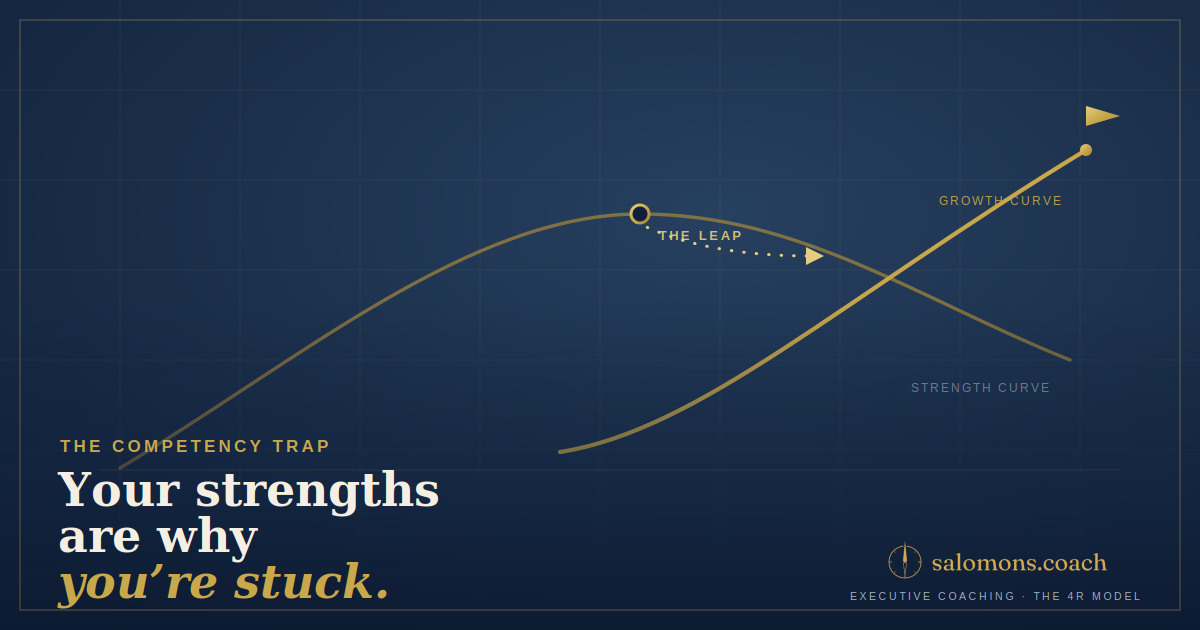
A dark blue professional hero image showing two gold curves—growth and strength—crossing, with a labeled point 'The Leap' and the headline 'Your strengths are why you're stuck,' plus the brand salomons.coach at the bottom right.

Leadership Development · The Competency Trap

Your Strengths Are Why You’re Stuck.

The competences that earned a senior leader their seat are the same ones quietly keeping them in it. On outsight, endings, and why growth at the top runs outside-in.


Every senior leader has a signature strength. The thing they are known for, rewarded for, promoted for. It is also, more often than anyone admits, the thing holding them in place.

The competence that got you here was never built to get you there. It was built to get you here. And it is very, very good at keeping you here.

Two games, two strategies

Here is the nuance most strength-bashing misses. A senior leader is really playing two different games, and they reward opposite moves.

To get better at the job you have, apply your strength. Go deeper, sharpen it, lean in. This is exactly right. Mastery is built by doing more of what you are already good at.

To earn the job you want, do the opposite. The next role rewards the skills you do not have yet, not more of the ones you do. Advancement is built by becoming a beginner again, on purpose.

Careers stall when leaders run the first move against the second problem: they pour energy into a strength exactly when the next level is quietly asking for a capability they have not built. Getting better and getting ahead are not the same project.

The competency trap

There is a second danger, and it is subtler. A strength is not only the wrong tool for the next game. Used too much, it stops serving you even in the current one.

We gravitate to what we already do well. It feels productive. It earns applause. So we do more of it, and the new, clumsy, lower-status behaviours that would actually grow us get crowded out. The trap is not incompetence. It is competence, over-applied.

A leader known for operational rigour keeps reaching for rigour when the moment calls for vision. A brilliant closer keeps closing when the role now needs them to build others who can. The strength becomes a reflex, the reflex becomes a ceiling, and the ceiling is invisible precisely because it is made of things you are good at.

The trap is not incompetence. It is competence, over-applied.

The Dutch lens: every quality has a pitfall

Daniel Ofman’s core quadrant makes the mechanism precise. Every core quality carries a pitfall: the same trait, overdone. Decisiveness, pushed too far, becomes steamrolling. Care becomes meddling. Drive becomes burnout. Rigour becomes nitpicking. The work is not to abandon the quality but to watch the dose. A strength rarely fails a leader by being too little. It fails them by being too much, and the one you lean on hardest is the one most likely to tip.

The theory: outsight, not insight

Herminia Ibarra named this in Act Like a Leader, Think Like a Leader. The conventional model says: change yourself by reflecting first, then acting. She inverts it. We grow into leaders by acting like one and earning outsight, the fresh, outside-in perspective that only new action and new people can supply. Insight, the introspective kind, tends to confirm the self you already are. Outsight disrupts it. You cannot think your way out of a competency trap. You act your way out, and let the new experience rewrite the thinking.

Before a new self, an ending

Here is the part leaders resist most. To step into the next version of yourself, you first have to let go of the identity built on your current strengths. And that identity is precisely the one that has been winning.

Loosening your grip on “the operator”, “the closer”, “the firefighter” feels like a loss of self before it feels like a gain. It is supposed to. That discomfort is not a sign you are doing it wrong. It is the sign you have finally started.

The theory: every transition begins with an ending

William Bridges drew the distinction between change and transition. Change is the external event. Transition is the inner reorientation it demands, and it begins not with a new beginning but with an ending: a loosening of the role and the self-image that came with it. Leaders who skip the ending, who try to bolt the new self on without releasing the old one, end up half-in and half-out, and stall there. The ending is not the obstacle to reinvention. It is the entrance.

What actually changes, and it changes outside-in

Outsight is not a mood you summon. It is the by-product of doing different things with different people. Ibarra points to three levers, and none of them start in your head:

Redefine the workTake on projects outside your proven lane, where your signature strength does not apply and you have to lead by something else. The discomfort is the point.

Reshape the networkYour current circle mirrors your current self back to you. New, more varied relationships are where outsight actually comes from. You borrow the next version of yourself from people who already live it.

Play with the selfTry provisional versions of the leader you might become, before you are certain. Reinvention is not declared. It is rehearsed.

The most sophisticated excuse

When a senior leader does not want to change, the most respectable reason they give is: “That just isn’t me.” Ibarra calls it the authenticity trap. Held too tightly, authenticity stops protecting who you are and starts preserving who you used to be. A growing leader treats identity as a draft, not a monument.

Authenticity, held too tightly, becomes a museum of who you used to be.

The leaders who plateau are rarely the ones who ran out of talent. They are the ones who kept spending the talent that already paid off. Growth at the top is seldom about adding a strength. It is about loosening your grip on the one you trust most, ending the version of you that was built around it, and acting your way into the next.

Watch next

The authenticity trap, in the words of the researcher who named it.

Herminia Ibarra, “The Authenticity Paradox” · TEDxLondonBusinessSchool

Sensing that your strongest card has become the one you can’t put down?

That is the conversation I have with senior leaders every week. Start yours at Salomons.Coach.

Related reading: when this question turns into a full career change, see the companion piece on the Pioneer Map and The Expedition, the method I use to coach senior career switches.

Further reading

Herminia Ibarra, Act Like a Leader, Think Like a Leader (Harvard Business Review Press, 2015). The source of outsight and the competency trap, and the case for changing from the outside in.

Herminia Ibarra, Working Identity: Unconventional Strategies for Reinventing Your Career (Harvard Business School Press, 2003). Provisional selves and reinvention through action rather than introspection.

William Bridges, Transitions: Making Sense of Life’s Changes (Addison-Wesley, 1980). Why every reinvention starts with an ending.

Daniel Ofman, Core Qualities: A Gateway to Human Resources (the English edition of Bezieling en kwaliteit in organisaties). The core quadrant, and how every strength, overused, becomes a pitfall.

Jan Salomons, Executive Coach & Transformation Consultant, Salomons.Coach. Member, Harvard Business Review Advisory Council. 35+ years in leadership, 20+ years coaching C-suite leaders across 55+ countries.

Tags:Core-qualitieslearningOfmanpersonal-developmentself-awarenessStrengths
  • Share:
salomons.coach
Jan Salomons is an international executive leader turned leadership specialist and executive coach with over 35 years of experience across IT, transport, and semiconductors. His senior roles in HR, L&D, operations, transformation, and portfolio management—combined with work in 50+ countries—give him a rare, practical understanding of how leadership behavior drives organizational success in high-pressure environments. Jan founded Salomons.Coach to help executives and teams create visible behavioral change and measurable results. In 2024, he joined the Harvard Business Review Advisory Council. Today he partners with CEOs and executive teams who want leadership behavior to become the engine of performance and transformation.

You may also like

The Authenticity Paradox | Professor Herminia Ibarra 

  • 27 June 2026
  • by salomons.coach
  • in Video
“Be authentic” — that’s what organizations, brands and people keep being told. But too often, following that advice can...
Blue gradient hero with a golden dotted path winding from left to right toward a compass on the right; headline reads 'You don’t plan a career switch. You explore one.'
You Don’t Plan a Career Switch. You Explore One.
27 June 2026
Infographic showing three TA ego states—Parent, Adult, Child—on the left and three leadership actions—Develop, Manage, Stay strategic—on the right, with a central 'A' node labeled Lead from Adult.
Transactional Analysis for Leaders: The Foundations, and How to Use Them
26 June 2026
Diagram titled 'The Operational Pull' showing an adult at center (A) with a glowing circle, arrows pointing from A to three top categories: 'Mid & long-term goals', 'Developing people', and 'Managing up'. Text 'ADULT' and 'the stance you choose' under A, and 'the daily firefight pulls your stance down' with a downward arrow toward two circles labeled P (Parent) and C (Child) at the bottom, indicating rescue and control dynamics.
The Daily Firefight Hijacks Your Leadership, Not Just Your Calendar
26 June 2026

Leave A Reply Cancel reply

Your email address will not be published. Required fields are marked *

This site uses Akismet to reduce spam. Learn how your comment data is processed.

Categories

  • AI (3)
  • Blog (131)
  • Books & Publications (7)
  • Change & Transformation (29)
  • Download (2)
  • Innovation & Strategy (5)
  • Learning & Development (12)
  • Organizations & Culture (32)
  • Self & Personal Growth (59)
  • Teams & Collaboration (25)
  • Tools & Methods (29)
  • Video (14)
  • VUCA & Leadership (60)
  • Web Courses & Programs (4)
  • Workshops & Events (11)

Recent Posts

Female speaker on stage delivering a TEDx talk, with a headset mic and gesturing, while a lower-third bio identifies her as a professor of organizational behaviour.
The Authenticity Paradox | Professor Herminia Ibarra 
27Jun,2026
A dark blue professional hero image showing two gold curves—growth and strength—crossing, with a labeled point 'The Leap' and the headline 'Your strengths are why you're stuck,' plus the brand salomons.coach at the bottom right.
Your Strengths Are Why You’re Stuck.
27Jun,2026
Blue gradient hero with a golden dotted path winding from left to right toward a compass on the right; headline reads 'You don’t plan a career switch. You explore one.'
You Don’t Plan a Career Switch. You Explore One.
27Jun,2026

Tags

4R model (6) accountability (5) authenticity (4) behavior (6) career (12) change (26) coaching (43) communication (6) cross-cultural leadership (8) culture (15) decision-making (8) dersonal-development (6) emotions (6) executive-coaching (7) executive coaching (5) focus (4) growth (6) leadership (55) leadership behavior (39) leadership coaching (8) leadership development (8) leadership growth (4) learning (9) learning organization (4) mindset (5) psychological safety (21) recovery (4) redundancy (9) reflection (30) resilience (17) self-awareness (46) self-leadership (13) self-management (9) self-regulation (5) stress (8) team alignment (5) team coaching (5) teams (7) TED (5) tools (14) transformation (5) trust (7) VUCA (34) VUCA leadership (32) work-life balance (5)
All posts - searchable table
Recent videos
Female speaker on stage delivering a TEDx talk, with a headset mic and gesturing, while a lower-third bio identifies her as a professor of organizational behaviour.

The Authenticity Paradox | Professor Herminia Ibarra 

In 27 June 2026
No Comment
Brooks – Harvard – on Happiness

Happiness as a Leadership Strategy

L360 youyrownjourney landing page L360

Find your true purpose

NeuroPlasticity aquare

How the Brain Changes Itself – Learning is Forever!

GET IN TOUCH

Salomons.Coach
KvK: 72129131
+31 6 53 89 75 67

jan@salomons.coach

The Netherlands

USEFUL LINKS

  • About
  • Privacy policy
  • Term & Conditions
  • Refund & Returns
  • Payment policy
  • Digital Policy
  • Methodology & Sources

LinkedIn

  • Linkedin
Receive blog updates

salomons.coach by J.K. Salomons Holding B.V., 2018-2026

  • Home
  • About Me
  • Blog
  • Downloads
    • Cross-Cultural Leadership Compass
    • Psychological Safety Field Guide
    • Energy Awareness Journal
    • The Executive Presenting Framework
    • The Executive Ownership Reinforcement Framework
    • The Evidence Base for Coaching Effectiveness
    • The Art of Time Boxing
    • VUCA Leadership WorkBook
    • VUCA Leadership Book
  • Services
  • Testimonials
  • Session Scheduler
  • Contact
  • Change language to Nederlands
Change language to Nederlands