What Makes Some Teams Stronger Under Pressure Than Others?
Executive summary
Organisations have invested heavily in helping individuals become more resilient. While personal resilience, boundaries and recovery remain important, they provide only part of the answer. Stress is experienced individually, but the capacity to cope is strongly influenced by the team environment.
Based on executive leadership experience, coaching practice and research into organisational psychology, teamwork and resilience, I believe six collective capabilities distinguish teams that sustain both performance and wellbeing under pressure.
The missing dimension of resilience
Most leadership conversations about stress focus on the individual. Can people recognise their warning signs? Are they setting appropriate boundaries? Do they recover sufficiently? Are they resilient enough to cope with increasing demands?
These are legitimate questions, but they tell only part of the story. In practice, two equally capable professionals facing comparable demands can experience very different outcomes. One remains engaged and performs consistently, while the other gradually becomes overwhelmed. The difference is not always explained by personality, mindset or individual resilience. It is frequently shaped by the environment surrounding them.
Teams influence whether pressure becomes visible or remains hidden. They determine whether people ask for help, whether leaders reconsider priorities when demands increase and whether responsibility is distributed—or quietly accumulates around the same dependable individuals.
The Collective Coping Framework™
I use the term Collective Coping to describe how teams recognise, respond to and learn from periods of sustained pressure together.
The framework does not transfer responsibility for personal wellbeing to colleagues or leaders. Instead, it makes explicit the team conditions that help individuals use their own coping capabilities more effectively. Six collective capabilities are particularly important.
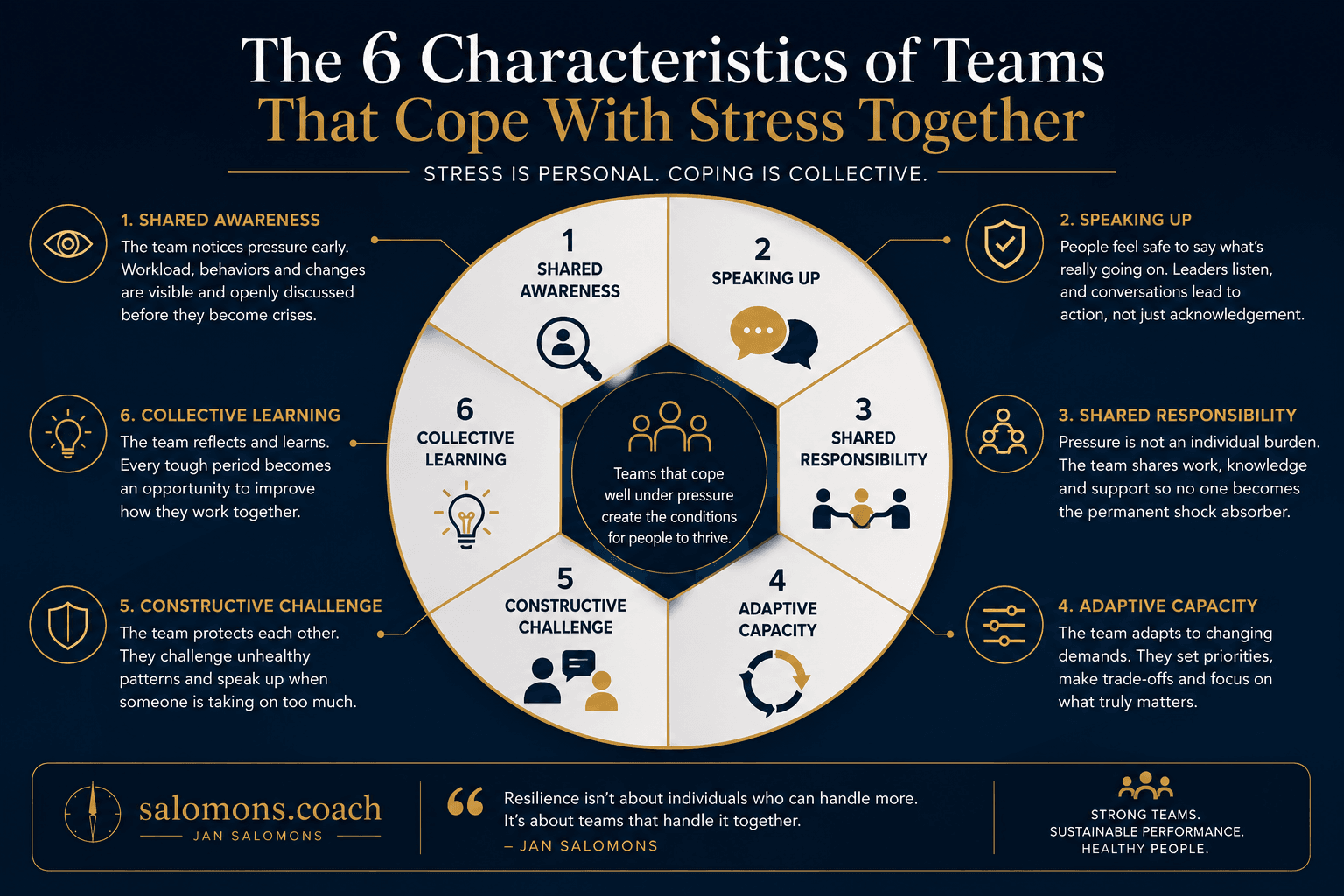
Six capabilities of teams that cope collectively
Shared awareness
Teams that cope effectively under pressure know where pressure is accumulating. They do not confuse continued output with available capacity. Leaders and colleagues monitor workload, dependencies, energy and changing behaviour before a deterioration in performance forces the issue into view.
Capacity discussions are embedded in normal operational management rather than reserved for moments when someone is already approaching exhaustion.
Speaking up
Awareness is valuable only when people can act on what they see. In resilient teams, uncertainty, conflicting demands and overload can be discussed without an immediate loss of credibility.
More importantly, speaking up produces a meaningful response. Leaders listen, colleagues engage and the team uses the information to make better decisions. Psychological safety without operational follow-through may create conversation, but it does not reduce overload.
Shared responsibility
Strong teams avoid allowing pressure to become a private burden. When one member faces an exceptional demand, colleagues can share knowledge, provide backup, redistribute selected work or temporarily adjust responsibilities.
This does not dilute accountability. It protects delivery by ensuring that the team is not structurally dependent on the endurance of one person. Sustainable performance is a collective capability, not the result of repeated individual sacrifice.
Adaptive capacity
Resilient teams do not treat every new request as an addition to the existing workload. They continuously reassess priorities, negotiate trade-offs and distinguish essential commitments from work that can be reduced, delayed or stopped.
Resilience is therefore not the ability to absorb unlimited pressure. It is the capacity to adapt intelligently as demands, risks and available resources change.
Constructive challenge
Healthy teams challenge patterns that appear productive in the short term but create risk over time. They notice when colleagues repeatedly work excessive hours, accept every new responsibility or become the default solution to every urgent problem.
Rather than celebrating heroic behaviour indefinitely, colleagues and leaders address the underlying dependency. Constructive challenge protects the individual while strengthening the operating model of the team.
Collective learning
Every demanding period contains information about how the team operates. Resilient teams do not simply recover and move on. They examine what generated unnecessary pressure, where accountability became blurred, which interventions helped and what should change before the next peak.
Learning transforms resilience from the ability to return to the previous state into the capacity to operate more effectively in the future.
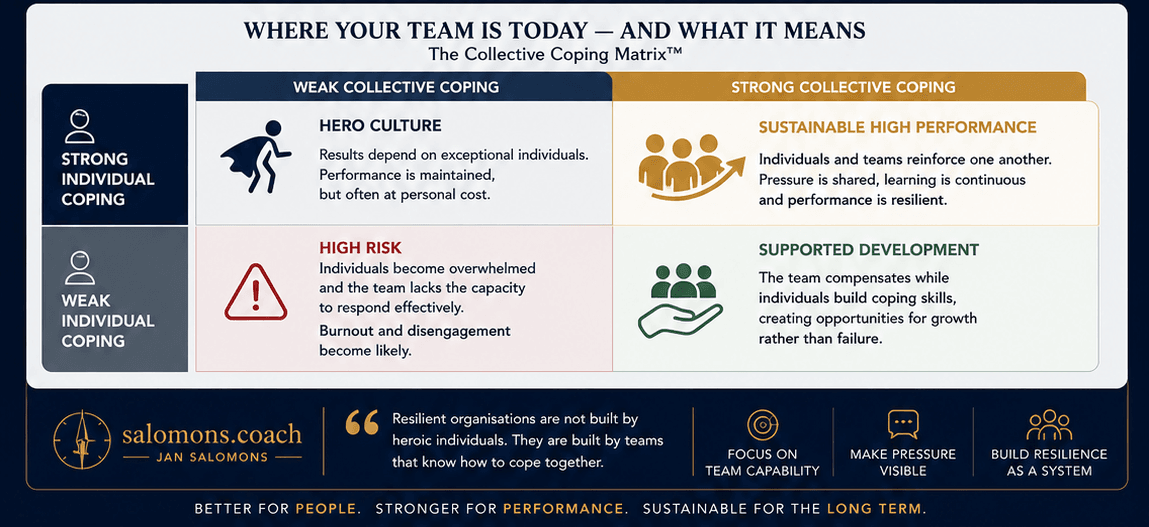
Individual coping and collective coping complement one another
Focusing on collective coping does not remove personal responsibility. Individuals remain responsible for recognising their warning signs, communicating honestly, developing healthy coping strategies and making responsible choices about recovery and boundaries.
However, teams create the operating conditions in which those individual capabilities become more—or less—effective. Sustainable resilience requires deliberate attention to both.
| Dimension | Individual coping | Collective coping | Executive implication |
|---|---|---|---|
| Core focus | Managing personal pressure, energy and recovery. | Managing workload, priorities and support across the team. | Build individual capability and team capacity simultaneously. |
| Primary question | How am I responding to pressure? | How are we responding to pressure? | Make both personal and system-level factors discussable. |
| Early visibility | The individual recognises personal warning signs. | The team detects changes in workload, behaviour and capacity. | Do not rely solely on individuals to declare overload. |
| Speaking up | The individual raises concerns and asks for help. | The team responds constructively and acts on the signal. | Measure the quality of the response, not merely openness. |
| Work allocation | The individual manages priorities and boundaries. | The team redistributes work and makes trade-offs explicit. | Prevent commitments from accumulating silently. |
| Recovery | The individual protects rest, reflection and renewal. | The team creates space after periods of peak demand. | Treat recovery as part of performance management. |
| Learning | The individual reflects on personal triggers and responses. | The team changes routines, roles and decisions that created pressure. | Convert difficult periods into organisational learning. |
| Principal risk | Overload, withdrawal and reduced professional effectiveness. | Hidden dependency, repeated heroics and operational fragility. | Address human sustainability and system resilience together. |
A practical question for every leadership team
Most executive teams track financial performance, operational delivery, customer outcomes and employee engagement. Far fewer assess how effectively their teams recognise and manage pressure together.
The following questions can initiate a more useful leadership conversation:
Questions for your next leadership meeting
- Do we know where pressure is accumulating before performance begins to decline?
- Can people raise concerns early without damaging their professional credibility?
- Does responsibility repeatedly become concentrated around the same dependable individuals?
- Do we explicitly reprioritise when capacity or circumstances change?
- Does speaking up lead to decisions—or only to acknowledgement?
- Do we learn from demanding periods, or simply move on to the next deadline?
The answers may reveal more about future organisational resilience than a performance dashboard alone.
From individual endurance to collective capability
Collective coping is not another wellbeing initiative. It is a leadership and operating capability. When teams make pressure visible, respond together, adapt priorities and learn continuously, they create better conditions for sustainable performance.
Stress will always remain personal. How successfully people cope with that stress, however, is profoundly influenced by the quality of the team surrounding them.
The Collective Coping Series
How well does your team cope with pressure together?
The Team Stress Coping & Resilience Profile™ helps teams understand how pressure is distributed, how members currently respond and which collective capabilities require attention. The objective is not to label individuals, but to create a more informed and constructive team conversation.
Combined with a facilitated workshop, the profile translates insight into a focused set of team practices that strengthen sustainable performance.
Start the conversationReferences and further reading
Hartwig, A., Clarke, S., Johnson, S., & Willis, S. (2020). Workplace team resilience: A systematic review and conceptual development. Organizational Psychology Review, 10(3–4), 169–200.
Rodríguez, I., Kozusznik, M. W., & Peiró, J. M. (2019). Individual, co-active and collective coping and organizational stress: A longitudinal study. European Management Journal, 37(1), 86–98.
Salas, E., Sims, D. E., & Burke, C. S. (2005). Is there a “Big Five” in teamwork? Small Group Research, 36(5), 555–599.
Edmondson, A. C., & Lei, Z. (2014). Psychological safety: The history, renaissance, and future of an interpersonal construct. Annual Review of Organizational Psychology and Organizational Behavior, 1, 23–43.
Bakker, A. B., & Demerouti, E. (2007). The Job Demands–Resources model: State of the art. Journal of Managerial Psychology, 22(3), 309–328.
Cross, R., Rebele, R., & Grant, A. (2016). Collaborative overload. Harvard Business Review.

You may also like


What Am I No Longer Hearing Because of the Power I Hold?

High performance can hide overload