Transactional Analysis for Leaders: The Foundations, and How to Use Them
Transactional Analysis for Leaders: The Foundations, and How to Use Them
Most of the difficulty in leadership isn’t technical. It lives in the space between two people: the tone that makes someone defensive, the rescue that quietly keeps a capable person small, the meeting where everyone agrees and nobody commits. Transactional Analysis, a model from communication psychology, gives you a clear, usable language for that space. This article is the foundation, written to be understood and then applied: what it is, why it works, how it relates to other ideas you have probably met, and how to start using it tomorrow.
- Where Transactional Analysis comes from
- The three ego states, and how they differ from Freud
- The psychology: why we shift between them
- Transactions: how stances pull on each other
- Strokes and life positions: the climate you create
- Games and the Drama Triangle: the patterns that trap leaders
- How TA connects to other models you know
- Applying it in day-to-day leadership
- An honest word on the evidence
1. Where Transactional Analysis comes from
Transactional Analysis (TA) was developed by the psychiatrist Eric Berne through the late 1950s, and reached a wide audience with his 1964 bestseller Games People Play. Berne trained in psychoanalysis, studying under Paul Federn and Erik Erikson, but grew impatient with how abstract and inaccessible it remained for ordinary people. He wanted a psychology you could observe in real time and put to use in everyday conversation, without years on the couch and without specialist jargon.
His move was to shift the focus from the hidden contents of the mind to the observable patterns of how people communicate. Rather than mapping unconscious drives, TA asks a far more practical question: which version of you is talking right now, which version of them is answering, and where is that exchange taking the two of you? For a leader, that is precisely the useful question, because it can be answered in the moment, from what you can actually see and hear.
2. The three ego states, and how they differ from Freud
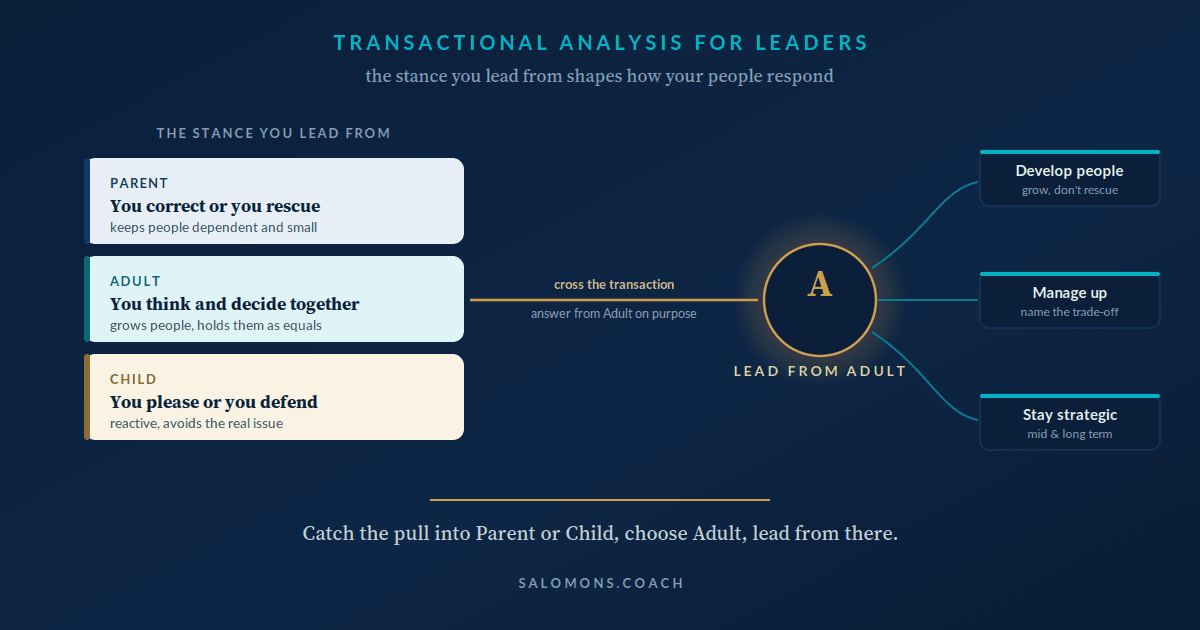
At the centre of TA sits the idea that, in any exchange, you are operating from one of three internal positions, what Berne called ego states: coherent, recognisable patterns of thinking, feeling, and behaving. These are not roles, ranks, or ages. They are stances you step into and out of constantly, sometimes several times in a single meeting.
The voice of authority (taught)
Behaviour and beliefs absorbed from the authority figures in your life. It shows up two ways: the Critical Parent (judging, correcting, setting standards, “you should have caught this”) and the Nurturing Parent (protecting, reassuring, taking over, “don’t worry, I’ll handle it”). Both, even the kind one, position you above the other person.
The voice of partnership (thought)
Dealing with what is actually in front of you, here and now: facts, options, decisions, on equal footing. Calm, curious, direct. It asks real questions instead of issuing verdicts, and it can listen to both the Parent and the Child inside you without being run by either. This is where genuine problem-solving, accountability, and growth happen.
The voice of feeling (felt)
Patterns carried from your own early experience. The Free Child is spontaneous, creative, playful, the source of energy, humour, and ideas, and a real asset. The Adapted Child reacts to pressure: pleasing and apologising, or defending and rebelling. Leaders rarely admit to this stance, yet it surfaces more than they think.
It is tempting to line these up with Freud’s Superego, Ego, and Id, and the parallel is real but partial. Berne knew Freud’s model well and deliberately built something different. The Superego, Ego, and Id are theoretical constructs, inferred forces you can never directly observe. Berne’s ego states are phenomenological: each is a real, present, observable way of being that shows up in posture, tone, and word choice, and each contains thinking, feeling, and behaving together, rather than splitting reason from drive. Crucially, the Parent and Child are not primitive layers to be tamed by reason; they are full recordings of real experience. The aim is not to suppress them but to keep the Adult in charge of choosing when each belongs.
Berne also noticed that the Adult can become contaminated: a Parent prejudice (“people from that team can’t be trusted”) or a Child fear (“if I push back I’ll be rejected”) slips in wearing the disguise of objective fact. Much of the practical work, for leaders especially, is decontamination: learning to tell a present-tense Adult assessment apart from an old Parent rule or a Child reflex that is merely posing as one.
One principle runs through all of it: the goal is recognition, not labelling. The label is for the behaviour in the moment, never the person. A calm colleague slides into Critical Parent under a deadline; a seasoned executive drops into defensive Child when blindsided in front of the board. “That came across as Nurturing Parent” is useful. “He is a Nurturing Parent” is a cage. Hold every read lightly, as a hypothesis you keep testing.
3. The psychology: why we shift between them
If the three stances were only a vocabulary, they would be a clever party trick. What makes TA genuinely useful is understanding why people drop into Parent or Child, and why holding Adult takes real effort. Three mechanisms explain it.
Ego states are stored, learned patterns
The Parent is internalised behaviour from earlier authority figures; the Child is stored reactions from your own early experience. Under pressure, the brain reaches for these automatic scripts because they are fast and familiar, which costs far less energy than building a considered response from scratch. The behaviour is not a character flaw. It is an efficient shortcut, firing at the wrong moment.
Stress tips people out of Adult
The Adult stance leans on the brain’s slower, reasoning, perspective-taking, self-regulating machinery. Under threat, criticism, or sheer overload, the faster, more reactive systems take over, and the defending Child or the correcting Parent appears almost on its own. Holding Adult is therefore less a matter of willpower than of noticing the tip early enough to interrupt it.
If you know Daniel Kahneman’s Thinking, Fast and Slow, this maps cleanly. The reactive Parent and Child behave like fast, automatic System 1: instant, effortless, pattern-matched. The Adult is effortful System 2: slower, deliberate, able to weigh and choose. Stress, fatigue, and time pressure all starve System 2, which is exactly when leaders default to their oldest scripts. TA gives you names for which script just fired.
Transactions are reciprocal
This is the heart of the model, and the next section gives it the room it deserves. In short: the stance you take pulls the other person toward a matching stance. A conversation is not two monologues running in parallel. It is a chain of stimulus and response, and you are shaping the other person’s response in real time, whether you mean to or not.
4. Transactions: how stances pull on each other
Berne called a single exchange a transaction: one person’s stance is the stimulus, the other person’s stance is the response. The decisive insight for leaders is that stances invite their counterparts. Lead from Critical Parent and you tend to pull the other person into Adapted Child, they shrink, apologise, and quietly hide the next mistake. Lead from helpless Child and you invite the other person into Parent, to correct or rescue you.
When the response matches the invitation, as it does here, Berne called it a complementary transaction: the conversation runs smoothly along its track. The trouble is that the track can lead somewhere unhelpful, in this case toward a team member who is smaller, more careful, and less likely to bring you the next problem while it is still cheap to solve.
The core leadership skill is to cross the transaction: receive a Parent or Child invitation and deliberately answer from Adult, which quietly invites the other person up with you. It is not a trick or a power move; it is a refusal to run the unhelpful script, offered with enough respect that the other person can follow.
The stance you hold sets the stance the other person is pulled into.
5. Strokes and life positions: the climate you create
Two further TA concepts explain why some leaders generate energy around them and others quietly drain it.
Berne used the word strokes for units of recognition, any acknowledgement that says “I see you.” Strokes can be positive or negative, and conditional (“good work on that report”) or unconditional (“glad you’re on this team”). His unsettling observation, borne out in any workplace, is that people need recognition so much that negative strokes beat none at all. A team starved of attention will often provoke criticism just to be noticed. For a leader this is directly practical: if the only recognition you give is corrective, you are training people to get their strokes through problems and drama. Deliberate, specific, positive strokes are not soft, they are how you set the emotional economy of a team.
Life positions describe the basic stance a person carries toward themselves and others, popularised by Thomas Harris as four combinations of “I’m OK / I’m not OK” and “You’re OK / You’re not OK.” The healthy, Adult-to-Adult ground is “I’m OK, You’re OK”: I can challenge you hard and still hold you as a capable equal. The others quietly distort leadership, “I’m OK, You’re not OK” breeds the Critical Parent and micromanagement; “I’m not OK, You’re OK” feeds the Adapted Child and approval-seeking; “I’m not OK, You’re not OK” drains hope from a team. Much of what we call presence is simply a leader operating, reliably, from “I’m OK, You’re OK.”
6. Games and the Drama Triangle: the patterns that trap leaders
Berne’s most famous idea is the game: a repeating, predictable exchange that runs below the surface and ends with both people feeling a familiar bad feeling. Games are not played on purpose. They are out-of-awareness patterns that deliver a hidden payoff, often a chance to confirm an old life position (“see, no one ever takes responsibility”).
The most useful map of these patterns for leaders is Stephen Karpman’s Drama Triangle, a direct development of Berne’s work. It describes three roles people rotate through in a stuck dynamic:
“Let me fix it for you”
Steps in uninvited, solves what isn’t theirs to solve. Feels generous; actually keeps the other person dependent and small. The Nurturing Parent gone unhelpful, and the single most common trap for capable, well-meaning managers.
“This is your fault”
Blames, criticises, controls. The Critical Parent under pressure. Often a Rescuer who has run out of patience and flipped.
“There’s nothing I can do”
Feels powerless, helpless, put-upon. The Adapted Child. Invites either a Rescuer to swoop in or a Persecutor to pile on, and so the triangle keeps turning.
The trap is that the roles rotate. The leader who rescues a struggling report today becomes the persecutor who snaps at them next week (“after everything I did”), and may privately feel the victim when it all lands back on their desk. Recognising the triangle is the first step out; the way out is, once again, the Adult.
David Emerald’s Empowerment Dynamic offers the Adult-stance counterpart to each role, a useful next step once a leader can spot the triangle. The Rescuer becomes a Coach (asks, builds capability, hands responsibility back), the Persecutor becomes a Challenger (sets a clear, respectful standard without contempt), and the Victim becomes a Creator (owns the outcome and the next move). It is, in effect, the Drama Triangle answered from “I’m OK, You’re OK.”
7. How TA connects to other models you know
TA is not an island, and seeing how it sits alongside ideas you already use makes it both clearer and more credible. A few of the strongest links:
Carl Rogers and the coaching stance. Rogers’ person-centred conditions, genuineness, unconditional positive regard, and empathy, are almost a description of skilled Adult-to-Adult contact held from “I’m OK, You’re OK.” Where Rogers gives you the attitude, TA gives you the diagnostic: a way to notice the precise moment you slip out of that stance into Parent or Child.
Schema therapy and “modes.” Modern schema therapy describes “modes” such as the vulnerable child, the punitive parent, and the healthy adult, language that echoes TA closely and shows how durable Berne’s basic intuition has proven. For a leader, the overlap is reassurance that this is not a 1960s curiosity: the same three-part structure keeps reappearing in serious clinical work because it maps something real.
Psychological safety. Amy Edmondson’s research shows teams perform best when members feel safe to speak up, admit error, and take interpersonal risk. TA explains, at the level of a single conversation, how that climate is built or broken: a leader who habitually answers from Critical Parent or Persecutor teaches a team to stay quiet, while one who holds Adult and gives genuine strokes makes speaking up safe. Psychological safety is the team-level outcome; the crossed transaction is one of its building blocks.
Emotional intelligence. Where Goleman’s framework names the broad capacities, self-awareness, self-regulation, empathy, social skill, TA turns them into something you can practise in the moment. Catching your own pull into Child is self-awareness; crossing the transaction is self-regulation made concrete. TA is, in a sense, emotional intelligence with a usable instruction set.
8. Applying it in day-to-day leadership
Understanding the model changes little on its own. It becomes leadership when you can use it in real time, under pressure. Four practices turn the theory into a habit.
Read the room, others first
Start outward, because watching others is far less ego-defensive than watching yourself. In your next handful of conversations, simply notice which stance the other person is speaking from, and the observable signs that give it away: the prescriptive “you should,” the reflexive apology, the question that is really an accusation. This trains your ear without putting you on the spot.
Catch your own pull
Then turn the lens inward. A Parent stance invites you into Child, a Child stance invites you into Parent, and that pull is a physical thing with early warning signs: the jaw tightening as you are drawn toward correcting, the urge to grab the laptop and rescue, the stomach dropping as you slide toward defending. The whole skill lives in that half-second of noticing, because it is the gap where choice becomes possible.
Step back into Adult on purpose
When you feel the pull, you can decline the invitation. The move is small: notice the pull, name it silently (“I’m being drawn into Critical Parent,” “I’m about to rescue”), and respond from Adult anyway. Keep the care, hand back the responsibility. This is not about going cold. It is the same warmth, with the problem left where it belongs and the other person treated as a capable equal.
A stance you only understand in a calm moment isn’t available under pressure. Build a short, repeating reflection: after any charged conversation, ask yourself which stance did I speak from, what pulled me there, and what would the Adult have said? Cue it to something that already happens in your day, and review the pattern weekly. You don’t rise to your intentions under pressure, you fall to your level of practice.
Watch the patterns, with whom and where
Over a few weeks, the same situations and the same people will keep pulling you into the same stance, and very often into the same Drama Triangle role. That pattern is the real prize: it points to exactly where your leadership growth, and the most useful coaching, actually sits.
9. An honest word on the evidence
It is worth being straight about what TA is and isn’t. It is intuitive, widely used in coaching and organisational work, and it gives people fast, usable language for what they already half-notice. It is best understood as a practical lens for self-observation and dialogue, not a clinically proven treatment, and its formal empirical base is lighter than, say, cognitive behavioural therapy. That is exactly why this article has linked it, throughout, to models with their own bodies of research, Kahneman, Rogers, Edmondson, schema therapy, they triangulate from different directions onto the same human realities TA names so plainly. Use TA for what it does best: a shared vocabulary that makes a hard interpersonal moment visible and workable. Where it earns its place is not in any claim of cure, but in the simple, repeatable act of helping you choose your stance instead of defaulting to it.
Related to this post is “The Daily Firefight Hijacks Your Leadership, Not Just Your Calendar”, part of my series on Leadership and Transactional Analysis. It is about why operational chaos doesn’t only steal your hours, but the very stance you lead from, and how to take it back.

You may also like

The Leadership Iceberg

Power Deafens: Here is How to Avoid it