An executive summary of the five best videos on ADHD for leaders. A hard-science lecture, a memoir, a reframe, a coaching explainer, and the popular superpower talk, watched together, converge on one conclusion, and it's the argument of The ADHD Leader in a sentence.

A short, curated watch list for leaders who want to understand ADHD, from Russell Barkley on executive function to Jessica McCabe's story of failing at normal. The best videos on the science, the lived experience, and the strengths, with a note on what to watch critically.
Does executive coaching work? The short answer is yes — with conditions. A growing body of peer-reviewed research confirms significant, measurable effects across performance, behavioral change, and leadership outcomes. The harder question is how you know when it is working in your organization. This article examines the evidence, exposes the limits of widely cited ROI claims, and outlines what a rigorous evaluation framework actually looks like.
Generative AI has not eliminated the need for expertise. It has eliminated the need for unexamined expertise. In organizations, the most damaging failures no longer come from a lack of technical capability, but from poor problem framing, misplaced optimization, and leaders who mistake speed for judgment. As AI takes over more of the executional “middle,” human value shifts to the boundaries: defining what truly matters and taking responsibility for real-world consequences. This is why so-called soft skills—critical thinking, systems awareness, ethical judgment, and human leadership—are no longer optional. They have become the premium capabilities of the AI era.
In coaching supervision, I return to three questions that keep me sharp as a coach — and grounded as a leader. They are not about tools or techniques, but about self-awareness, restraint, and the courage to slow down when speed is expected. These reflections matter not only for coaches, but for every leader navigating complexity.
One-on-one meetings are one of the most powerful leadership tools — and one of the most frequently misused. Drawing from personal leadership experience and evidence-based research, this article explores how leaders can design and execute one-on-ones that go beyond status updates and become conversations that build clarity, trust, and sustainable performance.
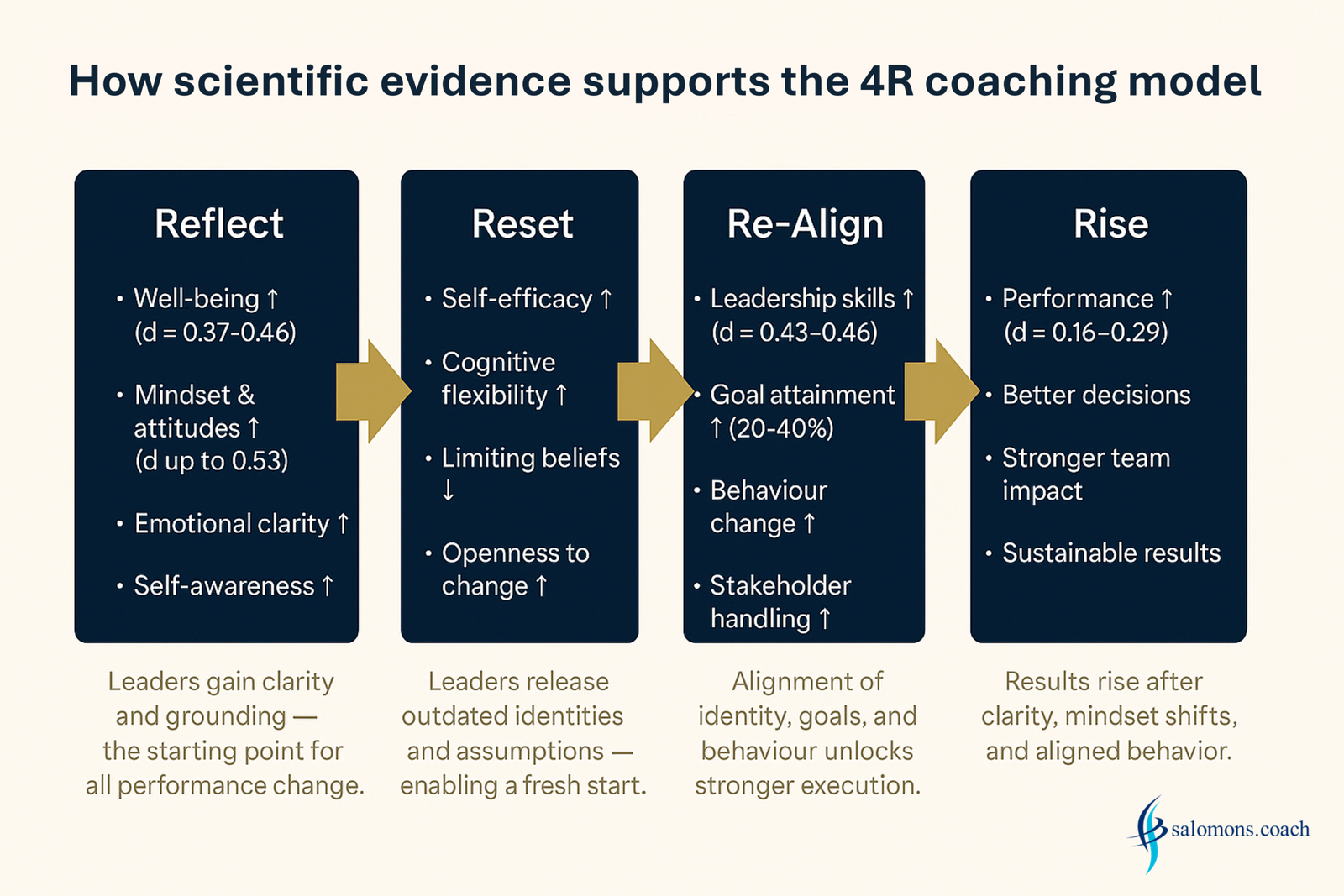
The latest scientific research on workplace coaching shows a clear, measurable pattern: meaningful change happens in four stages. Leaders first gain emotional clarity and self-awareness, then release limiting beliefs, realign their behaviour and skills with a stronger identity, and finally see measurable performance improvements. This progression mirrors the 4R Model (Reflect–Reset–Re-Align–Rise™). Backed by meta-analyses and randomized controlled trials, the evidence confirms that sustainable leadership performance begins with inner clarity—not with KPIs.
The Salomons.Coach Toolbox™ gives every client a structured, evidence-based set of tools to reflect deeply, act intentionally, and build lasting leadership behavior that strengthens business results.
Lara Boyd’s TEDx talk reveals one of the most empowering discoveries in neuroscience: you are constantly shaping your brain. Through your behavior, habits, and even your mistakes, your brain rewires itself. This phenomenon is called neuroplasticity—and it means that change is always possible.
Ask “What’s the ROI of coaching?” and you’ll get metrics: performance KPIs, engagement scores, 360-feedback. Useful — yet incomplete. What often remains unseen is the inner transformation: increased self-awareness, emotional regulation, and deliberate leadership behavior. Real-world stories — a leader choosing to listen rather than control; a team feeling more trusted — reveal the essence of lasting change. This blend of data and narrative gives the truest picture of progress. Discover how embracing nuance, investing in reflection, and using stories can elevate your organization’s coaching journey from mere intervention to profound transformation. Curious how to start your own development journal?