Senior leaders are trained to remove uncertainty, yet a career switch resists exactly that. You can't analyse your way into a new identity; you have to explore your way in. Here's how the Pioneer Map and The Expedition guide the senior career pivot — and the theory beneath the method.

Generative AI is a superb career thought partner — for CVs, interviews, search strategy, and rehearsal. But coaching isn't information. Drawing on systemic and provocative coaching and three decades in the leadership chair, Jan Salomons argues that the deeper work, seeing your system, facing your blind spot, growing past your own comfort, is precisely what an AI built to agree with you can never do.
Many experienced leaders hesitate when reaching out to their network, not because they lack capability, but because they struggle with how to ask. This article explains why senior professionals often get networking wrong, how to reframe outreach as a leadership act, and how to invite meaningful conversations that lead to real opportunities.
After job loss, many CVs become longer — and weaker. This article explains why modern CVs must shift from career history to relevance, and how AI screening has made positioning non-negotiable. Your CV is no longer a record of the past. It is a focused case for why you fit this role, now.
Especially after redundancy, many professionals explain themselves too much — in interviews, CVs, and conversations. But interviews are not about telling your story. They are about positioning. This article shows why “tell me about yourself” is a strategic question — and how to answer it with relevance, not biography.
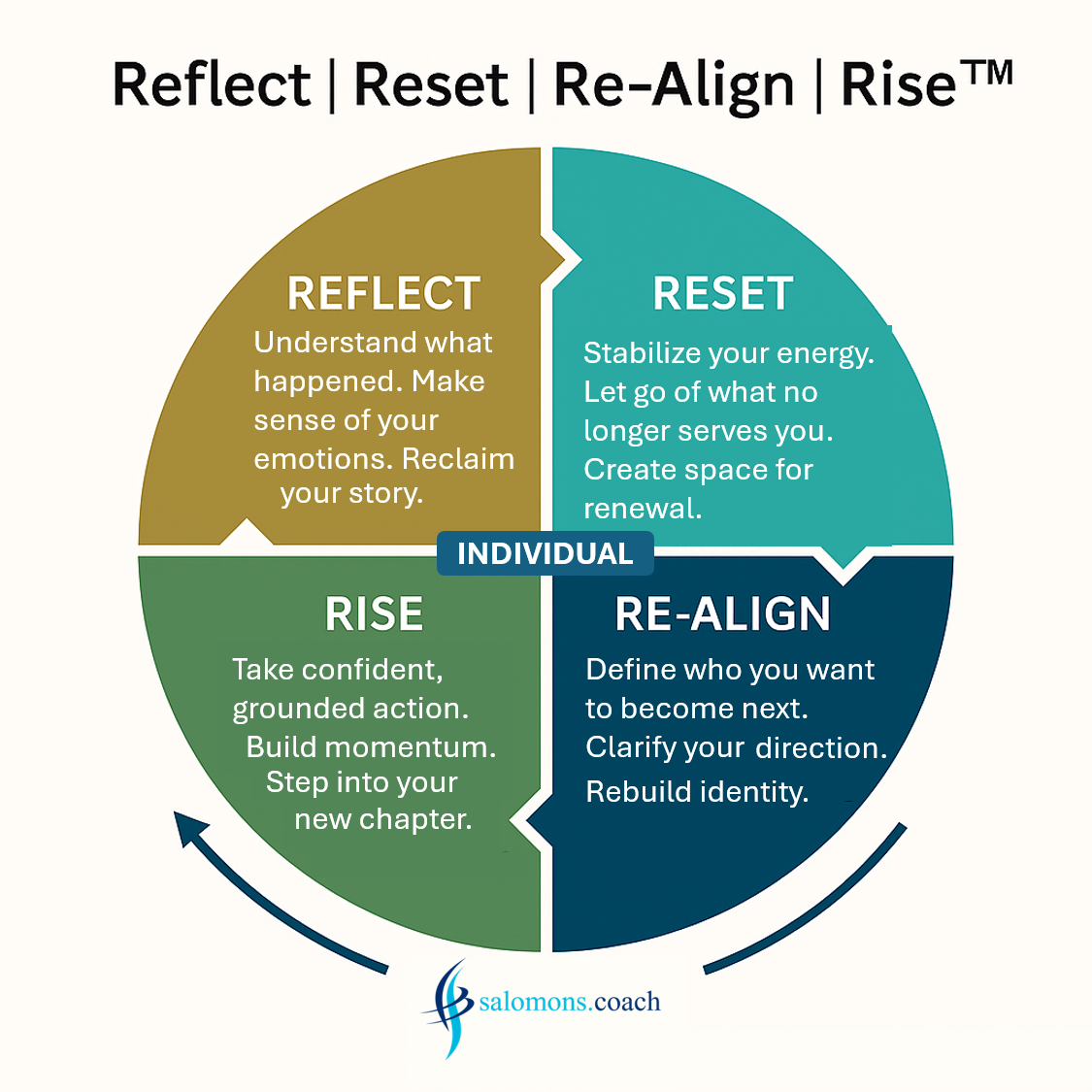
Many professionals over 45 hear the same reassuring phrases when they lose their job—yet the reality they face in the Dutch labour market is far more complex. This article explores why experienced mid-career professionals struggle not because of capability, but because the hiring system interprets their broad value too narrowly. Based on the 4R Model (Reflect–Reset–Re-Align–Rise™) and real client insights, it reveals the hidden dynamics that shape career transitions and what truly helps professionals rise stronger.
It’s not mindset. Not your CV. Not networking. It’s time.
We talk about layoffs as if they are linear: job ends > new job starts.
But real life doesn’t work that way.
What determines whether someone recovers well or gets stuck is the amount of time they have to move through the inner journey: Reflect > Reset > Re-Align > Rise™
Redundancy in the Netherlands is legally structured yet psychologically disruptive. Even with strong protections and the VSO process, employees experience identity loss, uncertainty and emotional turbulence. Leaders often underestimate this impact—and the effect on those who remain. Research shows that structured transition support significantly improves outcomes. The 4R Model—Reflect, Reset, Re-Align, Rise—helps individuals stabilize, rebuild identity and re-enter the labor market with clarity and confidence. Increasingly, Dutch organizations engage external coaches during the VSO period to support departing managers and sustain trust, well-being and business continuity. Redundancy is not an ending—it is an inflection point.
Redundancy in the Netherlands is often misunderstood as a personal failure, while in reality it is a legally structured process with strong employee protections. This article explains your rights, the procedures employers must follow, and the timeframes involved — from UWV approval and notice periods to reassignment obligations, dismissal bans, transition payments and WW benefits. With clarity and compassion, it guides you through what the law requires, what you can expect, and how to move forward confidently in your next career chapter.
In today’s fast-changing workplace, leaders and teams benefit from regularly reflecting on whether their current environment still supports their energy, growth, and purpose. Using a structured reflection questionnaire, I help leaders gain clarity on what strengthens or drains them — and whether they should stay, adjust, or move on. The same process transforms teams by uncovering hidden dynamics, restoring passion, and realigning people with the mission and vision. This reflective approach boosts engagement, performance, and retention, while preventing silent resignation long before it starts. Reflection isn’t a sign of doubt — it’s a sign of leadership.