salomons.coachsalomons.coach
  • Home
  • About Me
  • Blog
  • Shop
  • Downloads
    • Your Own Career Coach
    • Cross-Cultural Leadership Compass
    • Your stress Profile
    • Psychological Safety Field Guide
    • Energy Awareness Journal
    • The Executive Presenting Framework
    • The Executive Ownership Reinforcement Framework
    • The Evidence Base for Coaching Effectiveness
    • The Art of Time Boxing
    • VUCA Leadership WorkBook
    • VUCA Leadership Book
  • Services
  • Testimonials
  • Session Scheduler
  • Contact
  • Change language to Nederlands
Back
  • Home
  • About Me
  • Blog
  • Shop
  • Downloads
    • Your Own Career Coach
    • Cross-Cultural Leadership Compass
    • Your stress Profile
    • Psychological Safety Field Guide
    • Energy Awareness Journal
    • The Executive Presenting Framework
    • The Executive Ownership Reinforcement Framework
    • The Evidence Base for Coaching Effectiveness
    • The Art of Time Boxing
    • VUCA Leadership WorkBook
    • VUCA Leadership Book
  • Services
  • Testimonials
  • Session Scheduler
  • Contact
  • Change language to Nederlands
  • Home
  • Blog
  • Blog
  • Team building with core qualities of Daniel Ofman (incl. Dutch version)

Blog

04 Jul

Team building with core qualities of Daniel Ofman (incl. Dutch version)
  • By salomons.coach
  • In Blog, Teams & Collaboration

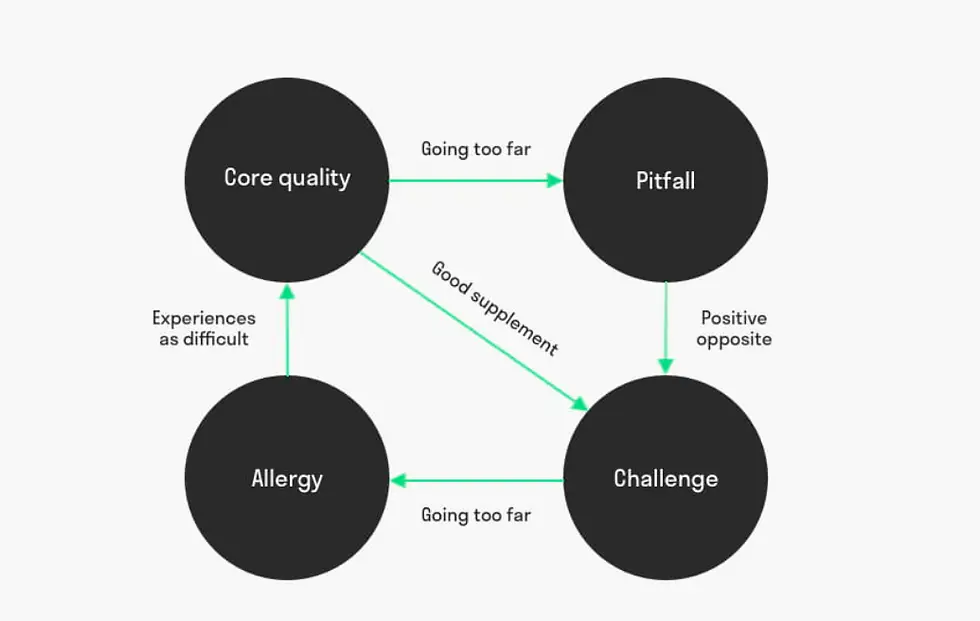
The Core Quadrants by Daniel Ofman are a powerful tool for team development and building. They provide insight into personal and team dynamics by identifying core qualities, pitfalls, challenges, and allergies. Here’s how you can use Ofman’s Core Qualities for team building:

1. Introduce the concept of core qualities

Explanation: Explain the model of core qualities, pitfalls, challenges, and allergies to the team. Use relatable examples, such as:

• Core Quality: Drive
• Pitfall: Acting too hastily
• Challenge: Patience
• Allergy: Passivity

Use visual aids like a diagram or practical examples to make it easy to understand.

2. Identify individual core qualities

Exercise: Ask team members to identify their own core qualities. Use questions like:
• What are you really good at?
• What qualities do others often appreciate about you?
• Encourage team members to reflect on how these core qualities contribute to their work and collaboration.

3. Explore pitfalls, challenges, and allergies

Help each team member explore the possible pitfalls of their core quality by asking:
• What happens when you rely too much on this quality?
• Discover challenges and allergies:
• What can you develop to balance your core quality?
• What traits in others irritate you, and why?

4. Compare and discuss core quadrants within the team

Organize a session where team members share their core quadrants.

Focus on complementarity:
• Which qualities complement each other?
• Where do irritations (allergies) arise, and how can they be resolved?

Reflect: How do different core qualities contribute to team goals?

5. Work on joint team development

Use the core quadrants to address team challenges:
• Are there shared pitfalls within the team (e.g., too much perfectionism)?
• What challenges can help the team grow (e.g., more flexibility)?
• Encourage the team to appreciate each other’s strengths and tackle challenges together.

6. Integrate core quadrants into daily collaboration

  • Feedback culture: Encourage team members to give constructive feedback based on the core quadrants.
  • Problem-solving: Use core qualities to find solutions and avoid pitfalls.
  • Celebrate successes: Highlight how team members’ core qualities have contributed to achievements.

7. Reflection and follow-up

Plan regular evaluations to discuss how the team is utilizing and developing its core qualities.
Show how working with the core quadrants improves team collaboration and performance.
Example in a team:

• Core Quality of Team Member A: Creativity
• Pitfall: Chaotic working style
• Challenge: Adding structure
• Allergy: Rigid rules

• Core Quality of Team Member B: Structured
• Pitfall: Rigidity
• Challenge: Flexibility
• Allergy: Disorganization

These differences might initially cause tensions, but by valuing each other’s qualities, they can learn how their strengths complement and enhance one another.

Would you like a specific exercise or template for a core qualities workshop? Contact me here
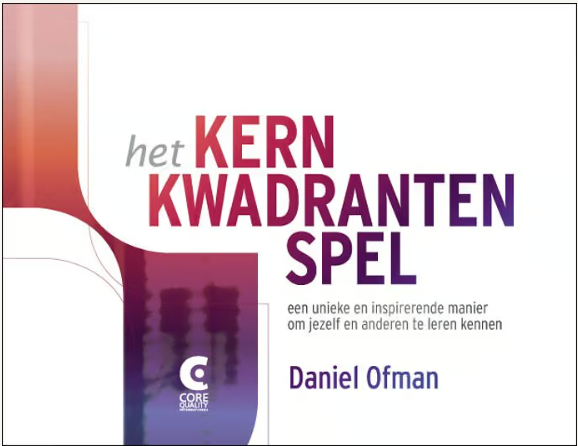
Er is een kernkwadranten spel verkrijgbaar in het nederlands. Ik gebruik dit al een aantal jaren met veel succes. Het spel bevat veel kaartjes voor elk kwadrant. Geeft een leuke variatie op bovenstaande teamoefening. Bijv. de kaartjes etaleren en iedereen een kernkwaliteit voor een collega laten uitkiezen en deze met korte toelichting overhandigen. Daarna gezamelijk de kwadranten doorwerken. Geeft hoge kwaliteit feedback naast complimenten.

Wil je ook een specifieke oefening of template voor een kernkwaliteiten-workshop? Contacteer me hier.

Tags:coachingcommunicationleadership behaviorOfman core qualitiesreflectionteam buildingteamstools
  • Share:
salomons.coach
Jan Salomons is a seasoned leader/executive who shares his knowledge and experience as an executive mentor/coach/trainer and transformation consultant. He has over thirty-five years of experience working with with senior leaders across more than sixty countries, and is an elected member of the Harvard Business Review Advisory Council.

You may also like

Two professionals in a coaching session discuss a stuck conversation, with a glowing pyramid diagram between them; 'When Conversations Get Stuck' text on dark blue background.

Why Conversations Get Stuck

  • 17 August 2026
  • by salomons.coach
  • in Blog
When leadership conversations become repetitive or defensive, the real problem may not be the content. This post explores how...
Leadership coaching banner: a giant iceberg halves above and below water with the title 'The Leadership Iceberg' and subtitle 'What really drives behaviour and communication?'
The Leadership Iceberg
17 August 2026
Dark blue stage scene showing a gold executive chair on a circular pedestal, facing gold-framed panels and glowing circuit lines, with the headline “Power Deafens: Why Leaders Stop Hearing the Truth.”
Power Deafens: Here is How to Avoid it
8 August 2026
Time Management
7 August 2026

Leave A Reply Cancel reply

Your email address will not be published. Required fields are marked *

This site uses Akismet to reduce spam. Learn how your comment data is processed.

Categories

  • AI (3)
  • Blog (143)
  • Books & Publications (7)
  • Change & Transformation (29)
  • Download (2)
  • Innovation & Strategy (5)
  • Learning & Development (12)
  • Organizations & Culture (35)
  • Self & Personal Growth (70)
  • Teams & Collaboration (31)
  • Tools & Methods (36)
  • Video (16)
  • VUCA & Leadership (71)
  • Web Courses & Programs (4)
  • Workshops & Events (14)

Recent Posts

Two professionals in a coaching session discuss a stuck conversation, with a glowing pyramid diagram between them; 'When Conversations Get Stuck' text on dark blue background.
Why Conversations Get Stuck
17Aug,2026
Leadership coaching banner: a giant iceberg halves above and below water with the title 'The Leadership Iceberg' and subtitle 'What really drives behaviour and communication?'
The Leadership Iceberg
17Aug,2026
Dark blue stage scene showing a gold executive chair on a circular pedestal, facing gold-framed panels and glowing circuit lines, with the headline “Power Deafens: Why Leaders Stop Hearing the Truth.”
Power Deafens: Here is How to Avoid it
08Aug,2026

Tags

4R model (6) accountability (5) authenticity (5) behavior (8) career (12) change (28) coaching (49) communication (8) cross-cultural leadership (8) culture (15) decision-making (8) dersonal-development (6) emotions (6) executive-coaching (8) executive coaching (6) feedback (4) growth (6) HBR (4) leadership (64) leadership behavior (47) leadership coaching (8) leadership development (8) learning (9) mindset (5) psychological safety (27) redundancy (9) reflection (34) resilience (21) self-awareness (55) self-leadership (14) self-management (9) self-regulation (6) stress (10) team-dynamics (9) team alignment (5) team coaching (7) teams (7) TED (5) Time Management (5) tools (19) transformation (5) trust (7) VUCA (37) VUCA leadership (35) work-life balance (5)
All posts - searchable table
Recent videos
the-adhd-watch-list-hero

The Best ADHD Videos for Leaders: Science, Stories, Strategy

In 14 July 2026
No Comment
Female speaker on stage delivering a TEDx talk, with a headset mic and gesturing, while a lower-third bio identifies her as a professor of organizational behaviour.

The Authenticity Paradox | Professor Herminia Ibarra 

Brooks – Harvard – on Happiness

Happiness as a Leadership Strategy

L360 youyrownjourney landing page L360

Find your true purpose

GET IN TOUCH

Salomons.Coach
KvK: 72129131
+31 6 53 89 75 67

jan@salomons.coach

The Netherlands

USEFUL LINKS

  • About
  • Privacy policy
  • Term & Conditions
  • Refund & Returns
  • Payment policy
  • Digital Policy
  • Methodology & Sources

LinkedIn

  • Linkedin
Receive blog updates

salomons.coach by J.K. Salomons Holding B.V., 2018-2026

  • Home
  • About Me
  • Blog
  • Shop
  • Downloads
    • Your Own Career Coach
    • Cross-Cultural Leadership Compass
    • Your stress Profile
    • Psychological Safety Field Guide
    • Energy Awareness Journal
    • The Executive Presenting Framework
    • The Executive Ownership Reinforcement Framework
    • The Evidence Base for Coaching Effectiveness
    • The Art of Time Boxing
    • VUCA Leadership WorkBook
    • VUCA Leadership Book
  • Services
  • Testimonials
  • Session Scheduler
  • Contact
  • Change language to Nederlands
Change language to Nederlands