In a world full of noise and pressure, the most courageous leaders are not the loudest ones, but the ones who create space for stillness and honest self-reflection. Like a quiet bridge reflected in calm water, authentic leadership emerges when we stand steady in who we are and dare to look inward. Clarity, integrity, and presence begin not with action, but with awareness.
It’s not mindset. Not your CV. Not networking. It’s time.
We talk about layoffs as if they are linear: job ends > new job starts.
But real life doesn’t work that way.
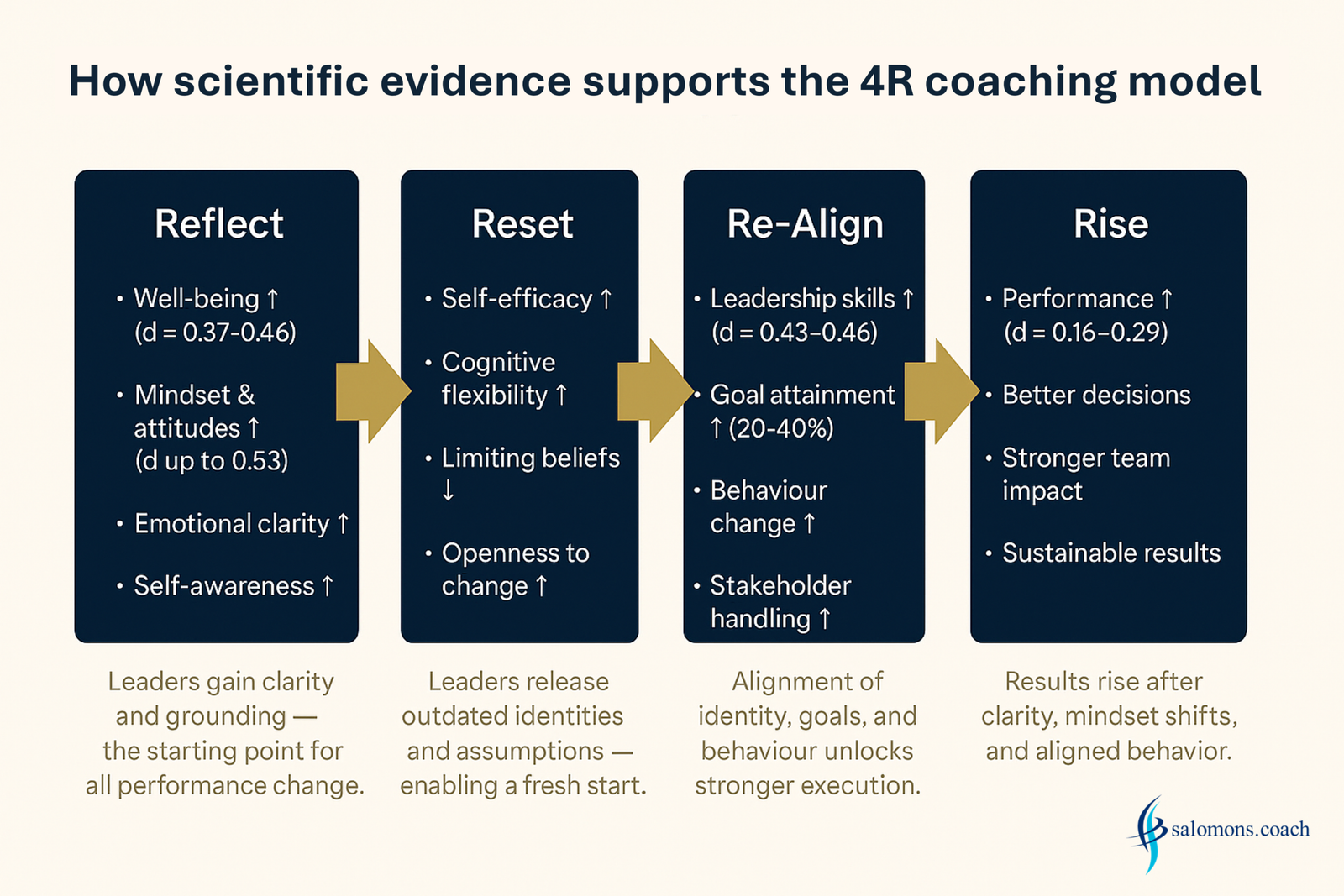
What determines whether someone recovers well or gets stuck is the amount of time they have to move through the inner journey: Reflect > Reset > Re-Align > Rise™
Most executive teams don’t fail because of strategy — they fail because of what they avoid. These 10 provoking questions cut through noise, expose blind spots, and accelerate real transformation. They challenge leaders to face the hard truths about their behavior, decisions, and impact. If you want to grow as a leader, start by answering these questions honestly.
Redundancy in the Netherlands is legally structured yet psychologically disruptive. Even with strong protections and the VSO process, employees experience identity loss, uncertainty and emotional turbulence. Leaders often underestimate this impact—and the effect on those who remain. Research shows that structured transition support significantly improves outcomes. The 4R Model—Reflect, Reset, Re-Align, Rise—helps individuals stabilize, rebuild identity and re-enter the labor market with clarity and confidence. Increasingly, Dutch organizations engage external coaches during the VSO period to support departing managers and sustain trust, well-being and business continuity. Redundancy is not an ending—it is an inflection point.
The Salomons.Coach Toolbox™ gives every client a structured, evidence-based set of tools to reflect deeply, act intentionally, and build lasting leadership behavior that strengthens business results.
The Wheel of Work Life is a powerful framework that reveals what truly shapes your well-being at work. By exploring eight essential dimensions — from psychological safety and leadership to autonomy, workload, recognition, growth, collaboration, and recovery — you gain a holistic view of what energizes you and what drains you. This model helps individuals and teams understand their current reality and identify the small, meaningful steps that lead to healthier, more sustainable performance.
The 4R Model—Reflect, Reset, Re-Align, Rise™—emerged from more than 35 years of leading and coaching in complex, high-pressure environments, combined with solid foundations in transition theory, emotional intelligence, identity work, and psychological safety. Supported by globally respected research (including HBR), the model provides a clear, humane framework that helps people navigate redundancy, burnout, and major career shifts. Instead of treating change as a purely logistical process, 4R guides the deeper psychological journey: understanding what’s happening internally, letting go of old identities, rebuilding direction, and rising with confidence and sustainable momentum. It turns disruption into structured growth.
Change doesn’t fail because of poor plans — it fails because people haven’t made the psychological transition. In this article, Jan Salomons explores his formula for successful change, combining shared vision, urgency, leadership, learning, and capacity. Drawing on his decades of experience and his VUCA leadership approach, he explains how leaders can guide teams through endings, transitions, and new beginnings while maintaining trust and connection. Learn why managing change isn’t enough — leading transition is what truly drives sustainable transformation.
trong emotions aren’t the enemy — they’re leadership data. In today’s volatile and uncertain world, emotions like frustration or fear often mask deeper values and unmet needs. Reframing helps leaders decode those emotions, turning tension into insight and pressure into performance. In this post, Jan Salomons explores how emotional intelligence and reframing allow leaders to stay grounded in a VUCA world — transforming reaction into reflection, and reflection into purposeful action. Learn how to work with, not against, your emotions and use them as a catalyst for self-leadership and organizational growth.
Feedback is often misunderstood as something to endure rather than embrace. Yet in my years as an executive and leadership coach, I’ve learned that growth doesn’t come from giving the perfect feedback—it comes from receiving it well. When we move beyond defensiveness and see criticism as potential coaching, feedback turns from a threat into a tool for learning. The moment we shift our mindset from “What’s wrong with me?” to “What can I learn here?”, we unlock one of the most powerful levers of leadership growth: the ability to find the coaching in criticism.