Make the Ask!
And Why Capable People Don’t Ask for Help, and How a Team Learns To
The fastest way to lighten a heavy load is to ask someone for help. It’s also the move the most capable people on a team will do almost anything to avoid. Here’s how I run a workshop that turns asking from a private admission into a shared, practised skill.
The problem in the room
The teams I’m brought in to work with are usually full of self-reliant people. They’re the ones who figure it out, who stay late, who quietly fix the thing rather than flag it. They’re proud of that, and they should be, it’s why they’re trusted with hard work.
But self-reliance has a hidden setting that’s easy to leave switched on too long: handle it alone. A problem lands, and the reflex is to absorb it, not to surface it. Redo the work rather than ask why it came back wrong. Carry the extra scope rather than say it doesn’t fit. For people who’ve built an identity around being capable, asking for help can feel like quietly conceding that they aren’t, so they don’t, and the load compounds where no one can see it.
This is the cruel twist I see in nearly every high-performing team. The single move that would relieve the pressure fastest, asking someone for help, is the exact move that capable people treat as a last resort, if they reach for it at all. And because everyone is doing the same thing, the silence becomes the norm. Nobody asks, so nobody asks, so the person drowning quietly assumes they’re the only one struggling.
The first job of a good workshop is to break that silence safely, to make asking visible, normal, and low-cost, before the load forces the issue.
What stress actually is
It’s worth being precise about what we’re managing, because “stress” is used to mean too many things at once.
The definition I find most useful comes from the appraisal model of Lazarus and Folkman: stress isn’t the event itself, but the gap between what’s being demanded of you and the resources you feel you have to meet it. Same workload, two people, different stress, because the perceived gap differs. The pressure lives in that gap, not in the inbox.
What I like about this definition is that it points straight at the levers. If stress is a gap, then stress management is gap-closing, and there are only a few honest ways to do it: reduce the demand, expand your resources, or change how you read the situation. Everything we call coping is one of those moves.
And here’s why asking matters so much: other people are a resource. Asking for help is one of the quickest, most direct ways to expand the resource side of the equation, to close the gap from the side most people never touch. It’s strange, when you put it like that, that it’s the move we resist hardest. Most of us will happily work longer hours (a slow, expensive fix) before we’ll send a two-line message asking a colleague for ten minutes (a fast, cheap one).
The stress profile: a mirror, not a diagnosis
Before the workshop, everyone completes a short stress profile questionnaire. It maps how each person currently carries pressure across nine dimensions, among them mindset, load, recovery, boundaries, and the one this post is about: reaching out, the instinct to handle things alone versus to bring others in.
I’m deliberate about framing the results as a mirror, not a diagnosis. The profile doesn’t grade anyone. It reflects, in their own answers, which coping moves they reach for by default and where their gap currently sits. The distinction is everything: a verdict makes capable people defensive; a mirror makes them curious.
And the pattern that comes back is remarkably consistent. Strong teams score high on active coping and a robust mindset, they attack problems and they read pressure as a challenge. And the dimension that sits lowest, again and again, is reaching out. These are people who are superb at doing and quietly allergic to asking. Seeing that pattern named on a single page, for the whole room at once, is usually the moment it stops being a personal quirk and starts being something the team can work on together.
Coping has families, and one stays quiet
Coping isn’t a single thing. Drawing on Carver’s research, it sorts into recognisable families: tackling the problem directly, reframing it, drawing on social support, avoidance, recovery, and protecting boundaries. Healthy people use a range and match the move to the moment. Trouble shows up when someone leans on one or two and lets the rest fall silent.
For capable teams, the family that goes quiet first is social support, and at its core, that means asking. It goes quiet for an understandable reason: asking carries a story. If I were good enough, I wouldn’t need to. That story is almost always wrong, and almost always expensive. Asking well is not a character trait you either have or don’t. It’s a coping skill, and like any skill it gets easier with reps.
That’s exactly what we give it in an exercise I call Make the Ask.
The Make the Ask exercise
Here’s the insight the exercise is built on. When I tell a team the answer is to “lean on each other more,” people often nod and then do nothing, because in a modern organisation they’re scattered, different projects, different stakeholders, rarely working side by side. It can feel like there’s no “together” available.
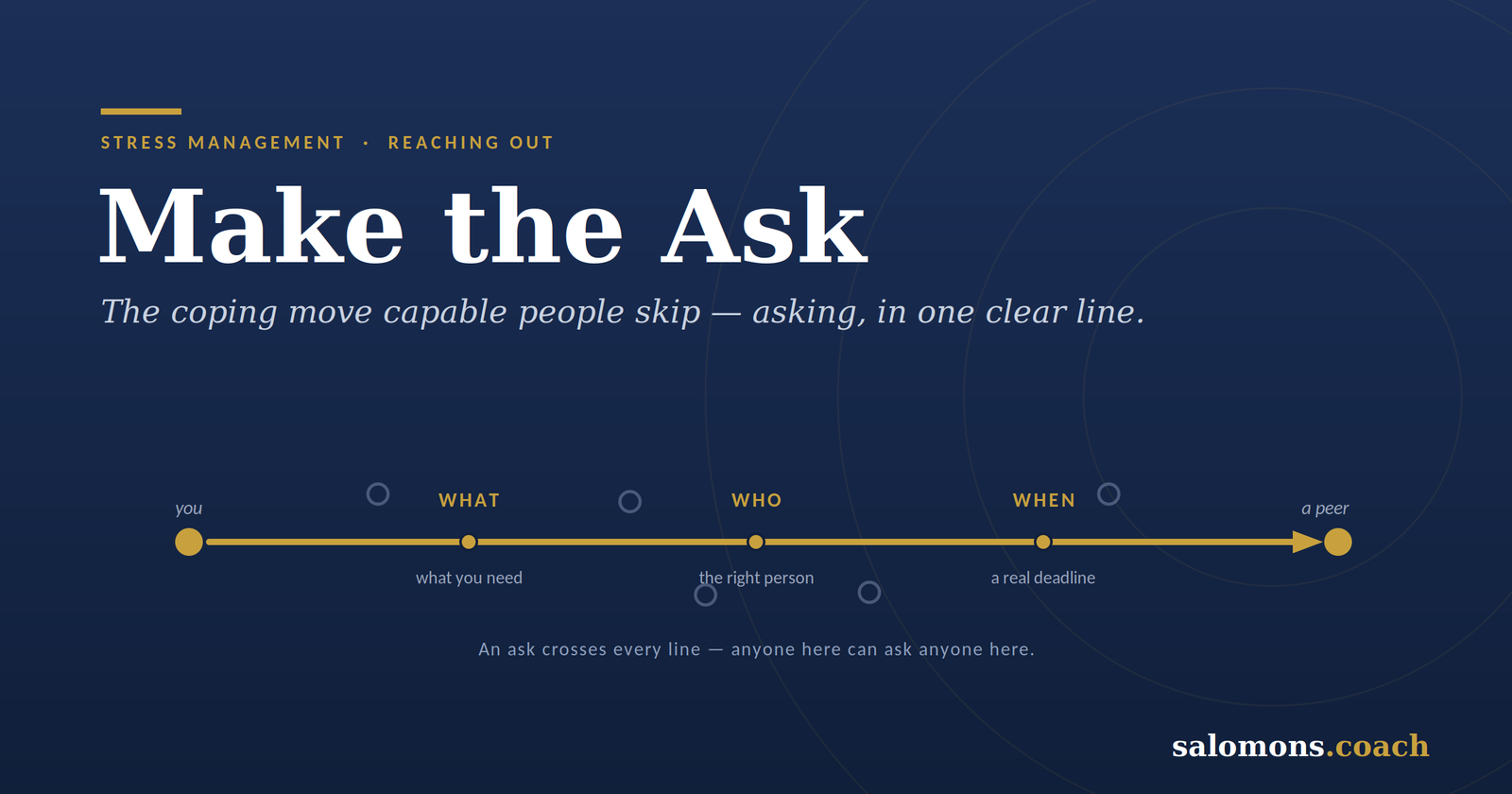
But asking is the one move that doesn’t depend on sitting together. A boundary is yours to hold alone, in your own context. An ask, by contrast, crosses every line. Anyone in the room can ask anyone else, regardless of which project they sit in, and crucially, the people in that room are often each other’s only true role-peers. Their day-to-day colleagues do a different job; the only people who really understand this work are the ones beside them in the workshop. That makes the room itself an asking network. The exercise is simply practice at using it.
It runs in about half an hour.
First, lower the cost out loud. I name the obvious truth: most of the cost of asking is in your own head, not in the other person’s reaction. The way to shrink it is to ask in front of peers until it stops feeling like a confession.
Then everyone finds a real ask, one current thing they could genuinely use help with but haven’t asked for. A decision they’re stuck on, work they keep redoing, a load they’re quietly carrying. Then they sharpen it to a single sentence:
I need [what], from [who], by [when].
The one-sentence discipline matters. Vague asks are hard to answer, which is a large part of why they never get made.
Then they work it in threes, rotating through three roles for a few minutes each:
- The Asker says their one-sentence ask out loud, adds just one line of context, no more, and notices any urge to apologise or over-explain.
- The Helper responds for real: offers something concrete, asks one clarifying question, or says honestly what they can and can’t do.
- The Witness watches for two things, did the ask stay specific? and did the Asker apologise, minimise, or over-justify?, and feeds it back kindly in thirty seconds.
That over-explaining is the tell. It’s the sound of someone who believes asking has to be earned. Naming it gently, in a safe room, is where the shift happens.
We close by harvesting what made an ask easy to respond to. The patterns come from the room itself: it’s specific, it names a person, it gives a real deadline, it drops the apology, and, counter-intuitively, it makes it easy to say no. “No pressure if you can’t” is the move that lowers the cost most, because it makes the ask cheap to make and cheap to decline. Hearing each other’s asks does something else, too: it quietly calibrates a shared sense of what’s normal to ask for. Then each person commits to one real ask they’ll actually make that week.
The line I want people to leave with is this: a good ask makes it easy to say yes, and easy to say no. Asking isn’t an admission that you’re not coping. It’s one of the most efficient coping moves there is, and the room becomes both the standard for it and the quiet accountability that keeps it alive.
(Asking is one half of a pair. The other, protecting your line, and saying no well, is its natural companion, and I’ve written about that separately.)
Bring it to your team
Make the Ask is one exercise in a half-day workshop built for the kind of team I described at the start: capable, self-reliant, and far better at carrying load than at sharing it.
In three to four hours with your team, we:
- map your collective stress profile across the nine dimensions, so the real pattern is visible and shared
- locate the one or two coping moves that would give your team the most leverage, usually asking and boundaries
- run live, practical exercises like Make the Ask, so people leave having actually done the thing, not just agreed it’s a good idea
- set the small norms that keep asking alive after the room empties
It’s practical, evidence-based, and shaped around your team’s real friction, not a generic stress talk. People leave with something they can use the same week.
If your team is strong, busy, and quietly carrying more alone than it needs to, let’s talk about running this session. Book a free call or get in touch, and we’ll shape a workshop around what your team actually needs.

You may also like


ADHD Leadership Videos