Beyond Hofstede: A Unified Framework for Cross-Cultural Executive Leadership
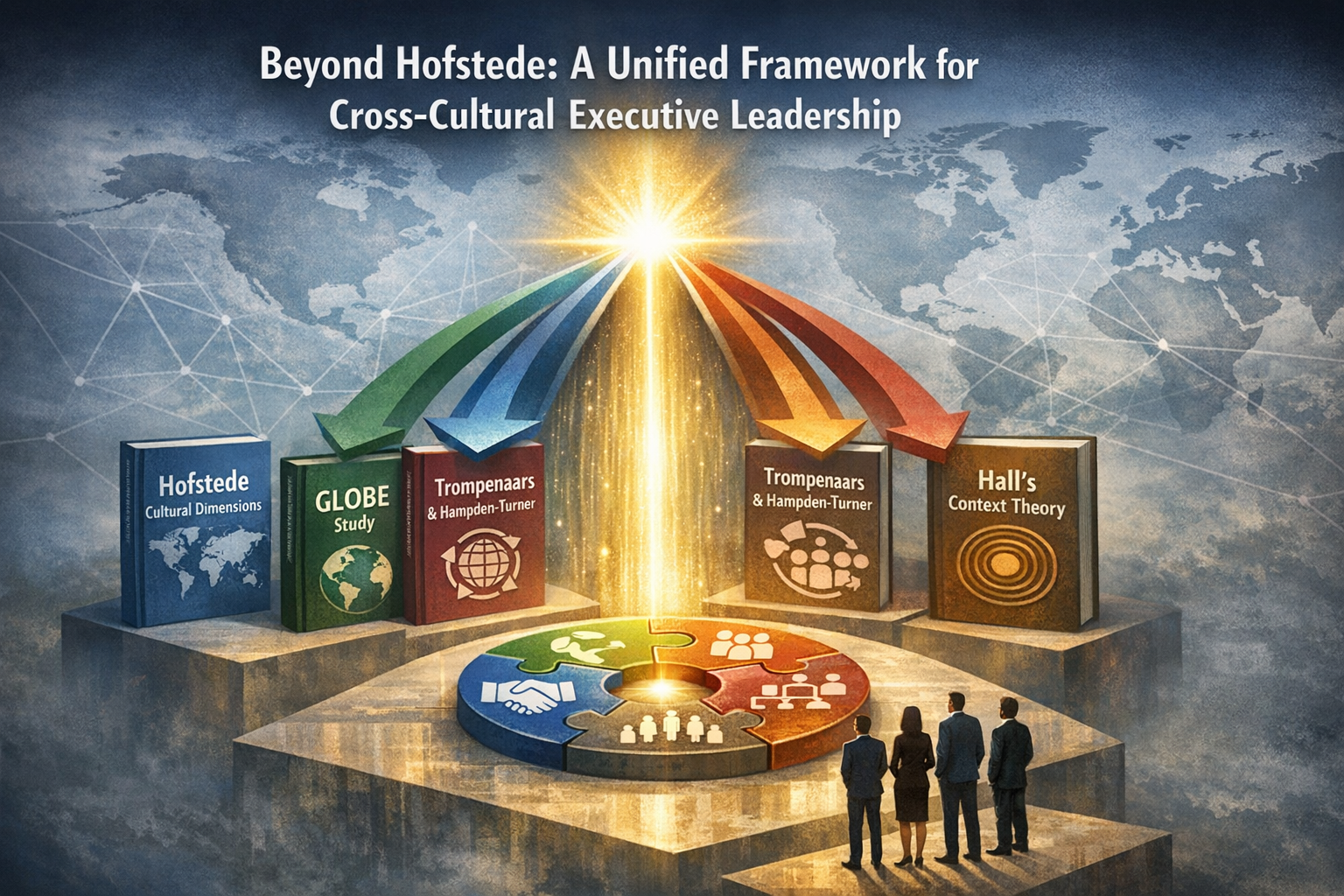
In the previous article in this series, we built a practical playbook from Hofstede’s six cultural dimensions. That playbook is robust. It is also, by itself, incomplete. Hofstede gave us the most widely cited framework in cross-cultural management, but he is not alone in the field, and the most rigorous executive approach is not built on a single map. It is built on the convergence of several maps, each drawn from different coordinates, each illuminating terrain the others leave in shadow.
This article places Hofstede alongside three other major evidence-based frameworks: the GLOBE study, Trompenaars and Hampden-Turner’s Seven Dimensions and Edward Hall’s context theory. We will examine what each brings to the table, identifies where they converge, and translates that convergence into a set of executive management principles with a stronger evidential foundation than any single framework can provide on its own.
The argument is straightforward: when four independent research programmes — conducted across different decades, different methodologies, and different country samples — arrive at the same conclusions about what drives human behaviour in organisations across cultures, those conclusions deserve to be treated as management imperatives, not merely interesting hypotheses.
“Leadership effectiveness is not universal. It is contextual. It is embedded in the societal and organisational norms, values, and beliefs of the people being led.” — Robert J. House, Principal Investigator, GLOBE Study
The Four Frameworks
Framework 1: Hofstede’s Cultural Dimensions (1980–2010)
Geert Hofstede · IBM dataset · 50+ countries · 6 dimensions
The foundation. Geert Hofstede derived his original four dimensions from a dataset of more than 116,000 questionnaires completed by IBM employees across more than 50 countries between 1967 and 1973. The elegance of using a single multinational employer was that it controlled for organisational culture, isolating national cultural variance. Two further dimensions — Long-Term Orientation and Indulgence — were added in subsequent decades through collaborations with Michael Bond and Michael Minkov respectively.
Hofstede’s primary contribution is a values-based model: it maps what people believe and desire — their mental programming — rather than what they actually do. This gives it predictive power across a wide range of organisational behaviours but also its principal limitation: values are slow to change, and the original data is now more than fifty years old.
Dimensions: Power Distance · Individualism · Masculinity · Uncertainty Avoidance · Long-Term Orientation · Indulgence
Framework 2: The GLOBE Study (2004–2014)
House, Hanges, Javidan, Dorfman & Gupta · 160+ researchers · 62 societies · 17,000+ managers
The GLOBE (Global Leadership and Organizational Behavior Effectiveness) study, launched by Robert House in 1991 and published in its seminal form in 2004, is the most ambitious cross-cultural leadership research programme ever conducted. A team of 160 scholars studied societal culture, organisational culture, and attributes of effective leadership in 62 cultures, surveying over 17,000 middle managers in banking, food processing, and telecommunications.
GLOBE’s critical innovation over Hofstede is its explicit connection between cultural dimensions and leadership effectiveness. Where Hofstede maps values, GLOBE maps what those values mean for what constitutes a good leader. GLOBE also distinguished between cultural values (what societies say they want) and cultural practices (what they actually do) — a distinction with profound implications for change management.
Its most important finding for executives: across all 61 countries studied, people want their leaders to be trustworthy, just, honest, and decisive. However, how these traits are expressed may still noticeably differ from society to society.
Dimensions: Performance Orientation · Assertiveness · Future Orientation · Humane Orientation · Institutional Collectivism · In-Group Collectivism · Gender Egalitarianism · Power Distance · Uncertainty Avoidance
Framework 3: Trompenaars & Hampden-Turner’s Seven Dimensions (1997)
Fons Trompenaars & Charles Hampden-Turner · 46,000+ managers · 40 countries · 7 dimensions
Published in their 1998 book Riding the Waves of Culture, following ten years of research and surveys of more than 46,000 managers. Trompenaars and Hampden-Turner’s distinctive contribution is their dilemma-based methodology. Rather than asking what people value in the abstract, they presented managers with concrete ethical and organisational dilemmas and observed how cultural background shaped their choices.
This produced a framework with sharper practical texture than Hofstede’s value surveys — and surfaced cultural dimensions Hofstede had not explicitly identified, particularly Specific/Diffuse (the boundary between personal and professional life) and Neutral/Affective (emotional expression in professional settings).
Dimensions: Universalism vs. Particularism · Individualism vs. Communitarianism · Specific vs. Diffuse · Neutral vs. Affective · Achievement vs. Ascription · Sequential vs. Synchronic Time · Internal vs. External Direction
Framework 4: Edward Hall’s Context Theory (1976)
Edward T. Hall · Anthropological fieldwork · High-context vs. Low-context communication
The oldest framework in this set, and in some ways the most immediately actionable. Developed through decades of fieldwork and published in Beyond Culture (1976). In high-context cultures (Japan, China, the Arab world, much of Latin America), meaning is embedded in context: in the relationship, the setting, the tone, what is not said. In low-context cultures (Germany, Scandinavia, the USA, the Netherlands), meaning is carried by the explicit content of words. What is said is what is meant.
Hall also contributed the distinction between monochronic time (one task at a time, schedules are commitments, punctuality is a moral value) and polychronic time (multiple tasks in parallel, schedules are approximate, relationships take precedence over agendas).
Concepts: High-Context Communication · Low-Context Communication · Monochronic Time · Polychronic Time
The combined evidence base: 4 independent research programmes spanning five decades · 80+ countries and societies · 100,000+ managers and employees surveyed across the three quantitative studies
Where the Frameworks Converge
When four independent research programmes using different methodologies, different country samples, and different theoretical starting points arrive at the same conclusions, those conclusions have a claim to be treated as something stronger than interesting insights. Six themes emerge with consistent support across all frameworks.
1 — Authority is never neutral. Every framework identifies power and authority as a core cultural variable. What constitutes legitimate authority — whether it derives from title, expertise, seniority, or performance — varies fundamentally across cultures and directly determines what leadership style will succeed or fail.
2 — Identity shapes everything. Whether people see themselves primarily as individuals or as group members is the deepest organising principle of organisational behaviour. It shapes accountability, recognition, conflict, communication, loyalty, and trust. No management intervention works the same way across both orientations.
3 — Communication is culturally encoded. What is said is never all that is communicated. Every framework demonstrates that the meaning of a message is always partly located in its cultural context. Leaders who hear only the words regularly misread the meaning.
4 — Time is a value, not a fact. All four frameworks address time orientation. Whether time is a sequence of discrete committed slots or a fluid resource to be allocated in parallel is not a scheduling preference — it is a moral framework that determines how seriousness, respect, and reliability are signalled.
5 — Rules and relationships compete. Every framework surfaces the fundamental tension between universalist rule-application and particularist relationship-deference. This tension lives in every hiring decision, every disciplinary process, and every contract negotiation across cultural boundaries.
6 — Leadership effectiveness is not portable. The single most consistent finding across all four frameworks: what makes a leader effective in one cultural context does not automatically translate to another. The executive who succeeds in New York may confuse or demoralise in Shanghai using exactly the same behaviours that made them successful at home.
“More than 90% of the organisational behaviour literature reflects US-based research and theory. Hopefully GLOBE will be able to liberate organisational behaviour from its US hegemony.” — Robert J. House, GLOBE Principal Investigator, 2004
Seven Executive Management Principles from the Convergence
These principles are drawn from the ground where all four frameworks overlap — supported by multiple independent lines of evidence.
Principle 1: Diagnose authority before you lead
Every decision you make about how to communicate, where to hold decision authority, and how to give feedback is filtered through your team’s orientation toward power. Get this wrong and no amount of strategic clarity will compensate. Use Hofstede’s PDI and GLOBE’s Power Distance for the macro calibration; Trompenaars’ Achievement vs. Ascription dimension tells you whether status is earned through performance or assigned through seniority — a distinction Hofstede does not cleanly separate. In practice: map the authority landscape before your first significant decision. Use it to determine how transparent to be about your own role, how visible to make your decision-making process, and where to position yourself in relation to formal organisational rank.
Evidence base: Hofstede PDI · GLOBE Power Distance · Trompenaars Achievement/Ascription · Hall High/Low Context
Principle 2: Design accountability for the group, not just the individual
The assumption that individuals should be held personally accountable for defined outcomes is a culturally specific norm, most firmly embedded in Anglo-Saxon and Germanic traditions. In collectivist cultures, embed individual accountability within a group framework: group-level targets alongside individual ones, recognition that acknowledges the team before the individual, and performance conversations that locate individual contribution within the collective story. The practical rule: in collectivist cultures, praise publicly at the group level and recognise individual contributions in private.
Evidence base: Hofstede IDV · GLOBE Institutional & In-Group Collectivism · Trompenaars Individualism/Communitarianism
Principle 3: Read the communication channel, not just the message
In high-context cultures — Japan, China, South Korea, the Arab world, much of Southern Europe and Latin America — a significant proportion of meaning is carried by context: the relationship history, the setting, the tone, what was not said. ‘Yes’ may mean ‘I heard you.’ Silence may mean disagreement. The executive principle: in high-context cultures, invest in relationship infrastructure before expecting clear communication. Build the relationship network that makes implicit communication decipherable. In low-context cultures, be explicit, written, and precise — the relationship does not fill in gaps the way it does elsewhere.
Evidence base: Hall High/Low Context · Trompenaars Neutral/Affective · Trompenaars Specific/Diffuse
Principle 4: Match your time horizon to your counterpart’s
All four frameworks converge completely on the time dimension. Hofstede’s Long-Term Orientation, GLOBE’s Future Orientation, Trompenaars’ Sequential/Synchronic dimension, and Hall’s monochronic/polychronic distinction all point to the same reality: time is a moral framework that encodes what you value and how serious you are. When working with long-term-oriented cultures, the relationship-building phase before a deal is not a social formality — it is due diligence. In mixed-orientation teams, make time norms explicit. Do not assume shared understanding of what a deadline means or whether ‘by end of week’ is a commitment or an aspiration.
Evidence base: Hofstede LTO · GLOBE Future Orientation · Trompenaars Sequential/Synchronic · Hall Monochronic/Polychronic
Principle 5: Know whether you are in a rule culture or a relationship culture
In universalist cultures — most of Northern and Western Europe, North America, Australia — the rule applies equally to everyone, the contract is the primary commitment, and applying different standards based on personal relationships is experienced as corruption. In particularist cultures — most of Asia, Latin America, much of Africa and the Middle East — the relationship is the primary commitment, and rigidly applying the same rule to a close partner and a stranger is experienced as cold and disloyal. This distinction lives in every international HR policy, supplier contract, whistleblowing approach, and performance management framework your organisation deploys globally. Identify which side you are on — and recognise that your default is not the universal standard.
Evidence base: Trompenaars Universalism/Particularism · Hofstede IDV, UAI · GLOBE Institutional Collectivism
Principle 6: Build culturally differentiated leadership, not a single global style
GLOBE’s most direct contribution: culturally contingent leader characteristics — ambitious, enthusiastic, formal, logical — are valued differently around the world. GLOBE identified six global leadership styles and demonstrated that their relative effectiveness varies significantly across cultural clusters. The Participative style is strongly preferred in Anglo, Nordic, and Germanic clusters and actively counterproductive in some Middle Eastern and Confucian Asian contexts. The implication is not that you must become a different person in different contexts — it is that you must develop a repertoire of styles and the diagnostic ability to know which to deploy.
Evidence base: GLOBE CLT Leadership Profiles · Hofstede PDI, IDV, MAS · Trompenaars Achievement/Ascription · Hall Context
Principle 7: Invest in cultural self-awareness as a discipline, not a training exercise
The hardest, most consistent finding across all four frameworks: your management style is a cultural artefact. The directness you consider professional, the work ethic you value, the decision-making speed you were rewarded for, the emotional register you were expected to inhabit — these are not universal virtues. They are the culturally specific products of the society and organisations that formed you. Cultural self-awareness is an ongoing leadership discipline: the practice of noticing when a response that feels natural to you might land as strange, wrong, or offensive to someone with a different cultural programme. The executive who builds this discipline gains access to the full talent and trust of diverse teams.
Evidence base: All four frameworks · GLOBE CLT · Trompenaars Dilemma Theory · Hall Beyond Culture · Hofstede Software of the Mind
A Critical Caveat
Four robust frameworks and a synthesis of their convergence still leave a significant margin for judgment. All four frameworks describe cultural tendencies at the national or regional level. None of them describe individuals.
The fundamental error to avoid: using any of these frameworks to predict how a specific individual will behave. Cultural frameworks are calibration tools for entering new contexts and diagnosing patterns when interactions repeatedly misfire. They are not character assessments, and they should never be used as such. The executive who says ‘I know how Chinese people think’ has not understood these frameworks — they have misused them.
What these frameworks do uniquely well is reduce the cost of the most common error in cross-cultural management: the assumption that your own cultural defaults are simply the correct way to do things. When Hofstede, GLOBE, Trompenaars, and Hall all point in the same direction, that pointing deserves serious attention. The practical starting point is not mastery — it is curiosity. The willingness to ask: what am I assuming here that my counterpart may not share? That question, applied consistently, is worth more than any framework score.
“The biggest barrier to cross-cultural effectiveness is not ignorance of other cultures. It is the unexamined assumption that your own culture is normal, and everyone else’s is the variation.” — Jan Salomons, Salomons.Coach
Further Reading
For the executive who wants to go deeper, the most practical entry points are Hofstede’s Cultures and Organizations: Software of the Mind (3rd edition, 2010), Trompenaars and Hampden-Turner’s Riding the Waves of Culture (3rd edition, 2012), the GLOBE summary by Michael Hoppe available through the CCL, and Hall’s Beyond Culture (1976). Erin Meyer’s The Culture Map (2014) provides an excellent practitioner-facing synthesis that complements all four frameworks and is particularly readable for time-pressed executives.
This is the second article in the cross-cultural leadership series on Salomons.Coach. The first — Managing Across Cultures: The Hofstede Playbook for Executives — covers all six Hofstede dimensions with specific management guidelines and is available alongside the interactive Cultural Alignment Scanner at salomons.coach.
Put this insight to work
Reading about cultural dimensions is one thing. Seeing them side by side — your country against your counterpart’s, across all six Hofstede dimensions at once — is where the real management value begins.
The Cross-Cultural Leadership Compass is a free executive tool built on the data behind this article. Select any two countries, and it maps the full Hofstede profile comparison, scores each dimension gap, and gives you specific management guidance for where the friction is highest. No registration required to explore — and if you want to save and share your results, a quick email unlock gives you download access too.
Use it before your next international negotiation, cross-border team meeting, or market entry brief.

You may also like

The Leadership Iceberg

Power Deafens: Here is How to Avoid it