Psychological Safety Is Not What Most Leaders Think It Is
And that confusion is costing you more than you realize. This post is based on the HBR article (2025) by Amy Edmondson and Michaela Kerrissey.
In a world where the margin for error is shrinking and the pace of change is not, the quality of your team’s conversations is one of the few genuine competitive advantages you can build. Psychological safety, when properly understood, is the foundation of those conversations. But most leaders are building on a definition that is subtly but significantly wrong. And that gap, small as it may seem, compounds over time into the kind of organizational dysfunction that is very hard to trace back to its source.
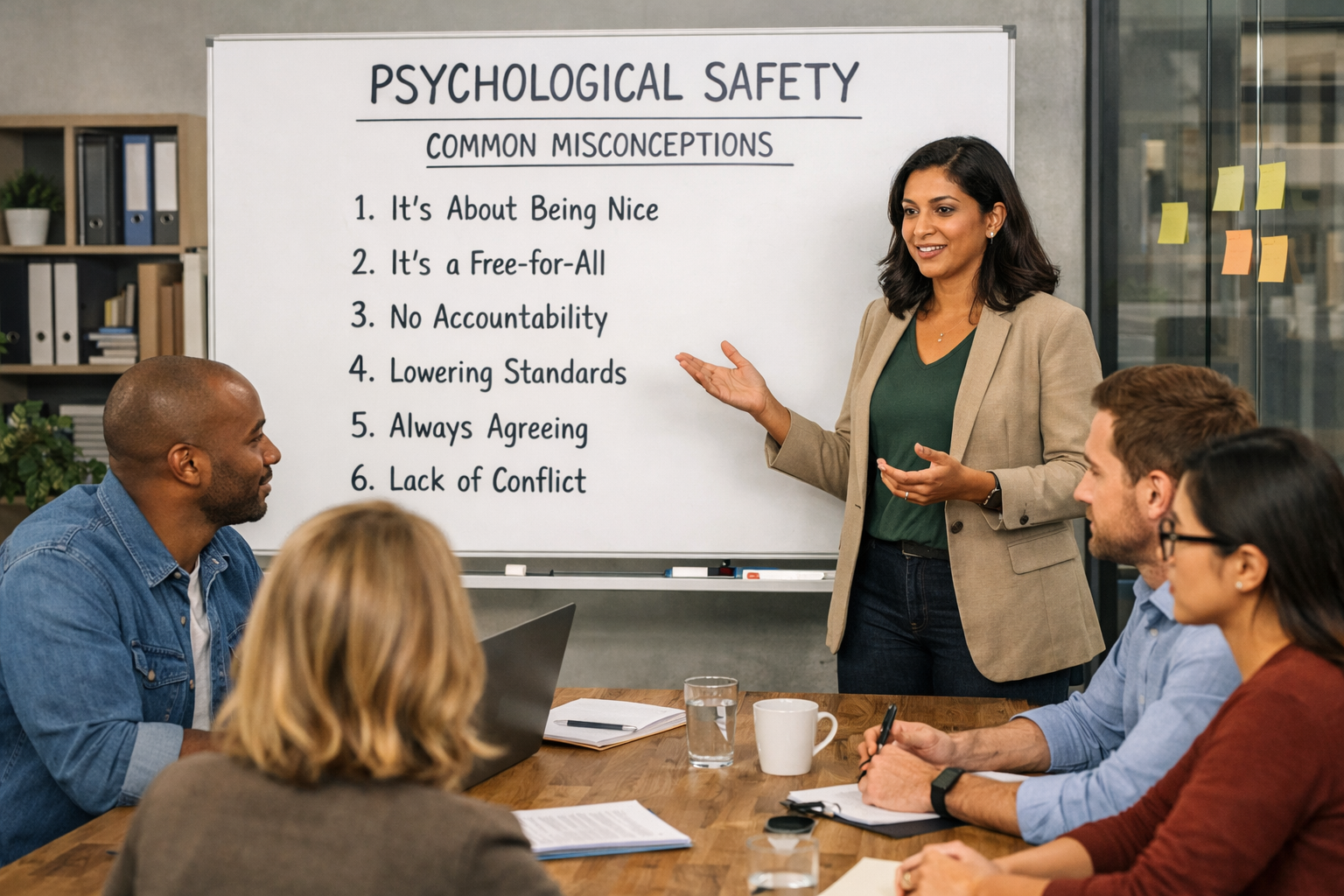
Almost every week I sit across from leaders who are doing their best in conditions that don’t make it easy. They’re balancing pressure with care, accountability with trust, strategy with the daily reality of managing people. Psychological safety is often on their list, because it is something they believe in, something they’re actively trying to build. And yet, consistently, I notice a gap between what they think it means and what it actually requires. Hence it needs maybe also your attention, understanding these 6 misconceptions can be crucial for you and your team.
Psychological safety has become one of those leadership concepts that everyone nods at and almost no one correctly understands. Amy Edmondson and Michaela Kerrissey’s recent HBR article puts this into sharp relief, identifying six stubborn misconceptions that derail even the most motivated leaders. I want to take their framework and push it further, because in my experience, the real problem isn’t just misunderstanding a concept. It’s that the misunderstandings are comfortable, and comfort is the enemy of learning.
Misconception 1: It means being nice
Let me be direct on this one: niceness is often the enemy of psychological safety, not its expression.
I’ve seen teams that were extraordinarily polite. They have smooth meetings, no visible conflict, everyone nodding, etc. At the same time they also feel deeply unsafe. What kept people quiet wasn’t aggression. It was warmth. A culture so focused on not hurting feelings that no one could afford to tell the truth.
Edmondson and Kerrissey draw a sharp distinction that I use constantly in coaching: nice is the easy way out of a hard conversation. Kind is being honest, even when it’s uncomfortable. Psychological safety doesn’t mean protecting people from difficult truths. It means creating conditions where difficult truths can be spoken without social punishment.
As a coach, when I see leaders confuse niceness with safety, I ask them one question: In the last month, what hard thing did someone on your team say to you,… and did you thank them for it? The silence that follows is usually answer enough.
Misconception 2: It means getting your way
This is where psychological safety becomes politically weaponized inside organizations.
I’ve watched smart people invoke psychological safety the moment a decision goes against them. “I don’t feel safe to disagree” becomes code for “I want my idea to win.” And once that dynamic takes hold, the concept is finished, it collapses into a tool of influence rather than a condition for learning.
Here’s the systemic reality: leaders don’t owe agreement. They owe genuine consideration. There’s a world of difference between a team where input is heard and weighted, and a team where every voice has veto power. The former drives performance. The latter drives paralysis.
Psychological safety is permission for candor, not a guarantee of consensus.
Misconception 3: It means job security
This one surfaces most painfully in reorganizations — and I’ve coached enough leaders through restructurings to know how destructive this confusion can be.
People conflate psychological safety with employment protection. They feel betrayed when layoffs follow what they experienced as a safe culture. But these are categorically different things. You can be candid, courageous, and honest in an organization that subsequently needs to reduce its headcount. In fact, the most genuinely psychologically safe teams I’ve seen are often the ones that can have honest conversations about organizational realities, including difficult ones.
The confusion here is a category error. Safety to speak is not safety from consequence. Conflating them doesn’t protect people — it leaves them unprepared.
Misconception 4: It requires a trade-off with performance
Of all six misconceptions, this is the one that most reveals a shallow understanding of how organizations actually work.
The belief that psychological safety softens accountability, that you have to choose between candor and standards, is empirically wrong and organizationally damaging. Edmondson and Kerrissey are unambiguous: these are distinct dimensions, not opposite poles. The real failure mode isn’t high safety with low standards. It’s low safety and low standards, the combination that produces groupthink, hidden errors, and eventual catastrophe.
Think about the Bay of Pigs. Kennedy’s advisors had concerns. No one spoke. The result was a foreign policy disaster. The Cuban Missile Crisis, handled differently, with structured candor and rigorous debate, produced a very different outcome. The difference wasn’t intelligence or intent. It was the conditions under which truth could be spoken.
In VUCA environments – volatile, uncertain, complex, ambiguous – this is not a nice-to-have. It is the competitive requirement. Organizations that cannot surface bad news early enough to course-correct don’t get second chances. I see this in every sector I work with.
Misconception 5: It’s a policy
Legislation mandating psychological safety is, at best, a category error and, at worst, actively counterproductive.
Telling people they must feel safe, or that organizations will be penalized if they don’t, confuses the measurement with the condition. You cannot compliance-train your way to candor. You can, however, signal very clearly that leadership doesn’t understand what it’s asking for.
Psychological safety is an emergent property of a team’s behavioral norms. It shows up – or doesn’t – in thousands of small moments: how a leader reacts when someone challenges them in a meeting, whether questions are welcomed or deflected, whether mistakes become learning or become liability. No HR policy changes any of those moments.
This is why it must be led, not administered.
Misconception 6: It requires a top-down approach
Here’s where I push back – gently – on a nuance in the HBR framing.
Yes, senior leaders set tone. Their posture of humility and curiosity matters enormously. But I’ve built genuinely psychologically safe team climates inside organizations whose senior leadership was, frankly, not helping. And I’ve seen psychologically safe cultures dismantled by a single new leader who didn’t understand what they’d walked into.
Psychological safety is local before it is organizational. It lives in the team. It is built through repeated small interactions, a question asked generously, a failure discussed openly, a challenge met with curiosity rather than defensiveness. Anyone on a team can influence this. Any leader of a team can build it, regardless of what’s happening two levels above.
This is actually empowering news for the leaders I work with. You don’t have to wait for permission from the top. You have far more influence over your team’s learning climate than you think.
What this means in practice
The research is clear. The misunderstandings are common. The gap between them is where most leadership development work needs to happen.
In my coaching practice, I use four questions to help leaders calibrate where they actually stand:
Reflect: What signals does your behavior send when someone raises a concern you don’t want to hear?
Reset: Where have you confused niceness with safety, and what did that cost?
Re-Align: Are your standards and your safety working together, or are you unconsciously sacrificing one for the other?
Rise: What’s one structural practice you can put in place this month to make candor the expected norm in stead of the exceptional act?
Psychological safety, properly understood, is not soft. It is rigorous. It requires courage – from leaders first, and from teams second.
The organizations that get this right don’t just feel better to work in. They perform better, adapt faster, and recover from failure more effectively. In an uncertain world, that is not a minor advantage.
That’s worth getting right.
Download the short Field Guide
Want to put this into practice? Download the free Psychological Safety Field Guide – six misconceptions, with concrete strategies to prevent and recover from each.

You may also like
Five Steps to Take Immediate Control of a Crisis
Most Leadership Teams Lack Dialogue