salomons.coachsalomons.coach
  • Home
  • About Me
  • Blog
  • Downloads
    • Cross-Cultural Leadership Compass
    • Psychological Safety Field Guide
    • Energy Awareness Journal
    • The Executive Presenting Framework
    • The Executive Ownership Reinforcement Framework
    • The Evidence Base for Coaching Effectiveness
    • The Art of Time Boxing
    • VUCA Leadership WorkBook
    • VUCA Leadership Book
  • Services
  • Testimonials
  • Session Scheduler
  • Contact
  • Change language to Nederlands
Back
  • Home
  • About Me
  • Blog
  • Downloads
    • Cross-Cultural Leadership Compass
    • Psychological Safety Field Guide
    • Energy Awareness Journal
    • The Executive Presenting Framework
    • The Executive Ownership Reinforcement Framework
    • The Evidence Base for Coaching Effectiveness
    • The Art of Time Boxing
    • VUCA Leadership WorkBook
    • VUCA Leadership Book
  • Services
  • Testimonials
  • Session Scheduler
  • Contact
  • Change language to Nederlands
  • Home
  • Blog
  • Blog
  • The one insight everyone misses: why time determines your recovery after redundancy

Blog

18 Nov

The one insight everyone misses: why time determines your recovery after redundancy

  • By salomons.coach
  • In Blog, Change & Transformation, Self & Personal Growth

When we talk about redundancy, we often focus on the emotional curve: shock, disbelief, anger, acceptance, reset. Or we talk about practical steps: updating your CV, networking, applying, rethinking your career path.

But there is one factor that is almost never discussed, and yet it shapes the entire recovery process more than anything else:

Time
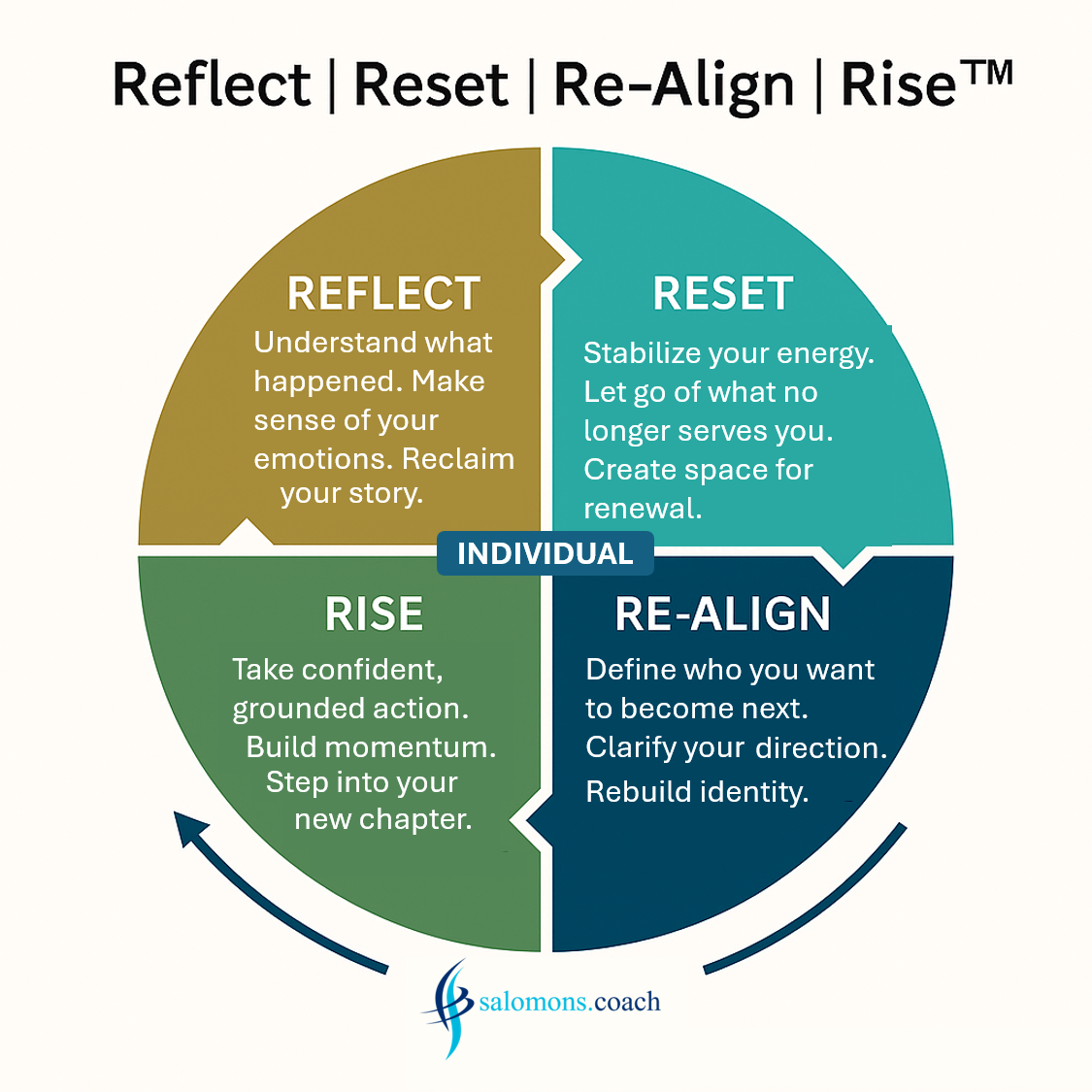
The amount of time someone has — or doesn’t have — determines how deeply they can move through the 4R phases:

Reflect → Reset → Re-Align → Rise™

And the truth is:
Not everyone gets the same amount of time.

Why time shapes the entire 4R journey

Every person’s timeline is influenced by very real, practical constraints:

  • VSO end date
  • Waiting period before social security kicks in (The Dutch WW benefit is the national unemployment insurance that provides temporary income support when you lose your job, as long as you meet the work-history and eligibility requirements)
  • Duration of WW entitlement
  • Financial responsibilities
  • Lifestyle impact
  • Family situation
  • Emotional resilience at the moment redundancy hits

Some people must move quickly — because money runs out, obligations rise, or the pressure to “bounce back” feels overwhelming. Others are fortunate enough to have breathing space, which allows them to:

  • reflect more deeply
  • truly reset
  • explore identity and values
  • experiment without panic
  • build clarity rather than scramble
  • re-enter the market with intention

But here is the deeper truth:

If the process goes too fast, the phases you “skip” will come back later — often at the worst possible moment.

A real timeline: how time shapes transformation

(Shared with permission, anonymised)

One of my coachees recently reflected on his 9-month transition. When he read my article on redundancy, he said:

“I could literally tick off all the 4R phases one by one. I saw my own journey mirrored in your model.”

His timeline looked like this:

  • Feb–May (no WW yet): emotional closure → Reflect & Reset
  • June: starting as entrepreneur → first Re-Align
  • July: family holiday → a second quiet Reflect & Reset
  • Aug: testing assignments → shift towards Rise after fine-tuning the inititial re-alignment
  • Sept–Nov: applying, lobbying, refining identity → deep Re-Align (feel the confirmation) → Big Rise

He described the experience like this:

“The energy to rebuild came back slowly. I didn’t want to rush this process. I want to make conscious choices, not fast ones.”

This clarity would not have emerged without time. And many people never get this window.

Time is not a luxury. It’s part of the healing.

Redundancy is not a career event — it’s a psychological transition. And unlike organizations, human beings don’t operate in neat timelines. We process identity loss, self-worth, fear, hope, and possibility in cycles. And cycles need time.

Leaders often underestimate this. Governments don’t factor it in. And employees feel guilty for needing it.

Redundancy is a form of rupture — and rupture requires recovery.

What happens when the process is rushed?

When people don’t get time, they often experience:

  • chronic self-doubt
  • rushed job choices
  • accepting roles below their potential
  • delayed emotional processing
  • collapse during the onboarding of their new job
  • identity confusion (“Who am I now?”)
  • burnout risk
  • regret
  • repeating the same patterns

Because the skipped phases of Reflect and Reset always show up later.

What happens when the process is paced well?

People who take time — even a little — often report:

  • renewed self-confidence
  • a clear personal narrative
  • stronger decision-making
  • a sharper understanding of their value
  • better role fit
  • healthier boundaries
  • more stable energy
  • a more meaningful career direction
  • integration instead of escape

This is why Re-Align and Rise become powerful instead of fragile.

What leaders should realise

Redundancy is legally structured but psychologically messy.
Giving people time isn’t a favor — it is the prerequisite for:

  • better outcomes
  • healthier transitions
  • reduced future absenteeism
  • better employer brand
  • more humane management practices

And often, it costs organizations nothing — except awareness.

What employees should realise

If you’ve been made redundant:

  • You are not “slow.”
  • You are not “unproductive.”
  • You are not “stuck.”
  • You are not “wasting time.”

You are recalibrating. And recalibration is work.

The 4R journey is not linear. It moves in spirals — sometimes forward, sometimes back — but always with meaning. Give yourself the time you need, even if that time feels uncomfortable.

Because time is not a delay. It is the very space where healing, clarity, and new identity are formed.

Need help with your process now or in the near future? Or you are seeking support for employees that will be made redundant? Please check in to see if my expertise can be of help.

Organizations that use the 4R model experience smoother transitions, lower costs, stronger employer branding, and healthier, more engaged employees—both those leaving and those staying.

I also wrote a fundamental article on redundancy and recovery:
When redundancy becomes a turning point: What leaders get wrong and how employees can rise stronger (context: The Netherlands)

Other posts on this subject:

  • Redundancy in the Netherlands: What Employees Need to Know
    (and Why the Process Is Not About You)
  • 4R model – Reflect, Reset, Re-Align, Rise™
  • The one insight everyone misses: why time determines your recovery after redundancy

Tags:4R modelcareerchangeemotionsrecoveryredundancyresiliencetimetransition
  • Share:
salomons.coach
Jan Salomons is an international executive leader turned leadership specialist and executive coach with over 35 years of experience across IT, transport, and semiconductors. His senior roles in HR, L&D, operations, transformation, and portfolio management—combined with work in 50+ countries—give him a rare, practical understanding of how leadership behavior drives organizational success in high-pressure environments. Jan founded Salomons.Coach to help executives and teams create visible behavioral change and measurable results. In 2024, he joined the Harvard Business Review Advisory Council. Today he partners with CEOs and executive teams who want leadership behavior to become the engine of performance and transformation.

You may also like

Hero banner with navy gradient: large white serif title 'The Authenticity Paradox' on the left, subtitle 'and the work of becoming' in italics, small gold decorative line, and the site 'salomons.coach' at the bottom left; right side features concentric gold rings and a dotted circular path with a gold center.

The Authenticity Paradox and the Work of Becoming

  • 5 July 2026
  • by salomons.coach
  • in Blog
"Just be yourself" is the worst advice a growing leader can follow. Herminia Ibarra's authenticity paradox explains why growth...
A dark blue professional hero image showing two gold curves—growth and strength—crossing, with a labeled point 'The Leap' and the headline 'Your strengths are why you're stuck,' plus the brand salomons.coach at the bottom right.
Your Strengths Are Why You’re Stuck.
27 June 2026
Blue gradient hero with a golden dotted path winding from left to right toward a compass on the right; headline reads 'You don’t plan a career switch. You explore one.'
You Don’t Plan a Career Switch. You Explore One.
27 June 2026
Infographic showing three TA ego states—Parent, Adult, Child—on the left and three leadership actions—Develop, Manage, Stay strategic—on the right, with a central 'A' node labeled Lead from Adult.
Transactional Analysis for Leaders: The Foundations, and How to Use Them
26 June 2026

Leave A Reply Cancel reply

Your email address will not be published. Required fields are marked *

This site uses Akismet to reduce spam. Learn how your comment data is processed.

Categories

  • AI (3)
  • Blog (132)
  • Books & Publications (7)
  • Change & Transformation (29)
  • Download (2)
  • Innovation & Strategy (5)
  • Learning & Development (12)
  • Organizations & Culture (32)
  • Self & Personal Growth (60)
  • Teams & Collaboration (25)
  • Tools & Methods (29)
  • Video (14)
  • VUCA & Leadership (61)
  • Web Courses & Programs (4)
  • Workshops & Events (11)

Recent Posts

Hero banner with navy gradient: large white serif title 'The Authenticity Paradox' on the left, subtitle 'and the work of becoming' in italics, small gold decorative line, and the site 'salomons.coach' at the bottom left; right side features concentric gold rings and a dotted circular path with a gold center.
The Authenticity Paradox and the Work of Becoming
05Jul,2026
Female speaker on stage delivering a TEDx talk, with a headset mic and gesturing, while a lower-third bio identifies her as a professor of organizational behaviour.
The Authenticity Paradox | Professor Herminia Ibarra 
27Jun,2026
A dark blue professional hero image showing two gold curves—growth and strength—crossing, with a labeled point 'The Leap' and the headline 'Your strengths are why you're stuck,' plus the brand salomons.coach at the bottom right.
Your Strengths Are Why You’re Stuck.
27Jun,2026

Tags

4R model (6) accountability (5) adaptability (4) authenticity (5) behavior (6) career (12) change (26) coaching (44) communication (6) cross-cultural leadership (8) culture (15) decision-making (8) dersonal-development (6) emotions (6) executive-coaching (8) executive coaching (5) focus (4) growth (6) leadership (55) leadership behavior (40) leadership coaching (8) leadership development (8) leadership growth (4) learning (9) mindset (5) psychological safety (21) recovery (4) redundancy (9) reflection (30) resilience (17) self-awareness (47) self-leadership (13) self-management (9) self-regulation (5) stress (8) team alignment (5) team coaching (5) teams (7) TED (5) tools (14) transformation (5) trust (7) VUCA (34) VUCA leadership (32) work-life balance (5)
All posts - searchable table
Recent videos
Female speaker on stage delivering a TEDx talk, with a headset mic and gesturing, while a lower-third bio identifies her as a professor of organizational behaviour.

The Authenticity Paradox | Professor Herminia Ibarra 

In 27 June 2026
No Comment
Brooks – Harvard – on Happiness

Happiness as a Leadership Strategy

L360 youyrownjourney landing page L360

Find your true purpose

NeuroPlasticity aquare

How the Brain Changes Itself – Learning is Forever!

GET IN TOUCH

Salomons.Coach
KvK: 72129131
+31 6 53 89 75 67

jan@salomons.coach

The Netherlands

USEFUL LINKS

  • About
  • Privacy policy
  • Term & Conditions
  • Refund & Returns
  • Payment policy
  • Digital Policy
  • Methodology & Sources

LinkedIn

  • Linkedin
Receive blog updates

salomons.coach by J.K. Salomons Holding B.V., 2018-2026

  • Home
  • About Me
  • Blog
  • Downloads
    • Cross-Cultural Leadership Compass
    • Psychological Safety Field Guide
    • Energy Awareness Journal
    • The Executive Presenting Framework
    • The Executive Ownership Reinforcement Framework
    • The Evidence Base for Coaching Effectiveness
    • The Art of Time Boxing
    • VUCA Leadership WorkBook
    • VUCA Leadership Book
  • Services
  • Testimonials
  • Session Scheduler
  • Contact
  • Change language to Nederlands
Change language to Nederlands