Your Personal Stress Coping Profile: Turning Pressure Into Insight
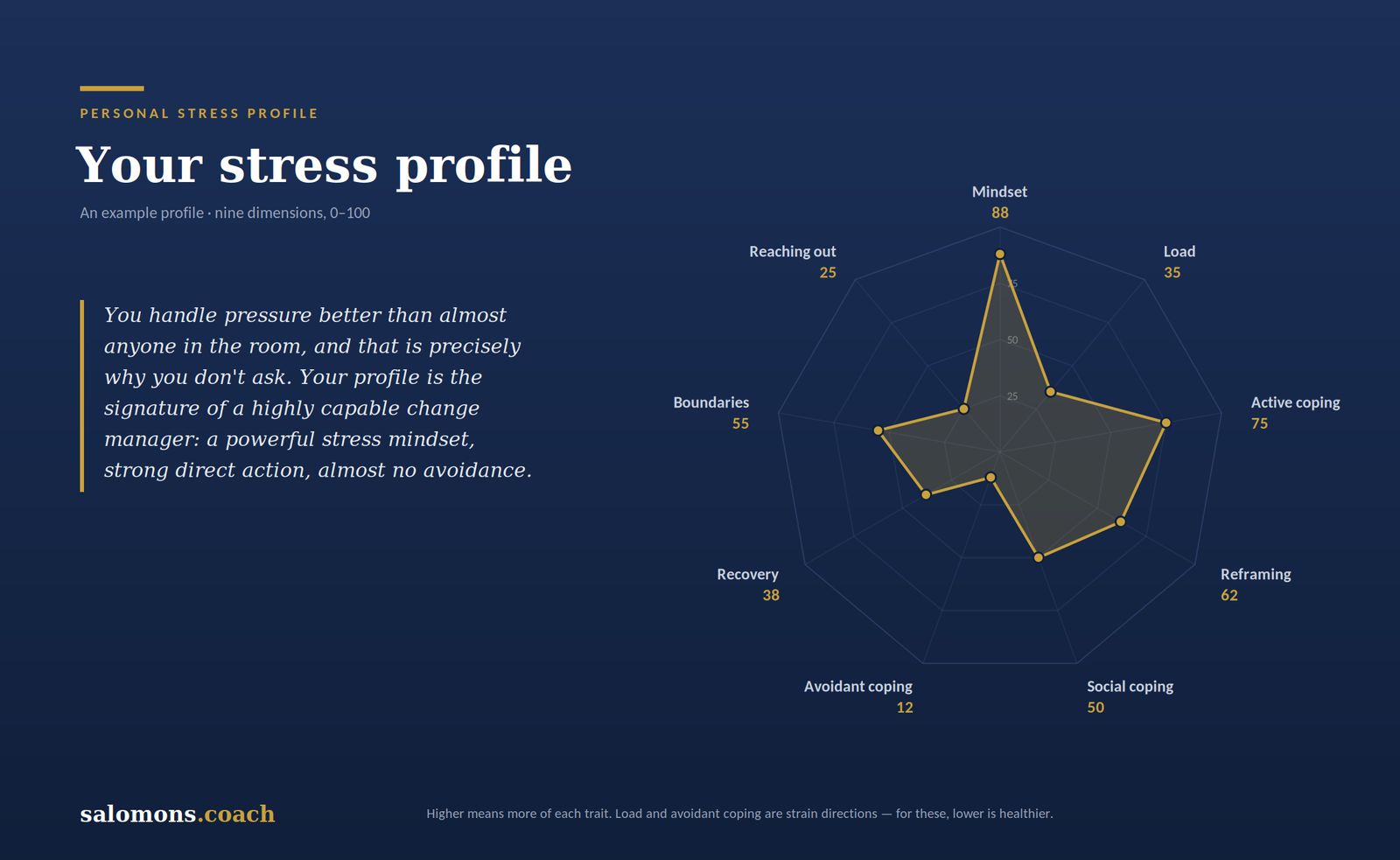
Your Personal Stress Coping Profile
Turning pressure into insight—and insight into more deliberate, sustainable choices.
By Jan K. Salomons · Salomons.Coach · Executive Coaching · Leadership Development · Stress Resilience
Executive summary
Stress is often discussed as though it were a single, easily identifiable condition. In reality, people differ considerably in what creates pressure, how they interpret it, which coping responses they use and how effectively they recover. The Personal Stress Coping Profile™ provides a structured mirror of these patterns.
The profile is not a clinical diagnosis and it does not assign people to fixed personality categories. It creates a practical starting point for reflection, coaching and development by making current pressure, coping habits, resilience resources and recovery patterns more visible.
Stress is familiar. Our own patterns are often less visible.
Most experienced professionals know what stress feels like. They recognise the mental restlessness, reduced concentration, shorter patience, physical fatigue or persistent sense that there is never enough time. Yet recognising that pressure exists is not the same as understanding how it operates.
People can experience similar demands and respond very differently. One person becomes highly focused and decisive, while another begins to hesitate or withdraw. Some people seek support early; others work harder and become increasingly isolated. Some recover naturally when a demanding period ends, while others remain mentally engaged long after the immediate pressure has passed.
These differences are not simply a matter of being strong or weak. They arise from a combination of workload, personal circumstances, beliefs about stress, established coping habits, available resources and the environment in which a person works.
Why create a personal stress coping profile?
Stress tends to become visible only after it has already begun to affect performance, relationships, health or confidence. Before that point, the early signals can easily be explained away. A demanding week becomes a demanding month. Temporary tiredness becomes a new normal. Working longer hours appears to solve the immediate problem, even when it gradually reduces the capacity to think, recover and make sound decisions.
Reflection can interrupt that pattern, but reflection is difficult when it remains abstract. Simply asking, “How stressed am I?” rarely produces enough insight to change behaviour. A structured profile helps break the experience down into more useful questions: What is creating pressure? How do I interpret that pressure? What do I do when demands rise? Which responses help me, and which may provide short-term relief while creating longer-term risk?
The purpose of the profile
The Personal Stress Coping Profile™ creates a structured overview of your current experience of pressure and the ways in which you respond. It is designed to support greater self-awareness, constructive dialogue and more deliberate choices—not to reduce a complex person to a score.
What does the profile explore?
The profile examines several connected dimensions. None should be interpreted in isolation. Together they provide a richer picture of how pressure is currently being experienced and managed.
Current pressure
The profile begins with the demands you are experiencing now. These may include workload, deadlines, conflicting priorities, uncertainty, interpersonal tension or significant circumstances outside work. The purpose is not to compare your situation with someone else’s, but to understand how demanding it currently feels to you.
Stress beliefs and mindset
What we believe about stress influences how we respond to it. Pressure may be interpreted as a challenge, a threat, a sign of personal failure or simply an unavoidable part of responsibility. These beliefs shape behaviour, including whether we seek help, persist, withdraw or attempt to regain control by working even harder.
Coping responses
Coping describes the actions and mental strategies we use to manage demands. These may include problem-solving, planning, seeking support, reframing the situation, avoidance, distraction or emotional suppression. A coping response is not automatically good or bad; its value depends on the situation and on its longer-term consequences.
Resilience resources
Resilience is supported by more than determination. Personal resources may include confidence, autonomy, experience, a sense of purpose and the ability to place events in perspective. External resources include supportive relationships, role clarity, access to expertise and the practical ability to ask for help.
Boundaries and capacity
Many capable professionals respond to increasing demand by extending their working day, reducing recovery time and accepting additional responsibility. This can work temporarily, but it may conceal the fact that demand has exceeded sustainable capacity. The profile helps examine how limits are recognised, communicated and protected.
Recovery and learning
Recovery is not simply the absence of work. It involves creating sufficient distance for the body and mind to restore energy and perspective. The profile also explores whether demanding periods lead to learning and changed behaviour, or whether the same patterns repeatedly return.
What the profile is—and what it is not
Responsible use requires clear boundaries. A reflective coaching instrument should support insight without pretending to provide a medical or psychological diagnosis.
The profile is
- A structured mirror of current patterns.
- A starting point for reflection and coaching.
- A way to make pressure and coping more discussable.
- A means of identifying strengths and development priorities.
- A snapshot that can change as circumstances change.
The profile is not
- A medical or clinical diagnosis.
- A personality test or permanent label.
- A judgement about whether someone is sufficiently resilient.
- A prediction that burnout will or will not occur.
- A substitute for professional medical or psychological care.
From answers to meaningful reflection
Completing a questionnaire is not the outcome. Its value lies in the quality of the reflection and conversation that follows. The process therefore combines structured input with professional interpretation and practical dialogue.
Complete the profile
You respond to a structured set of questions about current pressure, stress beliefs, coping behaviours, resilience resources, boundaries and recovery. The questions are designed to encourage honest reflection rather than produce a desirable score.
Receive a personal overview
Your responses are translated into an accessible profile highlighting current patterns, relative strengths and areas that may deserve closer attention. The profile should be read as a snapshot and as a source of questions, not as a verdict.
Explore the meaning
During a coaching conversation, the results are interpreted in the context of your role, working environment, personal circumstances and objectives. This prevents isolated scores from being treated as though they tell the whole story.
Choose focused actions
The process concludes with a small number of realistic priorities. These may relate to workload choices, recovery, communication, support, boundaries, role clarity or specific coping practices. The objective is not to change everything, but to act where the greatest difference can be made.
Individual insight is only the beginning
A personal profile can make your own patterns visible, but it cannot fully explain the environment in which those patterns operate. The ability to cope is also influenced by workload, role clarity, leadership behaviour, team relationships and whether practical support becomes available when pressure rises.
This is why personal and collective coping should not be treated as competing explanations. Individuals remain responsible for recognising their patterns, communicating honestly and making responsible choices. Teams and leaders influence whether those choices are encouraged, supported and translated into meaningful action.
Personal Stress Coping Profile™
Creates insight into an individual’s current pressure, coping patterns, resilience resources, boundaries and recovery.
Team Stress Coping & Resilience Profile™
Combines selected, anonymised input to help a team understand how pressure, coping resources and resilience conditions are distributed across its membership.
The Collective Coping Framework™
Provides six team capabilities through which leaders and teams can strengthen shared awareness, speaking up, mutual support, adaptability, constructive challenge and collective learning.
Questions worth asking yourself
You do not need a formal assessment to begin reflecting. The following questions can provide an initial indication of where greater attention may be useful.
A personal stress and coping check-in
- Which sources of pressure are currently having the greatest impact on my energy and attention?
- What changes in my behaviour usually indicate that my capacity is becoming constrained?
- Which coping responses help me address the underlying issue?
- Which habits provide temporary relief but may create longer-term risk?
- What assumptions make it difficult for me to ask for help or adjust expectations?
- Which responsibilities am I carrying because they are genuinely mine—and which have accumulated because I am dependable?
- What currently supports my recovery, and what repeatedly interrupts it?
- What is one practical change that would reduce unnecessary pressure without compromising essential performance?
A mirror, not a label
The purpose of the Personal Stress Coping Profile™ is not to classify people as resilient or vulnerable. Human responses to stress are more dynamic than that. The same person may cope effectively in one environment and struggle in another, depending on the demands, available resources, personal circumstances and support surrounding them.
A useful profile therefore acts as a mirror. It helps make patterns visible, creates language for a more honest conversation and supports decisions that may otherwise be postponed until pressure has already become damaging.
Stress cannot always be prevented, and difficult periods are part of professional and personal life. Greater insight, however, can make our responses less automatic and more deliberate. It can help us recognise when to persist, when to adapt, when to seek support and when the conditions around us need to change.
Explore the Collective Coping Series
Would greater insight help you work more effectively with pressure?
The Personal Stress Coping Profile™ can be used as part of an individual coaching process or as confidential preparation for a facilitated team programme. It provides a structured starting point for understanding current patterns and identifying a focused set of practical development priorities.
Where the profile is used within a team, individual results remain confidential. Only selected and anonymised information is combined to create the Team Stress Coping & Resilience Profile™.
Start a confidential conversation- Share:

You may also like
It is not the workload. Stop calling it the workload.
- 18 September 2026
- by salomons.coach
- in Blog

Responsible for Everything, in Charge of Almost Nothing

What Am I No Longer Hearing Because of the Power I Hold?