It’s not mindset. Not your CV. Not networking. It’s time.
We talk about layoffs as if they are linear: job ends > new job starts.
But real life doesn’t work that way.
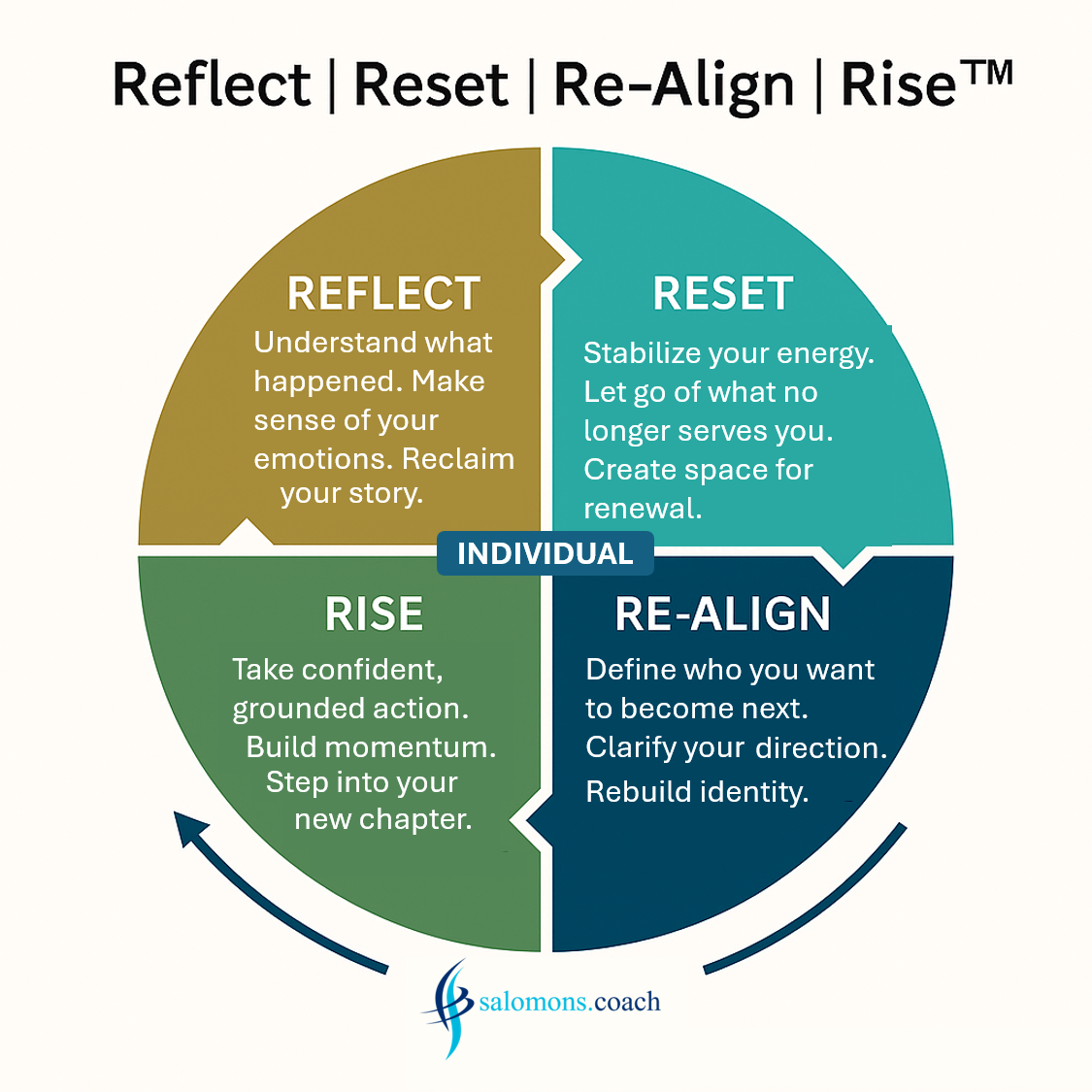
What determines whether someone recovers well or gets stuck is the amount of time they have to move through the inner journey: Reflect > Reset > Re-Align > Rise™
Most executive teams don’t fail because of strategy — they fail because of what they avoid. These 10 provoking questions cut through noise, expose blind spots, and accelerate real transformation. They challenge leaders to face the hard truths about their behavior, decisions, and impact. If you want to grow as a leader, start by answering these questions honestly.
Redundancy is often treated as a quick transition, but the real determining factor in someone’s recovery is time. The pace at which a person can move through the inner journey of Reflect–Reset–Re-Align–Rise™ depends on financial pressure, VSO terms, WW timelines, emotional impact, and life circumstances. When the process is rushed, unresolved phases return later as stress, confusion, or poor career choices. When people are given time, clarity grows, confidence returns, and their next step becomes intentional rather than reactive. Time isn’t a delay—it’s the space where healing and identity reconstruction take place.
Redundancy in the Netherlands is legally structured yet psychologically disruptive. Even with strong protections and the VSO process, employees experience identity loss, uncertainty and emotional turbulence. Leaders often underestimate this impact—and the effect on those who remain. Research shows that structured transition support significantly improves outcomes. The 4R Model—Reflect, Reset, Re-Align, Rise—helps individuals stabilize, rebuild identity and re-enter the labor market with clarity and confidence. Increasingly, Dutch organizations engage external coaches during the VSO period to support departing managers and sustain trust, well-being and business continuity. Redundancy is not an ending—it is an inflection point.
In a world defined by volatility, uncertainty, complexity, and ambiguity, leaders can no longer rely on fixed plans or past experience. VUCA describes the challenge — but PDSA provides a practical way to respond through fast learning cycles. My early years as a teacher, working with Kolb’s experiential learning model, taught me that people grow through experimentation, reflection, and adaptation. Decades later, the same learning loop has become essential for leaders: the ability to test, adjust, and learn faster than the environment changes.
The 4R Model—Reflect, Reset, Re-Align, Rise™—emerged from more than 35 years of leading and coaching in complex, high-pressure environments, combined with solid foundations in transition theory, emotional intelligence, identity work, and psychological safety. Supported by globally respected research (including HBR), the model provides a clear, humane framework that helps people navigate redundancy, burnout, and major career shifts. Instead of treating change as a purely logistical process, 4R guides the deeper psychological journey: understanding what’s happening internally, letting go of old identities, rebuilding direction, and rising with confidence and sustainable momentum. It turns disruption into structured growth.
Struggling with a new boss? You’re not alone. This article explains the psychology behind leadership transitions, why your brain reacts the way it does, and what practical steps help you rebuild clarity and trust—especially in high-pressure operational environments.
When TNT’s global network went dark during the NotPetya cyberattack, every system failed — but people didn’t. In this story, Jan Salomons shares how leadership, trust, and adaptability kept Europe’s largest logistics network running manually for days. It’s a story of crisis leadership in a VUCA world — where volatility, uncertainty, complexity, and ambiguity tested every level of society, organization, and individual behavior. As old hierarchies crumbled, new leaders emerged, purpose became crystal clear, and collaboration turned chaos into order. A powerful lesson in resilience, trust, and human connection under pressure.
Change doesn’t fail because of poor plans — it fails because people haven’t made the psychological transition. In this article, Jan Salomons explores his formula for successful change, combining shared vision, urgency, leadership, learning, and capacity. Drawing on his decades of experience and his VUCA leadership approach, he explains how leaders can guide teams through endings, transitions, and new beginnings while maintaining trust and connection. Learn why managing change isn’t enough — leading transition is what truly drives sustainable transformation.
Busyness has become a badge of honor, but it rarely leads to impact or well-being. In this post, Jan Salomons explores why being busy is more often a habit than a necessity — and how leaders can shift from managing time to managing focus. In a VUCA world, where speed and complexity dominate, clarity and reflection become the real leadership differentiators. Learn how to move from motion to meaning through self-awareness, attention, and purpose, and discover why slowing down might be the smartest move you can make.