salomons.coachsalomons.coach
  • Home
  • About Me
  • Blog
  • Shop
  • Downloads
    • Your Own Career Coach
    • Cross-Cultural Leadership Compass
    • Your stress Profile
    • Psychological Safety Field Guide
    • Energy Awareness Journal
    • The Executive Presenting Framework
    • The Executive Ownership Reinforcement Framework
    • The Evidence Base for Coaching Effectiveness
    • The Art of Time Boxing
    • VUCA Leadership WorkBook
    • VUCA Leadership Book
  • Services
  • Testimonials
  • Session Scheduler
  • Contact
  • Change language to Nederlands
Back
  • Home
  • About Me
  • Blog
  • Shop
  • Downloads
    • Your Own Career Coach
    • Cross-Cultural Leadership Compass
    • Your stress Profile
    • Psychological Safety Field Guide
    • Energy Awareness Journal
    • The Executive Presenting Framework
    • The Executive Ownership Reinforcement Framework
    • The Evidence Base for Coaching Effectiveness
    • The Art of Time Boxing
    • VUCA Leadership WorkBook
    • VUCA Leadership Book
  • Services
  • Testimonials
  • Session Scheduler
  • Contact
  • Change language to Nederlands
  • Home
  • Blog
  • Blog
  • Trust – The Origin of Teams

Blog

07 Dec

Trust – The Origin of Teams

  • By salomons.coach
  • In Blog, Building high-performing leadership teams

Trust, what can we do without? Nothing to my humble opinion. Many research has been done and even more books are written about trust. Let’s have a look into trust and how this relates to our day-to-day way of working, wellbeing and personal development.

First of all, we all understand trust, as this is the first thing that we develop – or maybe are born with. Newborns trust their caretaker within one hour of birth. Trust is the origin of social connection, and critical for survival when we are dependent.

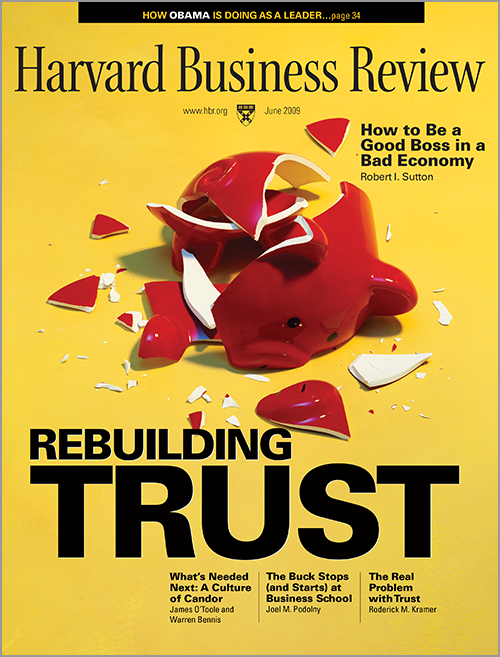
HBR, by Roderick M. Kramer, a social psychologist, published a mind breaker in 2009 called “rethinking trust”. The article, based on the collapse of the world economy caused by corporate scandals (Madoff, Enron, WorldCom, Tyco, etc.).

Kramer presents the thesis that human beings are naturally predisposed to trust—it’s in our genes and our childhood learning—and by and large it’s a survival mechanism that has served our species well. Kramer also highlights that our willingness to trust often gets us into trouble. Moreover, we sometimes have difficulty distinguishing trustworthy people from untrustworthy ones. At a species level, that doesn’t matter very much so long as more people are trustworthy than not. At the individual level, though, it can be a real problem. Kramer’s thesis is that

“To survive as individuals,
we’ll have to learn to trust wisely and well.”

That kind of trust—Kramer calls it tempered trust—doesn’t come easily, but if you diligently ask yourself the right questions, you can develop it.

To trust is human,
b
ut our judgment is sometimes poor

The shadow of doubt lingers over every decision to trust. The 7-step approach aims to reduce this doubt:

  1. Know yourself
  2. Start small
  3. Write an escape clause
  4. Send strong signals
  5. Recognize the other person’s dilemma
  6. Look at roles as well as people
  7. Remain vigilant and always question

You can read the full article here: HBR-Rethinking Trust

When it comes to teams, team performance and team leadership, Lencioni made a great model that puts trust where it belongs: at the fundament of people working together, also being the source for all elements needed to work together successfully.
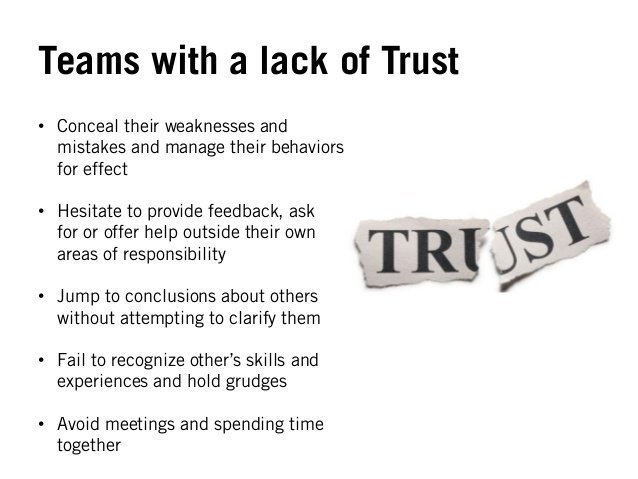
Lencioni defined that without trust, people cannot speak-out what’s in their mind, they don’t feel safe enough. Google recently came up with exactly the same conclusion, based on a (very) big data analysis (check the article here).

A quote from Google article: “Psychological safety was far and away the most important of the five dynamics Google analysists found — it’s the underpinning of the other four. How could that be? Taking a risk around your team members seems simple. But remember the last time you were working on a project. Did you feel like you could ask what the goal was without the risk of sounding like you’re the only one out of the loop? Or did you opt for continuing without clarifying anything, in order to avoid being perceived as someone who is unaware?

Turns out, we’re all reluctant to engage in behaviors that could negatively influence how others perceive our competence, awareness, and positivity. Although this kind of self-protection is a natural strategy in the workplace, it is detrimental to effective teamwork. On the flip side, the safer team members feel with one another, the more likely they are to admit mistakes, to partner, and to take on new roles. And it affects pretty much every important dimension we look at for employees. Individuals on teams with higher psychological safety are less likely to leave the organisation, they’re more likely to harness the power of diverse ideas from their teammates, they bring in more revenue, and they’re rated as effective twice as often by executives.”

Trust is the major differentiator when it comes to identify successful teams. We all know about trust, we all have experience with its impact, nevertheless we all feel sometimes that we have something to lose when we give trust. Time to unlearn!

In team building and development sessions, often the focus is on methods, communication, etc. For me the trust component is always the first and last I bing along when facilitating teams. It does not always mean trust is created immediately, however seeds are planted ti rethink trust, too rethink how team members approach each other, and especially, rethink we with think about each other. The heart of “a lack of trust” is our thinking. Yes, indeed often based on past experiences, however, creating new experiences based on the old ones, will only create another experience similar to the old one. By rethinking how we create relationships and work together, be aware of our prejudgements and pre-mis-conceptions, we will approach people differently, creating a different – new & positive – experience.

Therefore learning to let go of the past, and letting go of experiences so they don’t influence our current one, is a great way going forward. Together and with an (more) open mind. The only way to trust, create trust and of course receive trust.
Tags:psychological safetyTeam effectivenesstrust
  • Share:
salomons.coach
Jan Salomons is a seasoned leader/executive who shares his knowledge and experience as an executive mentor/coach/trainer as well as a transformation and operations excellence expert. He has over 35 years of experience working with senior leaders across more than 55 countries, and is an elected member of the Harvard Business Review Advisory Council.

You may also like

Businesswoman standing and presenting to colleagues around a glass-walled conference room table.

New Leader, Existing Team, Team Reset

  • 16 October 2026
  • by salomons.coach
  • in Blog
Inheriting an established team means inheriting its habits, unresolved tensions and operating assumptions. When is a reset necessary, and...
Infographic titled 'What gets seen, gets repeated' showing two columns: left red section 'Visible. Immediate. Reactive.' with a red alert siren, a worker on the phone, factory silhouettes, and a '22:00' breakdown; caption 'IS A HERO.' Right green section 'Invisible. Deliberate. Proactive.' with a worker at a laptop displaying a rising graph and icons labeled 'Identify risk', 'Address causes', 'Prevent failure'; caption 'WEEKS EARLIER – PREVENTION' and 'IS ALMOST INVISIBLE.' Bottom banner reads 'Shift recognition. Reward prevention. Build resilient operations.' and shows salomons.coach.
What Gets Seen, Gets Repeated – Firefighters vs Preventers
26 September 2026
Infographic titled STEER showing five circular steps (S, T, E, E, R) for crisis leadership on a dark blue background. Steps: Stabilise, Triage, Establish, Execute & inform, Review & refine.
Five Steps to Take Immediate Control of a Crisis
24 September 2026
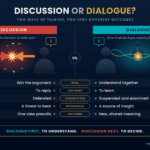
Infographic comparing Discussion (left) and Dialogue (right): clash graphic vs connected waves, with goal-focused comparisons and a shared outcomes section.
Most Leadership Teams Lack Dialogue
22 September 2026

Leave A Reply Cancel reply

Your email address will not be published. Required fields are marked *

This site uses Akismet to reduce spam. Learn how your comment data is processed.

Categories

  • Blog (174)
  • Building high-performing leadership teams (25)
  • Closing leadership capability gaps (24)
  • Improving personal leadership effectiveness (46)
  • Leading across cultures and boundaries (15)
  • Leading through uncertainty and crisis (11)
  • Making better leadership decisions (4)
  • Making change stick (12)
  • Navigating leadership and career transitions (13)
  • Sustaining performance under pressure (15)
  • Turning strategy into operational results (9)
  • Video (16)

Recent Posts

Businesswoman standing and presenting to colleagues around a glass-walled conference room table.
New Leader, Existing Team, Team Reset
16Oct,2026
Infographic titled 'What gets seen, gets repeated' showing two columns: left red section 'Visible. Immediate. Reactive.' with a red alert siren, a worker on the phone, factory silhouettes, and a '22:00' breakdown; caption 'IS A HERO.' Right green section 'Invisible. Deliberate. Proactive.' with a worker at a laptop displaying a rising graph and icons labeled 'Identify risk', 'Address causes', 'Prevent failure'; caption 'WEEKS EARLIER – PREVENTION' and 'IS ALMOST INVISIBLE.' Bottom banner reads 'Shift recognition. Reward prevention. Build resilient operations.' and shows salomons.coach.
What Gets Seen, Gets Repeated – Firefighters vs Preventers
26Sep,2026
Infographic titled STEER showing five circular steps (S, T, E, E, R) for crisis leadership on a dark blue background. Steps: Stabilise, Triage, Establish, Execute & inform, Review & refine.
Five Steps to Take Immediate Control of a Crisis
24Sep,2026

Tags

accountability (10) adaptability (5) AI & leadership (5) authenticity (10) Career transitions (11) Change execution (13) Coaching effectiveness (9) Coaching tools (18) communication (17) cross-cultural leadership (15) Cultural frameworks (12) decision making (6) Dialogue & conflict (7) emotional-intelligence (8) executive-coaching (15) Executive judgment (5) Executive presence (7) feedback (6) Focus & priorities (11) Global teams (5) Leadership behaviour (21) leadership development (16) Leadership transitions (5) learning culture (9) Neuroscience & learning (7) Operational excellence (6) Operational resilience (4) Organisational culture (15) Organisational transformation (7) Ownership & delegation (6) Performance measurement (6) Personal resilience (10) psychological safety (14) Purpose & values (8) Recovery & wellbeing (7) Redundancy & outplacement (6) Research & evidence (8) self-awareness (43) Stress & coping (10) systems thinking (7) team alignment (6) Team effectiveness (15) trust (7) VUCA & uncertainty (9) Work-life boundaries (4)
All posts - searchable table
Recent videos
the-adhd-watch-list-hero

The Best ADHD Videos for Leaders: Science, Stories, Strategy

In 14 July 2026
No Comment
Female speaker on stage delivering a TEDx talk, with a headset mic and gesturing, while a lower-third bio identifies her as a professor of organizational behaviour.

The Authenticity Paradox | Professor Herminia Ibarra 

Brooks – Harvard – on Happiness

Happiness as a Leadership Strategy

L360 youyrownjourney landing page L360

Find your true purpose

GET IN TOUCH

Salomons.Coach
KvK: 72129131
+31 6 53 89 75 67

jan@salomons.coach

The Netherlands

USEFUL LINKS

  • About
  • Privacy policy
  • Term & Conditions
  • Refund & Returns
  • Payment policy
  • Digital Policy
  • Methodology & Sources

LinkedIn

  • Linkedin
Receive blog updates

salomons.coach by J.K. Salomons Holding B.V., 2018-2026

  • Home
  • About Me
  • Blog
  • Shop
  • Downloads
    • Your Own Career Coach
    • Cross-Cultural Leadership Compass
    • Your stress Profile
    • Psychological Safety Field Guide
    • Energy Awareness Journal
    • The Executive Presenting Framework
    • The Executive Ownership Reinforcement Framework
    • The Evidence Base for Coaching Effectiveness
    • The Art of Time Boxing
    • VUCA Leadership WorkBook
    • VUCA Leadership Book
  • Services
  • Testimonials
  • Session Scheduler
  • Contact
  • Change language to Nederlands
Change language to Nederlands