Parent, Adult, Child: The Three Modes You Lead From
Parent, Adult, Child: The Three Modes You Lead From
Every leader switches between three internal modes throughout the day — usually without noticing. The one you default to shapes how your people grow, or don’t.
You walk out of a one-on-one feeling like you handled it well. You were supportive. You stepped in, you fixed the problem, you took something off their plate. So why does the same person keep bringing you the same problem three weeks later?
Part of the answer is in which mode you were leading from. A useful model from communication psychology — sometimes called Parent Adult Child leadership — says that in any exchange we operate from one of three internal positions: Parent, Adult, or Child. These are not roles or age — they are stances we step into and out of constantly. As a leader, the stance you hold determines whether a conversation makes the other person bigger or smaller.
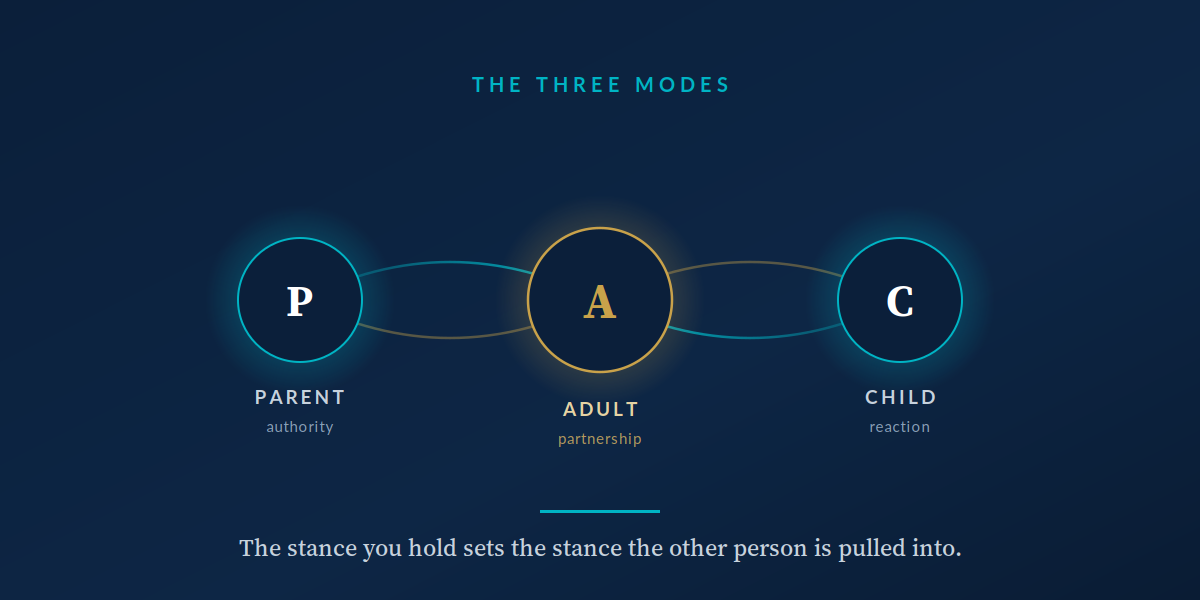
1.The three modes of Parent Adult Child leadership
Parent modeThe voice of authority
You instruct, correct, protect, or rescue. It can sound caring (“Let me handle that for you”) or critical (“I expected better”). Either way, you are positioning yourself above the other person.
Adult modeThe voice of partnership
You deal with what is actually in front of you — facts, options, decisions — on equal footing. Calm, curious, direct. This is where real problem-solving and accountability happen.
Child modeThe voice of reaction
You react from emotion: defensive when challenged, eager to please when seeking approval, or quietly resentful. Leaders rarely admit to this mode, but it shows up more than they think.
None of these is “bad.” A sharp word of correction has its place; warmth and protection have theirs. The problem is operating from one mode on autopilot, especially when you believe you are simply “being a good leader.”
2.Listen to how the same moment plays out
A team member submits a report with errors in the figures. Watch how three different modes turn one small moment into three very different conversations.
The report gets fixed. But the person learned nothing except that you don’t trust them, and that mistakes are something to hide. Notice the reply lands in Child mode — the Parent stance pulled it there.
Same error, thirty seconds longer, completely different outcome. The person owns the fix, keeps their dignity, and is more likely to catch it themselves next time. That is what Adult mode buys you: it builds capability instead of dependency.
3.The leader who keeps reaching for the father role
There is one pattern worth singling out, because it is so easy to mistake for good leadership. It is the leader who is drawn, again and again, into the protective father role — the mentor, the shield, the one who always has your back.
On the surface it looks generous. He stays late to rescue a struggling junior. He absorbs the blame in front of the board so his team won’t take the hit. He gives unsolicited advice about your career, your stress, sometimes your life. People call him a great boss to work for. And often he genuinely is.
Warm, isn’t it? But trace the effect. The team member never learns to fix the structure. The next hard thing comes straight back to his desk. And underneath the kindness sits a quiet message: “I don’t quite trust you to handle this on your own.” Over time the team organises itself around him — everyone a little smaller, him a little more indispensable, and a little more exhausted.
Here is the part that is rarely said out loud. For some leaders, the pull toward the father role isn’t really about the team. It is about a role they once needed and never had. A leader who lacked a steady, protective figure growing up can find himself unconsciously trying to be the figure he wished for — offering others the mentorship, safety, and belief he missed. It feels deeply meaningful, which is exactly why it is so hard to see and so hard to put down.
This is where the model becomes genuinely useful rather than just clever. The behaviour isn’t a flaw to be scolded out of you. It is a need showing up in the wrong place. Once a leader can see “I’m in Parent mode again, and this is meeting something in me, not something the team asked for,” a choice opens up that wasn’t there before.
The shift is not to become cold. It is to move the same care into Adult mode: “This is hard. I believe you can crack it — tell me where you’re stuck and let’s think it through, but the proposal stays yours.” Still warm. Still supportive. But it grows the person instead of the dependency — and it lets the leader finally set down a weight he has been carrying since long before this job.

You may also like

Five Steps to Take Immediate Control of a Crisis

Most Leadership Teams Lack Dialogue