The GLOBE Study: The Framework That Asks What Leadership Actually Works — And Where
By Jan Salomons · Salomons.Coach
Most cross-cultural frameworks tell you how cultures differ. The GLOBE Study tells you what kind of leader each culture is actually willing to follow.
That is a different and more useful question for anyone in an executive role.
I have worked with senior leaders across Europe, the Middle East, and Asia for more than twenty years. The gap between knowing that a culture is “high on power distance” and knowing what that means for how you chair a meeting, escalate a decision, or give feedback to a direct report — that gap is where most cross-cultural frameworks run out of road. GLOBE narrows it significantly.
What Is the GLOBE Study?
The Global Leadership and Organizational Behavior Effectiveness study — GLOBE — was published in 2004 by Robert J. House and a team of 170 researchers across 62 societies. The study involved more than 17,000 managers in three industries: financial services, food processing, and telecommunications. It is, by any measure, one of the most ambitious cross-cultural research programmes ever undertaken.
Two things make GLOBE distinctive.
First, it measures both what is and what should be. For every dimension, GLOBE asked respondents to describe their society’s current cultural practices (As Is) and separately to describe what those practices ideally should be. This distinction — between the culture people actually live in and the culture they wish they lived in — is analytically powerful and practically important.
Second, it directly links cultural practices to leadership effectiveness. GLOBE did not just map cultural differences and leave executives to draw their own conclusions. It asked respondents specifically which leadership behaviours they considered effective and which they considered ineffective.
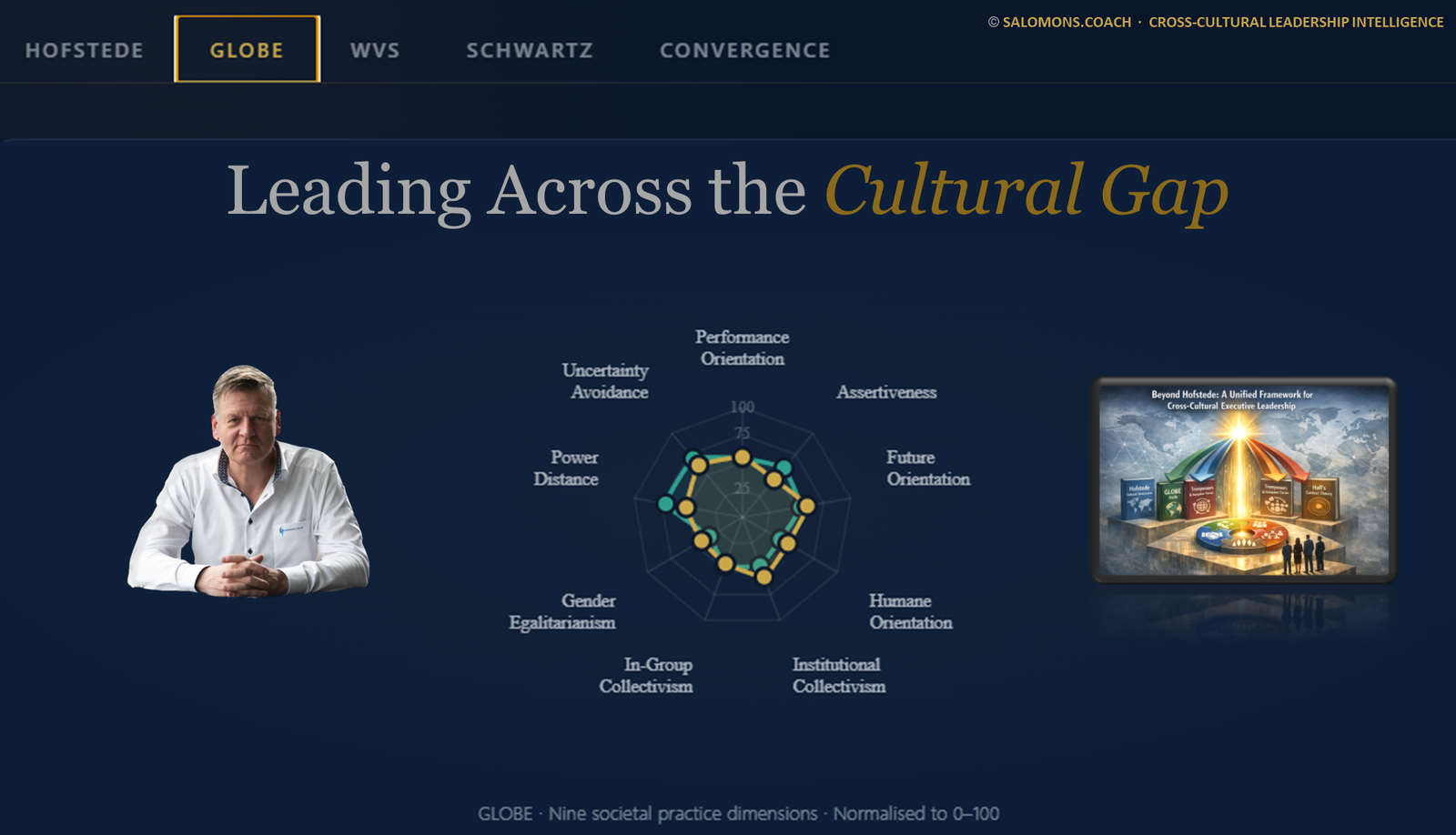
The GLOBE study identifies nine societal dimensions: Performance Orientation, Assertiveness, Future Orientation, Humane Orientation, Institutional Collectivism, In-Group Collectivism, Uncertainty Avoidance, Power Distance, and Gender Egalitarianism.
Why GLOBE Matters Differently from Hofstede
Hofstede’s data was collected between 1967 and 1973, from IBM employees. It is foundational research and I use it because its country coverage is unmatched and its dimensions are well-validated. But IBM employees in the 1970s were not a cross-sector, cross-function population, and five decades of social change mean that some of the scores have shifted.
GLOBE was conducted in the 1990s, across multiple industries, and with explicit attention to leadership behaviour. The result is a different kind of signal.
The most important GLOBE contribution for leaders is In-Group Collectivism. This dimension captures something specific: the degree to which loyalty to one’s immediate group — family, organisation, team — is a core social value. High In-Group Collectivism scores predict that relationship investment before professional collaboration is not a preference, it is a structural expectation.
This is the dynamic that catches Western European executives off guard in Chinese, Indian, and Middle Eastern contexts. Hofstede’s IDV dimension captures some of this. But GLOBE’s In-Group Collectivism is a more precise instrument for the specific leadership question: how much does the relationship have to come before the task?
Assertiveness is another dimension that Hofstede handles indirectly at best. The GLOBE Assertiveness dimension measures the cultural norm around direct, confrontational communication — and crucially, the As Is / Should Be split reveals something counterintuitive in many high-assertiveness cultures.
Uncertainty Avoidance in GLOBE is also coded differently from Hofstede. Hofstede’s UAI measures emotional need for rules and procedures. GLOBE’s UA measures the actual practice of using norms and procedures to manage uncertainty. The distinction matters: a culture may have a strong emotional preference for certainty (Hofstede UAI high) but have developed few effective procedural mechanisms for achieving it.
GLOBE in Practice: The Netherlands × China
Let me make this concrete with a pairing I work with frequently.
On Hofstede, the headline gaps are large: IDV Δ60, MAS Δ52, PDI Δ42. These are extreme differences.
GLOBE adds a layer of precision. The In-Group Collectivism gap between China (5.04) and the Netherlands (4.11) is Κ0.93 on a 7-point scale — which, in a dataset where most country differences cluster between 0.2 and 0.6, is a substantial signal. It tells us that the Chinese professional norm of building deep loyalty within the working group before trusting its outputs is one of the most measurable dimensions of difference in the dataset.
The Uncertainty Avoidance gap (China 5.80, Netherlands 3.70, Κ2.10) is even larger. Dutch professionals are comfortable with ambiguity and often see premature process as bureaucratic overhead. Chinese professionals experience unresolved ambiguity as a risk to be managed — through documentation, escalation protocols, and explicit confirmation of scope.
Now add the Flemish Belgian data. Belgium scores 4.69 on GLOBE UA. In a team that includes Dutch, Chinese, and Flemish members, the GLOBE UA data tells you that your Flemish team members and your Chinese colleagues share a higher tolerance for procedural structure than your Dutch colleagues.
GLOBE and the Cross-Cultural Leadership Compass
This is precisely why I built GLOBE into the Cross-Cultural Leadership Compass alongside Hofstede, the World Values Survey, and Schwartz.
The Convergence tab in the Compass is where this matters most. When all four frameworks independently flag the same gap between two countries, you are looking at a structural difference that is not framework-dependent or artefact-prone. It is real. It has been measured from four different methodological angles and they all agree.
The GLOBE In-Group Collectivism gap between China and the Netherlands appears in the convergence analysis. So does the Uncertainty Avoidance gap — confirmed by both GLOBE and Hofstede, corroborated by Schwartz Embeddedness. When three frameworks independently confirm the same gap, the leadership implication is not academic. It is a practical guide to where your energy, your preparation, and your intervention should go.
Three Leadership Questions GLOBE Helps You Answer
1. What does this culture actually expect from someone in authority? GLOBE’s CLT component identifies which leadership archetypes are considered effective in each society. In high Power Distance, high In-Group Collectivism cultures, self-protective and autonomous leadership styles score higher. In low Power Distance, high Performance Orientation cultures, charismatic and participative styles score higher.
2. Where will my default leadership style create friction I have not anticipated? If you have been developed as a leader in a low Power Distance, low In-Group Collectivism environment, your default style almost certainly includes direct feedback, flat communication, and task-based authority. GLOBE data will show you clearly which markets, teams, and stakeholder groups will experience that style as cold, disrespectful, or politically naive.
3. What does my team actually need from me — and is that the same for everyone in the room? A mixed team is not a single cultural context. GLOBE data gives you the dimension-level resolution to see where your Dutch direct report and your Flemish team member actually differ — even though they share a language and work in the same building.
Where to Start
The GLOBE data for your specific country pair — alongside Hofstede, WVS, and Schwartz — is available right now, at no cost, in the Cross-Cultural Leadership Compass.
Use the Cross-Cultural Leadership Compass →
Jan Salomons is an executive coach and leadership developer based in the Netherlands, with 35+ years of senior management experience including a decade at ASML. The Cross-Cultural Leadership Compass integrates Hofstede, GLOBE, World Values Survey, and Schwartz into a single analytical tool for leaders and coaches working across cultural boundaries.
House, R.J. et al. Culture, Leadership, and Organizations: The GLOBE Study of 62 Societies. SAGE Publications, 2004.

You may also like

Five Steps to Take Immediate Control of a Crisis

Most Leadership Teams Lack Dialogue