Hofstede Explained: What the Six Cultural Dimensions Actually Mean for Leaders
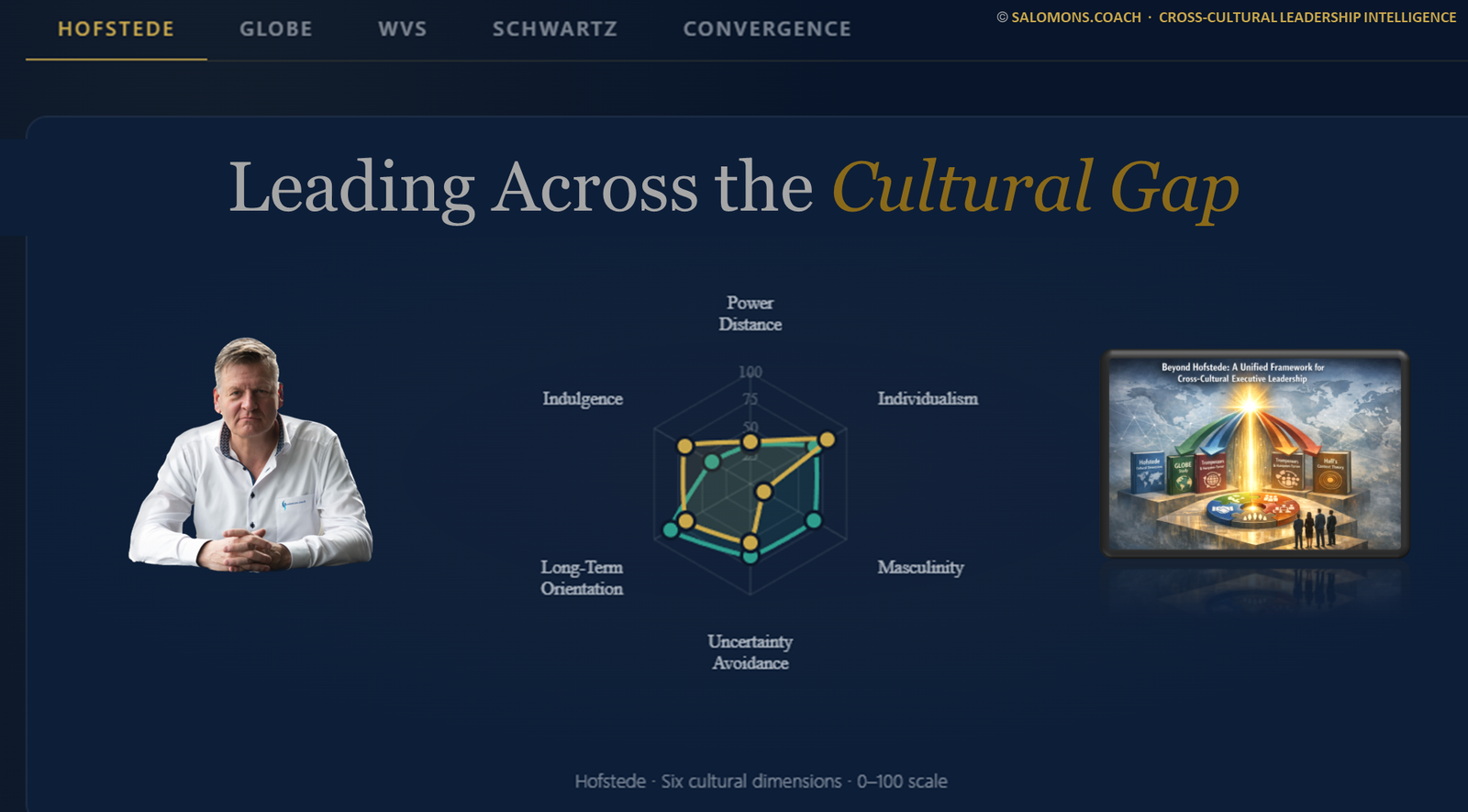
The most cited framework in cross-cultural management research, decoded for practical leadership use — and how the cross-cultural leadership compass puts this to work
Geert Hofstede spent decades researching one question: do people from different countries think and behave differently in professional contexts in ways that are systematic, measurable, and predictable? His answer, developed through surveys of over 100,000 IBM employees across more than 50 countries in the late 1960s and 1970s, and refined through subsequent decades of academic validation, was an unambiguous yes.
The result is the most widely cited framework in cross-cultural management research. Six dimensions. Numerical scores for over 90 countries. A dataset that has shaped how organisations, consultants, and leadership coaches understand professional culture for more than fifty years.
But knowing the framework exists and knowing how to use it are different things. Most professionals who have encountered Hofstede know that some countries score high on Power Distance and some score low on Individualism. Far fewer know what that actually means for how a meeting runs, how feedback lands, how trust is built, or how a manager reads a direct report’s silence.
The Cross-Cultural Leadership Compass, the analytical tool developed by Salomons.Coach, takes Hofstede’s six dimensions as one of its four foundational frameworks and translates them from abstract scores into specific, situational leadership guidance. This post explains the six dimensions, what they actually measure, and how the Compass deploys them in practice.
The Foundation: What Hofstede Actually Measured
Before unpacking the dimensions, it is worth understanding what Hofstede’s data represents — and what it does not.
Hofstede’s scores are national-level research averages derived from large-scale population surveys. They describe central tendencies across entire national populations. They do not describe individuals. The variation within any national culture is frequently larger than the variation between national averages. A Dutch professional may be more hierarchical than a Chinese colleague. A Chinese professional who has spent fifteen years working in Amsterdam will carry two cultural operating systems simultaneously, and neither the Chinese nor the Dutch score fully describes them.
What the scores do capture is the structural backdrop against which professional behavior is interpreted. In a high-Power-Distance culture, deference to seniority is read as respect. In a low-Power-Distance culture, the same behavior is read as lack of confidence. The score does not predict what any individual will do, it predicts the interpretive lens through which their behavior will be read by colleagues operating within that cultural context.
This distinction between describing individuals and describing interpretive environments, is the key to using Hofstede usefully rather than reductively.
The Six Dimensions
Dimension 1: Power Distance (PDI)
What it measures: The degree to which less powerful members of a society accept and expect that power is distributed unequally. High-PDI cultures see hierarchy as natural and legitimate. Low-PDI cultures treat hierarchy with scepticism and expect authority to be earned through demonstrated competence rather than granted by position.
The range: Malaysia sits at the top with a PDI of 104. Austria sits near the bottom at 11. The global average is approximately 55.
What it looks like in practice:
In a high-PDI culture (China: 80, many Middle Eastern and South Asian contexts), the professional hierarchy is real and felt. Subordinates do not openly disagree with managers in meetings. Status carries weight and is acknowledged through behavior, who speaks first, who defers, how disagreement is handled. Decision-making authority is concentrated at the top, and the expectation is that direction flows downward.
In a low-PDI culture (Netherlands: 38, Scandinavia: 18–31, Austria: 11), authority is expected to justify itself. Managers consult their teams before deciding. Subordinates challenge their managers’ proposals openly and expect this to be received as professional engagement, not insubordination. Titles and hierarchical status markers carry relatively little social weight. What matters is the quality of the argument.
The leadership friction this creates: A leader from a high-PDI background managing upward in a low-PDI culture will often interpret their manager’s expectation of direct challenge as a trap or a test. It is neither. It is simply how low-PDI professional culture understands good management relationships: the direct report is a peer who happens to report to this person, and the manager wants their genuine professional assessment, including when it contradicts the manager’s own view. Unexpressed disagreement, in a low-PDI professional culture, reads as either intellectual vacancy or dishonesty.
How the Compass uses PDI: PDI is the primary variable in the Managing Up, Managing Down, and Attending Meetings dimensions. It shapes how directive a leader should be with different team members, how much deference versus challenge a manager expects, and what silence means in a meeting room.
Dimension 2: Individualism vs. Collectivism (IDV)
What it measures: The degree to which individuals are integrated into groups. In highly individualist cultures, the ties between individuals are loose, people are expected to look after themselves and their immediate family. In highly collectivist cultures, people are integrated into strong, cohesive in-groups that offer protection in exchange for loyalty.
The range: The United States scores 91, the highest in the dataset. Guatemala scores 6, the lowest. China scores 20. The Netherlands scores 80. This is, by the Compass’s own assessment, one of the largest country-pair gaps in the entire dataset.
What it looks like in practice:
In individualist cultures, professional success is personal. You own your results, you own your failures, and you express your views in the first person. In a meeting, you say “I think” rather than “we feel.” Professional accountability is individual. Career paths are individual. The professional relationship is transactional: it exists because it serves a purpose, and when the project ends, the relationship becomes optional.
In collectivist cultures, group membership is the primary professional identity. Credit and blame are distributed across the group. Consensus matters before assertion. Individual opinion is expressed carefully, if at all, in ways that preserve group harmony. The in-group is protected, relationships carry obligation, and the social fabric is maintained actively.
The leadership friction this creates: The most immediate and persistent friction shows up in two places. First, in how credit and accountability are attributed: a collectivist leader who distributes credit to the team will be interpreted, in an individualist culture, as someone who either did not drive the result or is deflecting accountability. Second, in how disagreement is expressed: a collectivist professional’s indirect, hedged expression of a concern will be read as uncertainty or vagueness in an individualist context, not as the carefully calibrated professional courtesy it is.
How the Compass uses IDV: IDV is the most consequential dimension in the Compass for leaders from East Asian, South Asian, and Latin American backgrounds operating in northwestern European or North American professional contexts. It anchors the Communication Style, Building Professional Relationships, and Building Trust dimensions, and it underlies the Compass’s most consistent practical instruction to high-IDV professionals: start status updates, meeting contributions, and written communications with what you personally delivered or decided ,before attributing to the team.
Dimension 3: Masculinity vs. Femininity (MAS)
What it measures: This is Hofstede’s most contested and most misnamed dimension, the labels have generated significant debate, but what it actually captures is the degree to which a society values achievement, heroism, assertiveness, and material success (Masculine pole) versus cooperation, modesty, caring for the weak, and quality of life (Feminine pole).
It has nothing directly to do with gender roles in the contemporary sense. It is better understood as: does this culture treat competition and visible achievement as professional virtues, or does it treat collaboration and work-life balance as professional virtues?
The range: Japan scores 95, the most achievement-oriented culture in the dataset. Sweden scores 5, the most quality-of-life-oriented. China scores 66. The Netherlands scores 14, the second lowest globally.
What it looks like in practice:
In high-MAS cultures (Japan, China, Austria, Germany), professional status signals matter. Working long hours is a badge of commitment. Visible achievement, titles, formal recognition, demonstrating seniority through knowledge display, is legitimate professional currency. Competition between colleagues is relatively accepted.
In low-MAS cultures (Netherlands, Scandinavia), professional status signalling is actively discouraged. Working conspicuously long hours is read as poor planning or insecurity, not dedication. Modesty is genuinely valued. The quality of the work and the functioning of the team matter more than who gets credit. The Dutch even have a phrase, doe maar gewoon (just act normal), that captures this cultural pressure toward levelling: standing out ostentatiously is socially sanctioned.
The leadership friction this creates: A high-MAS leader in a low-MAS environment will instinctively try to demonstrate capability through visible effort, formal status acknowledgement, and explicit recognition of results. Their colleagues will not read these signals correctly. They will notice the quality of the work. They will not notice, or will actively discount, the status marking. Meanwhile, the high-MAS leader will find low-MAS colleagues’ apparent indifference to achievement or recognition bewildering or demotivating.
How the Compass uses MAS: MAS shapes the Dealing with Peers and Communication Style dimensions significantly, and it intersects with IDV in the Managing Up dimension. The Compass’s instruction to high-MAS professionals in low-MAS environments: make capability visible through technical precision and quality of analysis, not through effort signals or status markers that the cultural context does not read as meaningful.
Dimension 4: Uncertainty Avoidance (UAI)
What it measures: The degree to which members of a society feel threatened by ambiguous or unknown situations — and have developed institutions, rules, and rituals to try to avoid them. High-UAI cultures are uncomfortable with uncertainty and manage it through structure, documentation, rules, and formality. Low-UAI cultures are relatively comfortable with ambiguity and resist over-specification.
The range: Greece scores 112. Singapore scores 8. Belgium (Flemish) scores 94 — the highest in Western Europe. The Netherlands scores 53. China scores 30.
What it looks like in practice:
In high-UAI cultures (Belgium, Japan, much of Southern and Eastern Europe, Germany), ambiguity is uncomfortable and professional. Decisions need to be documented. Processes need to be specified. Rules exist for a reason and should be followed. Deviating from established procedure requires justification. The unknown is managed by reducing it.
In low-UAI cultures (Singapore, Jamaica, Denmark, Sweden), ambiguity is manageable and sometimes welcome. Rules are guidelines, not gospel. “We’ll work it out as we go” is a legitimate project management approach. Over-specification and excessive proceduralism are bureaucratic irritants. The unknown is managed by trusting the team to handle it.
The leadership friction this creates: In a mixed-UAI team, what reads to the low-UAI members as efficient flexibility reads to the high-UAI members as dangerous ambiguity. Leaving scope open-ended, decisions implicit, or protocols informal will produce discomfort, resistance, and quiet non-compliance from high-UAI team members, not because they are obstructive, but because their professional nervous system genuinely requires more certainty than the low-UAI culture’s default provides.
How the Compass uses UAI: UAI is the primary variable in the Compass’s treatment of Flemish Belgian team members, who sit at UAI 94, more than 40 points above the Dutch UAI of 53. The Compass makes the operational consequence explicit: Flemish team members need more documentation, more explicit decision confirmation, more formal process clarity, and more protection from ambiguity than Dutch colleagues. Providing it is not hand-holding, it is competent management for a specific cultural profile. Interestingly, China’s relatively low UAI (30) means Chinese professionals are often more comfortable with improvisation and ambiguity than their Dutch colleagues, a counter-intuitive finding that the Compass surfaces explicitly.
Dimension 5: Long-Term Orientation (LTO)
What it measures: The degree to which a society is oriented toward future rewards versus past and present obligations. High-LTO cultures value thrift, perseverance, deferred gratification, and adaptation of traditions to modern contexts. Low-LTO cultures value stability, respect for tradition, and fulfilling social obligations.
The range: South Korea scores 100. Pakistan scores 0. China scores 87, one of the highest globally. The Netherlands scores 67. Belgium scores 82.
What it looks like in practice:
In high-LTO cultures, patience is a professional virtue. Investment in relationships, processes, and capabilities that will pay off over years or decades is rational. Changing course in response to short-term pressures is not always wise. The long game matters.
In low-LTO cultures, quarterly results, immediate return on investment, and honouring existing commitments matter more than long-range planning. Quick adaptation is valued. Stability is respected.
The leadership friction this creates: LTO gaps show up most clearly in planning horizons, investment decisions, and relationship expectations. A high-LTO professional sees a five-year relationship investment as completely rational. A low-LTO colleague may see the same investment as disproportionate. In project contexts, high-LTO professionals may invest more in upfront process design than low-LTO counterparts find sensible.
How the Compass uses LTO: LTO is a secondary dimension in the Compass, but it surfaces an important alignment point: Chinese (87) and Flemish Belgian (82) professionals share a significantly higher LTO than Dutch colleagues (67). This creates a genuine structural overlap, both are oriented toward longer-range process thinking and sustained relationship investment, that a cross-cultural leader can leverage when managing Chinese-Flemish team dynamics.
Dimension 6: Indulgence vs. Restraint (IVR)
What it measures: The degree to which a society allows relatively free gratification of basic human desires related to enjoying life and having fun (Indulgence) versus the degree to which it suppresses and regulates gratification through strict social norms (Restraint). This was added to the framework in 2010 based on research by Michael Minkov.
The range: Venezuela scores 100, the most indulgent. Pakistan scores 0, the most restrained. The Netherlands scores 68. China scores 24.
What it looks like in practice:
Indulgent cultures tend to have a positive attitude toward leisure, personal freedom, and the expression of enjoyment. People in these cultures are more likely to feel happy, to have fun as a legitimate professional value, and to see work-life balance as a genuine right rather than an aspiration.
Restrained cultures tend to have a more disciplined, controlled approach to life. Enjoyment is earned rather than assumed. The expression of happiness or enthusiasm may be more measured. Work has a seriousness and a duty dimension that indulgent cultures may find heavy.
The leadership friction this creates: IVR gaps are subtler in professional contexts than some of the other dimensions, but they show up in meeting tone, team social events, the legitimacy of informal conversation, and expectations around flexibility and personal time. A high-IVR professional may seem surprisingly casual or social to a low-IVR colleague. A low-IVR professional may seem joyless or rigid to a high-IVR one.
How the Compass uses IVR: The Compass’s China-Netherlands analysis surfaces a Δ44 IVR gap — large, though not always the primary focus. It appears in the Building Professional Relationships dimension, particularly around the legitimacy of social investment in professional contexts, and in the communication chapters where the Dutch directness and pragmatism (high IVR in leisure but businesslike in work) meets Chinese professional seriousness (low IVR, restrained expression).
Why the Compass Uses Hofstede as One of Four Frameworks, Not the Only One
Hofstede is the most cited cross-cultural framework in management research for good reasons: it is empirically grounded, globally comprehensive, and practically actionable. But it has well-documented limitations.
The data has aged. The original surveys were conducted in the late 1960s and 1970s. While Hofstede and subsequent researchers have updated scores, cultural values do shift over generations, and some scores may reflect the culture of several decades ago more than today’s professional reality.
It describes national cultures, not organizational or professional cultures. Take for example ASML, the most important Dutch company. ASML is not the same as generic Dutch culture. It is a high-precision, globally staffed engineering company where Dutch directness intersects with international operating protocols and an intense quality culture. National scores alone underspecify this environment.
The six dimensions do not exhaust cultural variation. Other researchers have identified dimensions Hofstede did not capture, or captured imperfectly. The Schwartz framework’s Embeddedness dimension, for example, adds nuance to the Individualism/Collectivism axis that the Hofstede score alone obscures. The GLOBE study’s distinction between values as practiced and values as espoused captures something Hofstede’s framework does not reach.
This is precisely why the Cross-Cultural Leadership Compass integrates all four frameworks rather than relying on Hofstede alone. For any country pair, the Compass runs the analysis across Hofstede, GLOBE, the World Values Survey, and Schwartz simultaneously, and then identifies the convergence points: the gaps that all four frameworks independently confirm. These convergence signals are the highest-confidence indicators in the entire dataset, and they are where the Compass’s practical leadership guidance is most firmly grounded.
A Δ60 Hofstede IDV gap between China and the Netherlands is significant. When the Schwartz Embeddedness dimension (Δ50), the GLOBE In-Group Collectivism score (Δ0.93), and the WVS Self-Expression axis (Δ46) all point in the same direction, the confidence level is qualitatively different. That convergence is not just a large number, it is a structural reality confirmed by four independent bodies of research.
The Most Important Thing Hofstede Gives a Leader
Scores and dimensions and country comparisons are the architecture of Hofstede’s framework. But the most important thing it gives a cross-cultural leader is something more fundamental: a vocabulary for what is happening.
Most cross-cultural friction is invisible. It does not announce itself as cultural. It presents as personality conflict, or poor communication, or inexplicable resistance, or a colleague who simply does not seem to understand professional norms. The leader who has internalized Hofstede’s framework can look at a meeting where their direct challenge has been met with silence and ask a better question than “why is this person being difficult?” They can ask: “What does silence mean in a high-PDI culture? What is my Power Distance gap with this colleague? Am I reading their deference as a problem when it is actually a professional courtesy I am not recognizing?”
That reframing does not resolve every cross-cultural challenge. But it converts invisible friction into a named, workable problem, and that is the beginning of genuine cross-cultural leadership competence.
The Cross-Cultural Leadership Compass is designed to accelerate exactly that conversion: from unnamed friction to structured analysis to specific, situational, actionable guidance. Hofstede’s six dimensions are where it starts. Four frameworks, eleven leadership dimensions, and one deliberately practical orientation toward what you actually do differently on Monday morning are where it ends.
The Cross-Cultural Leadership Compass is available at salomons.coach/cross-cultural-leadership-compass — free four-framework analysis for any country pair. Full context-specific leadership reports are available via the tool. Salomons.Coach provides executive coaching and cross-cultural leadership development for senior leaders and international teams.

You may also like

The Leadership Iceberg

Power Deafens: Here is How to Avoid it