
Most cross-cultural leadership problems don’t look like cultural problems, until they cost you performance. Misaligned expectations around trust, feedback, hierarchy, and decision-making silently undermine teams, delay results, and create friction that leaders misread as personality or competence issues. The Cross-Cultural Leadership Compass translates decades of academic research, including Hofstede’s Cultural Dimensions, GLOBE Study, World Values Survey, and Schwartz Theory of Basic Values, into precise, actionable leadership insights. Instead of generic awareness, it gives you a data-backed map of where cultural gaps actually impact your role, your team, and your results.
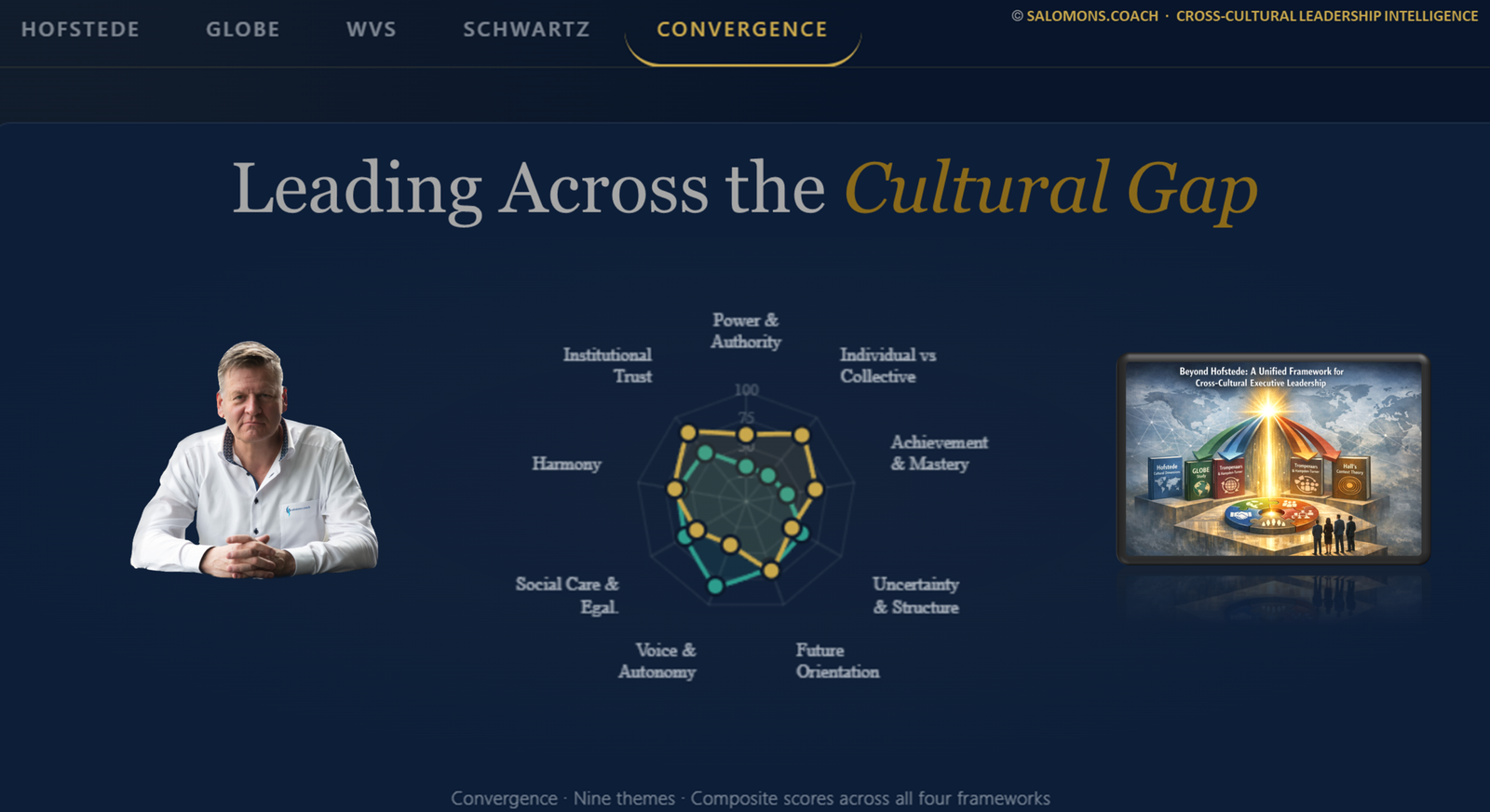
Every leader who crosses a cultural boundary carries two operating systems at once. One was installed in childhood. The other was acquired through years of professional adaptation. The real skill — the one that separates effective cross-cultural leaders from merely well-travelled ones — is knowing which system is running at any given moment, and whether it is serving the situation.
The Cross-Cultural Leadership Compass is built around exactly this challenge. It integrates four validated academic frameworks — Hofstede, GLOBE, the World Values Survey, and Schwartz — and translates the data into eleven specific leadership dimensions where cultural gaps play out in practice. This post unpacks each one.

