Why Conversations Get Stuck


Leadership communication
Why Conversations Get Stuck
The three layers of communication—and why relationship and structure determine what can be discussed.
When leaders prepare for an important conversation, they usually focus on the content: the facts, the message, the decision or the arguments they want to present.
Content matters, but it is only one part of communication. Every conversation is also shaped by its structure or format and by the relationship between the people involved. These deeper layers strongly influence what can be said, how it is interpreted and whether the conversation leads to understanding or resistance.
I use a simple three-layer model in leadership coaching:
- Content—what we are talking about
- Structure or format—how the conversation is organised
- Relation—how the people involved experience each other and their connection
The model uses two triangles because each participant enters the conversation with their own experience of all three layers. What one person intends is not necessarily what the other person experiences.
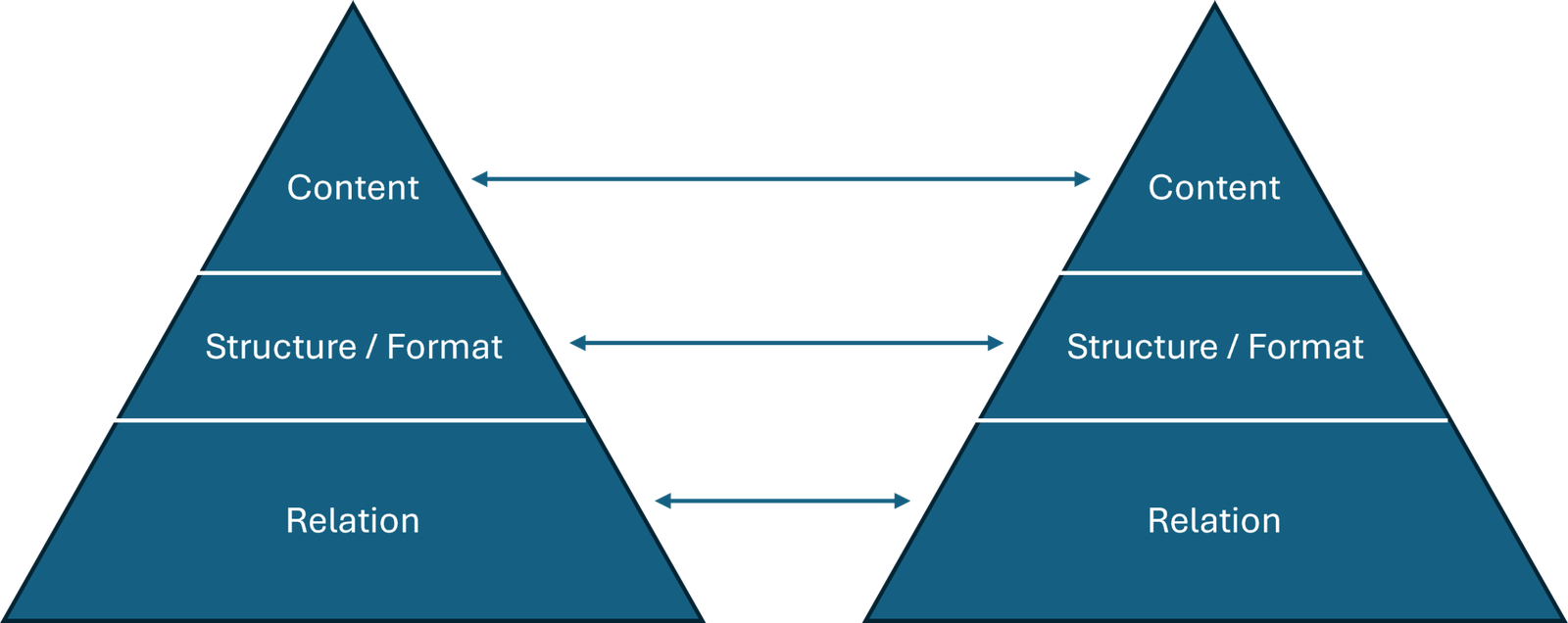
Three conversations are happening at the same time
During any leadership conversation, people are not only exchanging information. They are also interpreting how the interaction is organised and what it communicates about their relationship.
Even when these questions remain unspoken, people are often asking themselves:
- Who is leading this conversation?
- What role am I expected to play?
- Is my perspective genuinely welcome?
- Can I trust the other person’s intention?
- Is it safe to disagree?
- Will disagreement affect our relationship?
- Has the outcome already been decided?
This is why apparently rational discussions can become tense, repetitive or unproductive. The visible disagreement may concern content, while the real difficulty sits at the level of structure or relation.
Content: what we are talking about
The content layer contains the subject of the conversation:
- Facts and information
- Ideas and proposals
- Targets and results
- Problems and solutions
- Feedback
- Decisions
- Agreements and actions
Content is the most visible layer and therefore the easiest one to focus on. When a conversation becomes difficult, leaders often respond by explaining the point again, adding evidence or sharpening the argument.
That may help when the problem is genuinely a lack of information. It is much less effective when the other person is reacting to an unclear process, a lack of influence or a damaged relationship. More content does not resolve a problem at another layer.
Structure and format: how the conversation is organised
The structure or format creates the container for the conversation. It includes:
- Who initiates and attends the conversation
- Where and when it takes place
- Whether it is formal or informal
- The communication channel
- Who speaks first and for how long
- Whether questions and disagreement are invited
- Who has decision-making authority
- How conclusions and follow-up are handled
A leader may intend to consult an employee but organise the meeting like an announcement. The employee then responds to the structure rather than to the leader’s stated intention.
Compare these openings:
“I have invited you here to explain the decision we have made.”
“I want to discuss the situation, understand your perspective and then decide how we proceed.”
Both may concern the same topic, but they create very different expectations about participation, authority and influence. Clear structure helps people understand what is open, what is fixed and what contribution is expected from them.
Relation: the foundation of communication
The relation layer concerns how people experience each other and their connection. It includes:
- Trust
- Status and power
- History
- Mutual respect
- Psychological safety
- Perceived intention
- Openness or tension
- Expectations of each other
Every message also contains an implicit relational message:
“What does the way you communicate with me say about how you see me and our relationship?”
The same words can therefore have very different effects. Direct feedback from a trusted leader may feel helpful and respectful. The same feedback from a leader who has repeatedly dismissed someone’s contribution may feel threatening or humiliating.
Relation is at the base of the model because it influences everything above it. When trust is strong, people can usually tolerate more directness, uncertainty and disagreement. When trust is weak, even neutral content can be interpreted defensively.
Relation shapes structure—and structure shapes content
Relation → Structure → Content
The relationship influences how a conversation is organised. The structure then influences which content becomes possible. What happens at the content level feeds back into the relationship.
A leader who trusts a team may invite open discussion, make the decision process transparent and allow challenge. That structure produces richer content: risks are raised, assumptions are tested and alternatives become visible.
A leader who fears losing control may tightly manage the agenda, limit speaking time and move quickly towards a decision. The content becomes narrower, and silence can be mistaken for agreement. This result may then reinforce the leader’s belief that the team has little to contribute.
The three layers continually influence one another. The arrows between the two triangles also remind us that each person’s behaviour becomes part of the other person’s experience.
Why conversations become stuck
A conversation is often stuck at a deeper layer when:
- The same arguments are repeatedly exchanged
- People become defensive despite apparently reasonable content
- More data does not resolve the disagreement
- Decisions are repeatedly revisited
- People agree publicly but resist privately
- Emails become longer and more formal
- Small details replace the central concern
These signs invite a different question. Instead of asking only, “How can I make my point more convincingly?” the leader can ask, “At which layer is this conversation actually getting stuck?”
A leadership example
Imagine a leader who wants to discuss a pattern of missed deadlines. The leader sees the issue as one of accountability. The employee believes the workload and competing priorities have not been understood.
The leader schedules a formal meeting, presents a list of missed dates and asks the employee to explain. The employee experiences the structure as an accusation and the relation as one in which the conclusion has already been reached. They become defensive. The leader interprets this defensiveness as avoidance of responsibility.
The content discussion is now carrying an unresolved structural and relational problem.
A different opening could be:
“I want us to understand why the deadlines are repeatedly becoming difficult and agree what needs to change. I will share what I have observed, but I also want to hear how you see the situation before we discuss solutions.”
This does not remove accountability. It makes the purpose and process clear, while communicating that the employee’s perspective matters. The changed structure makes a more productive content conversation possible.
The connection with the Leadership Iceberg
The three-layer communication model and the Leadership Iceberg complement each other.
The communication model helps identify where a conversation is getting stuck:
- At the level of content
- In the structure or format
- In the relationship
The iceberg model helps explore what is driving the visible pattern: assumptions, emotions, values, needs, beliefs, earlier experiences or organisational pressures.
A leader may control the meeting structure because they feel anxious about losing authority. An employee may challenge the content because they feel excluded from the process. By combining the two models, coaching can connect the visible communication pattern with the internal processes beneath it.
How I use the model in leadership coaching
I usually begin with a specific conversation that did not produce the intended result. We examine the visible exchange: what was said, how the meeting was organised and what happened next.
We then map both triangles.
The leader’s triangle
- What content did the leader want to discuss?
- Which structure or format did they choose?
- How did they experience the relationship?
The other person’s likely triangle
- What did they believe the conversation was about?
- How might they have interpreted the structure?
- What did the interaction communicate about the relationship?
The purpose is not to pretend that we can know exactly what another person thought or felt. Assumptions become questions to test in dialogue. The map helps the leader identify the layer at which a small change could have the greatest effect.
The initial hurdles for leaders
The model is simple to understand, but using it well asks leaders to overcome several familiar habits.
Remaining focused on content
Leaders are trained to solve problems and make decisions. When a conversation becomes difficult, their instinct is often to improve the argument. The first hurdle is recognising that a content response cannot solve every communication problem.
Avoiding the relational conversation
Naming tension, mistrust or perceived disrespect can feel risky. Leaders may prefer to stay with a safer technical topic. Yet avoiding the relational layer often leaves it silently influencing every exchange.
Treating structure as administration
The meeting invitation, participants, setting, agenda and decision process are not neutral details. They communicate expectations and status. Leaders need to design the structure as deliberately as the message.
Underestimating the effect of authority
A leader may believe they have invited open discussion while employees experience a strong pressure to agree. Formal authority amplifies words, tone and format. Leaders need to account for that imbalance rather than assume that silence means consent.
Assuming instead of checking
The model can tempt people to interpret someone else’s triangle with too much certainty. Its value lies in generating better questions: “How did you experience the way this conversation was organised?” or “What would make it easier to discuss this openly?”
Outcomes I have seen with clients
With some of my clients, this model has helped turn vague communication frustration into something concrete and workable. Leaders have become better able to:
- Identify when a disagreement is not really about the content
- Clarify the purpose and decision process before a meeting
- Choose a format that supports the intended conversation
- Name tension without blame
- Create more space for questions and challenge
- Recognise how formal authority affects participation
- Reduce repetitive or defensive discussions
- Address relational issues before they distort the content
- Reach clearer agreements and more durable decisions
The model does not provide a script for every conversation. It provides a way to diagnose the interaction and choose a more useful intervention.
Questions to prepare an important conversation
Relation
- How would I describe our current relationship?
- How much trust is present?
- Is there unresolved tension or history?
- How might my role or authority affect openness?
- What should this conversation communicate about our relationship?
Structure / format
- What is the purpose?
- Is this discussion, consultation or decision?
- Who should participate?
- Which format best supports the purpose?
- How will voice and authority be balanced?
- What happens afterwards?
Content
- What is the central issue?
- Which facts and observations matter?
- Which assumptions am I making?
- What do I need to understand from the other person?
- What outcome or agreement is needed?
Effective communication starts below the content
Content matters. Leaders need clear messages, sound reasoning and explicit agreements. But relation and structure shape what can be discussed, what people are willing to contribute and how the content will be interpreted.
When a conversation becomes stuck, the most useful question is not always:
“How can I explain this more clearly?”
It may be:
“At which level is this conversation actually getting stuck?”
That shift helps leaders move beyond repeating the message and start shaping the conditions for meaningful communication.

You may also like

Five Steps to Take Immediate Control of a Crisis

Most Leadership Teams Lack Dialogue