salomons.coachsalomons.coach
  • Home
  • About Me
  • Blog
  • Downloads
    • Cross-Cultural Leadership Compass
    • Psychological Safety Field Guide
    • Energy Awareness Journal
    • The Executive Presenting Framework
    • The Executive Ownership Reinforcement Framework
    • The Evidence Base for Coaching Effectiveness
    • The Art of Time Boxing
    • VUCA Leadership WorkBook
    • VUCA Leadership Book
  • Services
  • Testimonials
  • Session Scheduler
  • Contact
  • Change language to Nederlands
Back
  • Home
  • About Me
  • Blog
  • Downloads
    • Cross-Cultural Leadership Compass
    • Psychological Safety Field Guide
    • Energy Awareness Journal
    • The Executive Presenting Framework
    • The Executive Ownership Reinforcement Framework
    • The Evidence Base for Coaching Effectiveness
    • The Art of Time Boxing
    • VUCA Leadership WorkBook
    • VUCA Leadership Book
  • Services
  • Testimonials
  • Session Scheduler
  • Contact
  • Change language to Nederlands
  • Home
  • Blog
  • Blog
  • When managers disengage: how leadership apathy fuels team disconnection

Blog

08 Aug

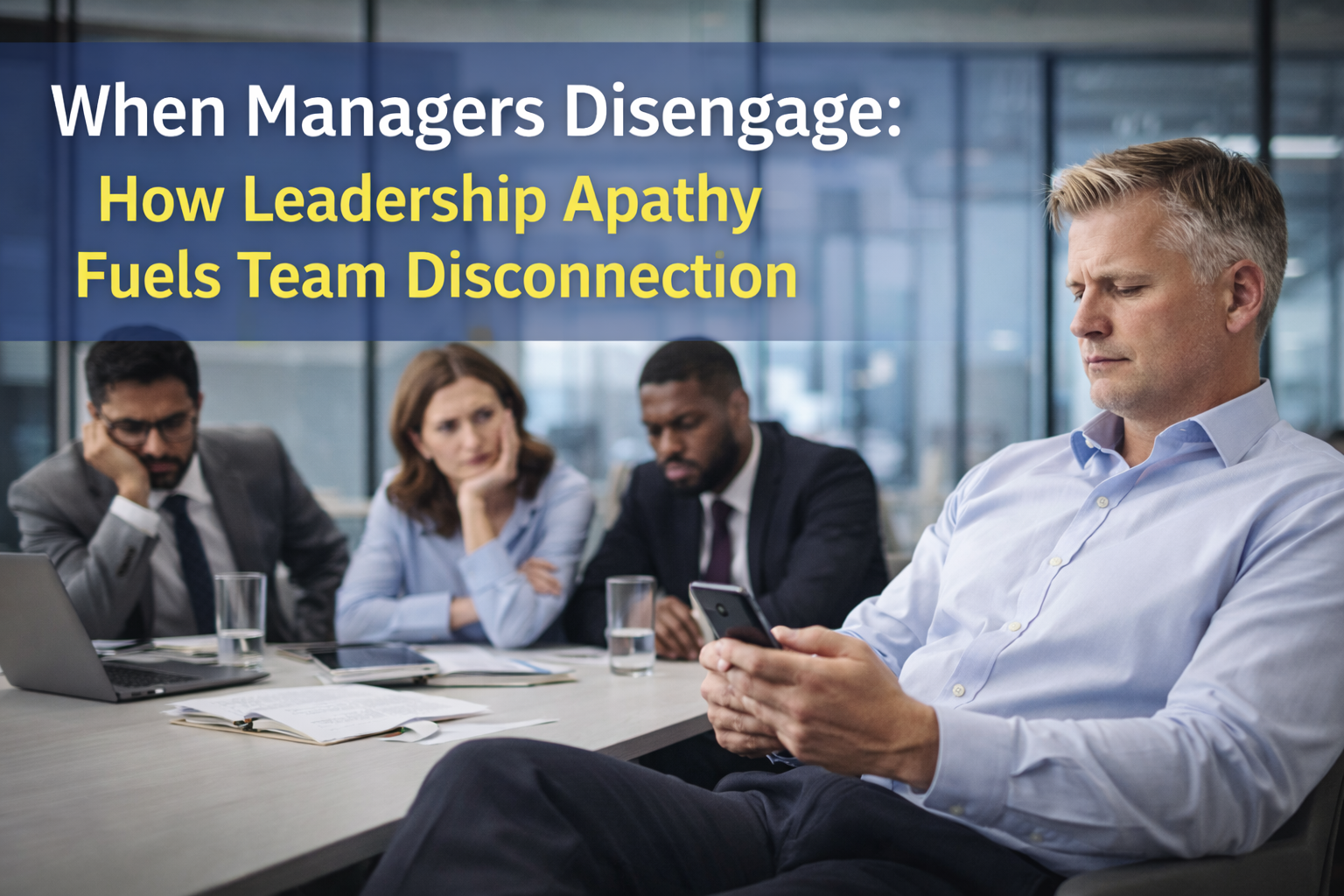
When managers disengage: how leadership apathy fuels team disconnection
  • By salomons.coach
  • In Blog, VUCA & Leadership

After I published my article on “Is it time to stay or move on?” on LinkedIn, — someone asked a sharp question:

“What about disengaged managers?”

A great question — and my quick answer was: “

Great point and also a growing pattern I think. If they decided not to reflect for whatever reason, I assume at some point their mamager will? At the same time, if tables are turned and the team is asked to reflect, this could become addressed.
In my coaching I have had this a few times Reconnecting to purpose makes the difference. They stay re-engaged or they move on.

On second thought, I really felt the need to dig deeper and deliver evidence on disengaged managers. My thinking is that this turns the table again (an expression used in the previous post a few times).

Because if we’re talking about disengagement, we might be looking in the wrong direction.
Maybe it’s not always the employees who’ve checked out.
Maybe it starts with us — the managers.

The silent drain of disengaged managers

Gallup’s latest State of the Global Workplace (2024) reveals that only 27% of managers are engaged at work, meaning nearly three-quarters lead from a place of disconnection. Other studies show that 70% of a team’s engagement is directly linked to their manager’s engagement level.

In other words, when leaders lose their spark, so do their teams.

And it’s not because managers don’t care — most started with purpose and ambition. But over time, constant pressure, unclear expectations, and limited reflection space can drain even the best. As Gallup and Harvard Business Review both noted, manager burnout is at record highs, and disengagement spreads quietly but quickly through organizations.

The reflection gap

When I wrote that “regular career reflection makes you a stronger leader,” I meant exactly this: reflection is not a luxury — it’s maintenance.

Disengagement often begins when managers stop asking themselves:

  • Why am I still doing what I do?
  • What gives me energy here — and what takes it away?
  • Am I still learning, growing, and making a difference?

Without that pause for reflection, managers risk running on autopilot — and teams feel it. Performance meetings become mechanical. Coaching turns into correction. Curiosity fades.
And before long, disengagement isn’t just personal — it’s cultural.

Turning the question back on us

In my original post, I encouraged professionals to ask: “Is it time to stay or move on?”
That question still stands — but it’s equally relevant for managers themselves.

Because if you, as a leader, feel disengaged, your team is already paying the price.
So before we label our teams as disengaged, we should first ask ourselves:

Am I still connected to my purpose?
Do I create space for learning and meaning — for myself and others?

Sometimes, the most courageous act of leadership is not pushing harder, but pausing long enough to reconnect, or if needed, to move on.

Re-engagement starts with self-leadership

Research from Edmondson, Senge, and McKinsey all point in the same direction:
organizations thrive when leaders model learning, reflection, and authenticity.
Engaged leaders create psychological safety and openness. Disengaged ones, even unintentionally, create silence and compliance.

That’s why career reflection isn’t just an HR exercise. It’s a leadership responsibility.
Before you can re-engage others, you need to re-engage yourself.

Reflection questions for leaders

  • When was the last time you felt deeply energized by your work?
  • What situations drain you most — and what does that reveal?
  • If your team mirrored your current level of engagement, what would that look like?
  • What one step could you take this week to reconnect with your purpose?

Final thought

Disengagement isn’t an employee problem — it’s an organizational signal.
And often, it starts at the top.

So yes — let’s keep asking “Is it time to stay or move on?”
But let’s make sure the question doesn’t just apply to our teams.
It might apply to us, too.

John M., Thank you for highlighting this and pointing out I missed this dimension of disengagement and the ultimate silent resignation problem in organizations.

References (for readers who value evidence):

  • Gallup (2024), State of the Global Workplace.
  • Afrahi, B. (2022), Work Disengagement: A Review of the Literature.
  • Mazzetti & Schaufeli (2022), Engaging Leadership and Team Effectiveness, PLOS One.
  • Harvard Business Review (2019), If Your Managers Aren’t Engaged, Your Employees Won’t Be Either.
  • Deloitte (2019), Learning in the Flow of Life.

One of my core activities is to deliver team coaching when specific challenges need to be taken up, either in terms of performance, or the way the team engages and works together. Feel free to book a free 30 minutes call with me to discuss if I can be of help for your situation.

Make a quick free appointment here

Tags:leadership behaviormindsetself-awarenessteam engagement
  • Share:
salomons.coach
Jan Salomons is a seasoned leader/executive who shares his knowledge and experience as an executive mentor/coach/trainer and transformation consultant. He has over thirty-five years of experience working with with senior leaders across more than sixty countries, and is an elected member of the Harvard Business Review Advisory Council.

You may also like

Team in a strategy workshop around a wall of charts and sticky notes

An Obeya Room Is Not a Wall Full of KPIs

  • 18 July 2026
  • by salomons.coach
  • in Blog
An effective Obeya room is more than a collection of dashboards and performance indicators. Discover how clear purpose, management...
ADHD Leadership Videos
14 July 2026
The Best ADHD Videos for Leaders: Science, Stories, Strategy
14 July 2026
Blue gradient banner: 'The ADHD Leader' with gold dotted lines and circular tech-inspired design, subtitle: 'Scattered energy, channelled by structure.' site: salomons.coach
The ADHD Leader
14 July 2026

Leave A Reply Cancel reply

Your email address will not be published. Required fields are marked *

This site uses Akismet to reduce spam. Learn how your comment data is processed.

Categories

  • AI (3)
  • Blog (135)
  • Books & Publications (7)
  • Change & Transformation (29)
  • Download (2)
  • Innovation & Strategy (5)
  • Learning & Development (12)
  • Organizations & Culture (32)
  • Self & Personal Growth (63)
  • Teams & Collaboration (26)
  • Tools & Methods (30)
  • Video (16)
  • VUCA & Leadership (65)
  • Web Courses & Programs (4)
  • Workshops & Events (12)

Recent Posts

Team in a strategy workshop around a wall of charts and sticky notes
An Obeya Room Is Not a Wall Full of KPIs
18Jul,2026
ADHD Leadership Videos
14Jul,2026
The Best ADHD Videos for Leaders: Science, Stories, Strategy
14Jul,2026

Tags

4R model (6) accountability (5) authenticity (5) behavior (6) career (12) change (26) coaching (47) communication (6) cross-cultural leadership (8) culture (15) decision-making (8) dersonal-development (6) emotions (6) executive-coaching (8) executive coaching (5) feedback (4) focus (4) growth (6) leadership (58) leadership behavior (42) leadership coaching (8) leadership development (8) leadership habits (4) learning (9) mindset (5) psychological safety (23) recovery (4) redundancy (9) reflection (33) resilience (19) self-awareness (50) self-leadership (14) self-management (9) self-regulation (6) stress (8) team alignment (5) team coaching (5) teams (7) TED (5) tools (14) transformation (5) trust (7) VUCA (34) VUCA leadership (33) work-life balance (5)
All posts - searchable table
Recent videos
the-adhd-watch-list-hero

The Best ADHD Videos for Leaders: Science, Stories, Strategy

In 14 July 2026
No Comment
Female speaker on stage delivering a TEDx talk, with a headset mic and gesturing, while a lower-third bio identifies her as a professor of organizational behaviour.

The Authenticity Paradox | Professor Herminia Ibarra 

Brooks – Harvard – on Happiness

Happiness as a Leadership Strategy

L360 youyrownjourney landing page L360

Find your true purpose

GET IN TOUCH

Salomons.Coach
KvK: 72129131
+31 6 53 89 75 67

jan@salomons.coach

The Netherlands

USEFUL LINKS

  • About
  • Privacy policy
  • Term & Conditions
  • Refund & Returns
  • Payment policy
  • Digital Policy
  • Methodology & Sources

LinkedIn

  • Linkedin
Receive blog updates

salomons.coach by J.K. Salomons Holding B.V., 2018-2026

  • Home
  • About Me
  • Blog
  • Downloads
    • Cross-Cultural Leadership Compass
    • Psychological Safety Field Guide
    • Energy Awareness Journal
    • The Executive Presenting Framework
    • The Executive Ownership Reinforcement Framework
    • The Evidence Base for Coaching Effectiveness
    • The Art of Time Boxing
    • VUCA Leadership WorkBook
    • VUCA Leadership Book
  • Services
  • Testimonials
  • Session Scheduler
  • Contact
  • Change language to Nederlands
Change language to Nederlands