salomons.coachsalomons.coach
  • Home
  • About Me
  • Blog
  • Shop
  • Downloads
    • Your Own Career Coach
    • Cross-Cultural Leadership Compass
    • Your stress Profile
    • Psychological Safety Field Guide
    • Energy Awareness Journal
    • The Executive Presenting Framework
    • The Executive Ownership Reinforcement Framework
    • The Evidence Base for Coaching Effectiveness
    • The Art of Time Boxing
    • VUCA Leadership WorkBook
    • VUCA Leadership Book
  • Services
  • Testimonials
  • Session Scheduler
  • Contact
  • Change language to Nederlands
Back
  • Home
  • About Me
  • Blog
  • Shop
  • Downloads
    • Your Own Career Coach
    • Cross-Cultural Leadership Compass
    • Your stress Profile
    • Psychological Safety Field Guide
    • Energy Awareness Journal
    • The Executive Presenting Framework
    • The Executive Ownership Reinforcement Framework
    • The Evidence Base for Coaching Effectiveness
    • The Art of Time Boxing
    • VUCA Leadership WorkBook
    • VUCA Leadership Book
  • Services
  • Testimonials
  • Session Scheduler
  • Contact
  • Change language to Nederlands
  • Home
  • Blog
  • Blog
  • Innovation: Aerodynamic Trucks

Blog

04 Apr

Innovation: Aerodynamic Trucks
  • By salomons.coach
  • In Blog, Innovation & Strategy, Video

A blast from the past.

Between 2010 and 2013, I had the privilege of working with TU Delft and Gandert van Raemsdonck, who was doing his PhD on vehicle aerodynamics and energy efficiency. At that time, I was responsible for business development, process optimization, and system innovation within TNT’s European Road Network, with fleet management and environmental performance also in my portfolio.

It was a fascinating period.
Electrification was still in its early stages, diesel dominated the industry, and the logistics sector was just beginning to realize how much untapped potential there was in aerodynamics and energy efficiency. A remarkable group of engineers, researchers, operations specialists, OEMs, policymakers, and environmental advocates joined forces. Everyone brought their own expertise, but we were united by one shared ambition:

How to make road transport cleaner, smarter, and more efficient?

Together with TU Delft — and driven by Gandert’s research — we explored how airflow, drag, and turbulence could be minimized. The focus was on real, practical, operational gains, not theoretical possibilities. We examined airflow around trailers, turbulence behind the truck, and the energy losses that occur in “dirty” flow zones — insights that were ahead of their time.

One unforgettable moment was when RTL Nieuws, the national news channel in the Netherlands, covered the project.
That video became our unexpected “moment of fame,” showing the wider public that innovation in logistics isn’t always about new engines — sometimes, it’s about smarter physics.

The aerodynamic features we developed included:

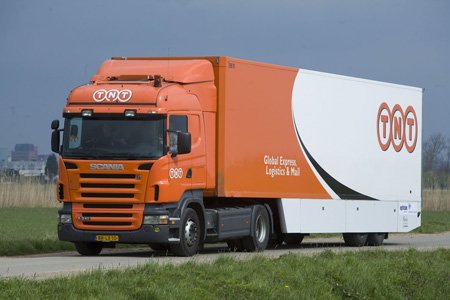
  • Side wings for trailers to smooth the airflow and reduce lateral drag.
  • Rear-end aerodynamic solutions aimed at reducing the vacuum effect behind trucks — the largest source of drag at higher speeds.
  • Early experiments that today resemble the tail flaps, vortex stabilizers, and flow management devices now common in modern fleets.

These innovations helped reduce fuel consumption, lower CO₂ emissions, and improve the environmental footprint of the entire network — long before sustainability became the mainstream priority it is today.

Looking back, this project taught me something that still shapes my leadership and coaching work today:

👉 Real progress happens when diverse minds come together, challenge assumptions, and experiment boldly.
👉 Innovation accelerates when you break silos — between universities and operations, between theory and practice, and between ambition and reality.

What started as a technical project became a powerful example of system-wide collaboration: academia, business, engineering, sustainability, and operations — all contributing to a shared result.

And although the technology has evolved dramatically since then, the lesson remains the same:

When you bring the right people together and give them the freedom to explore, you build the future before others even see it coming.
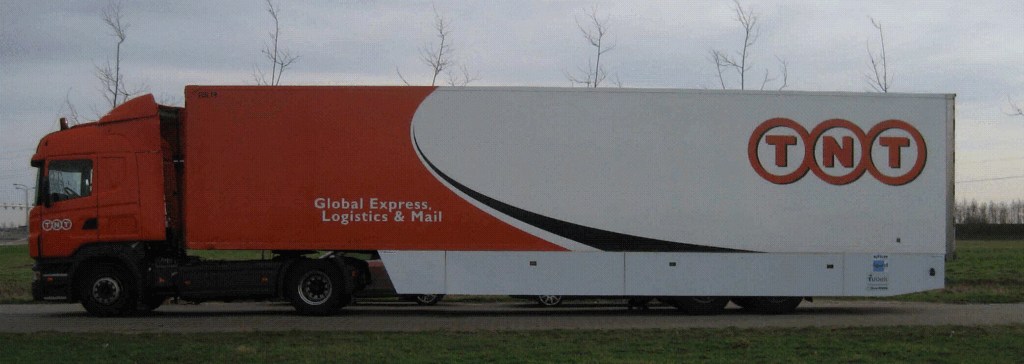
Aerodynamische vrachtwagen met side skirts langs A325. TNT
Tags:efficiencyenergy efficiencyengineeringindustrial designinnovationlogistics
  • Share:
salomons.coach
Jan Salomons is a seasoned leader/executive who shares his knowledge and experience as an executive mentor/coach/trainer as well as a transformation and operations excellence expert. He has over 35 years of experience working with senior leaders across more than 55 countries, and is an elected member of the Harvard Business Review Advisory Council.

You may also like

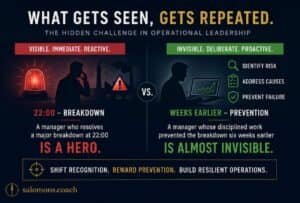
Infographic titled 'What gets seen, gets repeated' showing two columns: left red section 'Visible. Immediate. Reactive.' with a red alert siren, a worker on the phone, factory silhouettes, and a '22:00' breakdown; caption 'IS A HERO.' Right green section 'Invisible. Deliberate. Proactive.' with a worker at a laptop displaying a rising graph and icons labeled 'Identify risk', 'Address causes', 'Prevent failure'; caption 'WEEKS EARLIER – PREVENTION' and 'IS ALMOST INVISIBLE.' Bottom banner reads 'Shift recognition. Reward prevention. Build resilient operations.' and shows salomons.coach.

What Gets Seen, Gets Repeated – Firefighters vs Preventers

  • 26 September 2026
  • by salomons.coach
  • in Blog
A manager who fixes a breakdown at 22:00 is a hero. The manager whose work prevented it six weeks...
Infographic titled STEER showing five circular steps (S, T, E, E, R) for crisis leadership on a dark blue background. Steps: Stabilise, Triage, Establish, Execute & inform, Review & refine.
Five Steps to Take Immediate Control of a Crisis

24 September 2026
Infographic comparing Discussion (left) and Dialogue (right): clash graphic vs connected waves, with goal-focused comparisons and a shared outcomes section.
Most Leadership Teams Lack Dialogue
22 September 2026
Infographic poster with a dark blue background, large white headline reading “My team says it’s the workload,” and a diagram highlighting pressure factors (Ambiguity, Conflict, Overload) in orange.
It is not the workload. Stop calling it the workload.
18 September 2026

Leave A Reply Cancel reply

Your email address will not be published. Required fields are marked *

This site uses Akismet to reduce spam. Learn how your comment data is processed.

Categories

  • AI (3)
  • Blog (150)
  • Books & Publications (7)
  • Change & Transformation (30)
  • Download (2)
  • Innovation & Strategy (6)
  • Learning & Development (12)
  • Organizations & Culture (40)
  • Self & Personal Growth (74)
  • Teams & Collaboration (34)
  • Tools & Methods (38)
  • Video (16)
  • VUCA & Leadership (77)
  • Web Courses & Programs (4)
  • Workshops & Events (14)

Recent Posts

Infographic titled 'What gets seen, gets repeated' showing two columns: left red section 'Visible. Immediate. Reactive.' with a red alert siren, a worker on the phone, factory silhouettes, and a '22:00' breakdown; caption 'IS A HERO.' Right green section 'Invisible. Deliberate. Proactive.' with a worker at a laptop displaying a rising graph and icons labeled 'Identify risk', 'Address causes', 'Prevent failure'; caption 'WEEKS EARLIER – PREVENTION' and 'IS ALMOST INVISIBLE.' Bottom banner reads 'Shift recognition. Reward prevention. Build resilient operations.' and shows salomons.coach.
What Gets Seen, Gets Repeated – Firefighters vs Preventers
26Sep,2026
Infographic titled STEER showing five circular steps (S, T, E, E, R) for crisis leadership on a dark blue background. Steps: Stabilise, Triage, Establish, Execute & inform, Review & refine.
Five Steps to Take Immediate Control of a Crisis
24Sep,2026
Infographic comparing Discussion (left) and Dialogue (right): clash graphic vs connected waves, with goal-focused comparisons and a shared outcomes section.
Most Leadership Teams Lack Dialogue
22Sep,2026

Tags

4R model (6) accountability (7) authenticity (5) behavior (8) career (12) change (28) coaching (51) communication (8) cross-cultural leadership (8) culture (15) decision-making (9) dersonal-development (6) emotions (6) executive-coaching (8) executive coaching (6) feedback (4) focus (4) growth (6) leadership (66) leadership behavior (47) leadership coaching (8) leadership development (8) learning (9) mindset (5) psychological safety (29) redundancy (9) reflection (34) resilience (21) self-awareness (56) self-leadership (14) self-management (9) self-regulation (6) stress (10) team-dynamics (10) team alignment (5) team coaching (9) teams (7) TED (5) Time Management (5) tools (19) transformation (5) trust (7) VUCA (37) VUCA leadership (39) work-life balance (5)
All posts - searchable table
Recent videos
the-adhd-watch-list-hero

The Best ADHD Videos for Leaders: Science, Stories, Strategy

In 14 July 2026
No Comment
Female speaker on stage delivering a TEDx talk, with a headset mic and gesturing, while a lower-third bio identifies her as a professor of organizational behaviour.

The Authenticity Paradox | Professor Herminia Ibarra 

Brooks – Harvard – on Happiness

Happiness as a Leadership Strategy

L360 youyrownjourney landing page L360

Find your true purpose

GET IN TOUCH

Salomons.Coach
KvK: 72129131
+31 6 53 89 75 67

jan@salomons.coach

The Netherlands

USEFUL LINKS

  • About
  • Privacy policy
  • Term & Conditions
  • Refund & Returns
  • Payment policy
  • Digital Policy
  • Methodology & Sources

LinkedIn

  • Linkedin
Receive blog updates

salomons.coach by J.K. Salomons Holding B.V., 2018-2026

  • Home
  • About Me
  • Blog
  • Shop
  • Downloads
    • Your Own Career Coach
    • Cross-Cultural Leadership Compass
    • Your stress Profile
    • Psychological Safety Field Guide
    • Energy Awareness Journal
    • The Executive Presenting Framework
    • The Executive Ownership Reinforcement Framework
    • The Evidence Base for Coaching Effectiveness
    • The Art of Time Boxing
    • VUCA Leadership WorkBook
    • VUCA Leadership Book
  • Services
  • Testimonials
  • Session Scheduler
  • Contact
  • Change language to Nederlands
Change language to Nederlands