The World Values Survey: The Deepest Layer of Cultural Difference — and Why Leaders Miss It
By Jan Salomons · Salomons.Coach
Most executives I work with have heard of Hofstede. Some have encountered GLOBE. Almost none have heard of the World Values Survey — and yet it is arguably the most important piece of the cross-cultural picture for anyone who needs to understand not just how people behave at work, but why.
Hofstede and GLOBE measure cultural practices and values as they show up in professional contexts. The World Values Survey measures something deeper: the foundational beliefs that a society holds about what makes a good life, what institutions deserve trust, and whether individual autonomy or collective security is the more fundamental human priority.
These are the values that take generations to shift. They survive organisational culture change programmes. They outlast leadership transitions. And they shape the professional context you operate in at a level that no amount of training on “communication styles” will reach.
What Is the World Values Survey?
The World Values Survey is a global research programme launched by political scientist Ronald Inglehart in 1981. Now in its seventh wave (2017–2022), it has surveyed respondents in 87 countries covering more than 90 percent of the world’s population. It is the most geographically comprehensive values research programme in existence.
The framework that most directly derives from the WVS is the Inglehart-Welzel Cultural Map, which organises countries on two axes:
Traditional vs Secular-Rational values. Traditional societies emphasise religion, national pride, deference to authority, and the absolute importance of parent-child relationships. Secular-Rational societies are more comfortable questioning authority and tend toward economic and political rationalism.
Survival vs Self-Expression values. This is the axis I find most diagnostically valuable for leadership coaching. Survival-oriented cultures prioritise economic and physical security, conformity to social norms, and wariness of outsiders. Self-Expression-oriented cultures prioritise autonomy, individual quality of life, civic participation, and interpersonal trust.
The Cross-Cultural Leadership Compass also incorporates a third WVS-derived measure: Institutional Confidence — the degree to which a society’s population trusts its major institutions. This dimension turns out to be surprisingly predictive for leadership.
Why WVS Is Different From the Other Frameworks
The simplest way to put it: Hofstede and GLOBE measure how culture shows up in the workplace. The WVS measures what people bring to the workplace from their wider societal experience.
That distinction matters most in two situations.
First, when the professional context has changed faster than the underlying values. An organisation can adopt flat hierarchy and direct communication norms. It can train managers in Dutch-style directness or German-style procedural rigour. But the individuals in that organisation still carry their WVS-level values into every interaction. A Chinese professional working in a Dutch organisation for eleven years will have adapted significantly on the surface. The WVS Self-Expression score gap between China (40) and the Netherlands (86) — a Δ46 on a 0–100 scale — does not close in eleven years.
Second, when you are trying to understand trust. Institutional Confidence is one of the most underrated dimensions in the cross-cultural toolkit. It answers the question: to what degree does this person’s background incline them to extend default trust to institutions, contracts, and professional credentials — versus requiring that trust to be built through personal relationship?
China scores 82 on Institutional Confidence. The Netherlands scores 58. Spain scores 34.
When a Spanish professional appears to require an unusually deep personal relationship before a business deal can progress, it is often read as Southern European warmth. It is more precisely described as a rational adaptation to a history of low institutional reliability. Understanding it through the WVS lens changes how you build the relationship — and how long you allow for it.
The Inglehart-Welzel Map: What It Actually Shows
The Protestant European cluster (Scandinavia, Netherlands, Germany, Switzerland) occupies the top-right quadrant: high Secular-Rational, high Self-Expression. These societies are post-materialist in orientation. Economic security is assumed. What people work for is autonomy, self-realisation, and quality of life. The Dutch MAS score of 14 (the lowest in Hofstede’s dataset) is not an accident. It is the organisational expression of a WVS Self-Expression score of 86.
The Confucian cluster (China, Japan, South Korea, Taiwan) occupies the right side of the map but significantly lower on Self-Expression. These societies have moved substantially toward Secular-Rational values, but they remain more Survival-oriented. Collective security, family obligation, and institutional loyalty remain more central.
The Catholic European cluster (Spain, Italy, France, Portugal) occupies a middle position. Their low Institutional Confidence scores — Spain at 34, Italy and France similarly low — are the key leadership signal. These are societies where personal relationship has had to substitute for institutional reliability for a long time.
Three Things the WVS Reveals That Other Frameworks Miss
1. Whether individual autonomy or collective security is the default orientation. The Survival vs Self-Expression axis directly predicts whether a professional will be more energised by freedom, variety, and self-directed challenge — or by stability, belonging, and clearly defined expectations.
2. How much of your institutional credibility will transfer automatically — and how much you need to earn personally. When a Dutch leader arrives in a Chinese or Japanese context, their institutional credibility carries significant authority. When the same leader arrives in a Spanish, Greek, or Latin American context, the personal relationship has to come first.
3. How quickly the cultural distance will close with adaptation — and what will remain. WVS values change on generational timescales, not on individual ones. A professional who has spent a decade in a new cultural context may have adapted their communication style significantly. The WVS-level values they carry are far more stable.
WVS in the Cross-Cultural Leadership Compass
The Cross-Cultural Leadership Compass plots each country on the Traditional-Secular and Survival-Self-Expression axes, visualising them on the Inglehart-Welzel Cultural Map. For many users, this is the single most intuitive moment in the tool — seeing exactly where your two countries sit in relation to each other.
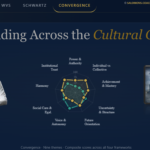
Where the WVS provides its most distinctive value in the Compass is in the Convergence analysis. The Survival-Self-Expression gap between China and the Netherlands (Δ46) is confirmed by the Hofstede Individualism gap (Δ60) and the Schwartz Affective Autonomy gap (Δ34). Three independent frameworks, all pointing to the same structural truth.
Where to Start
The World Values Survey data for your country pair — alongside Hofstede, GLOBE, and Schwartz — is in the Cross-Cultural Leadership Compass, free to use.
Use the Cross-Cultural Leadership Compass →
Jan Salomons is an executive coach and leadership developer based in the Netherlands, with 35+ years of senior management experience including a decade at ASML.
Haerpfer, C. et al. (eds.) (2022). World Values Survey: Round Seven. JD Systems Institute & WVSA Secretariat. DOI: 10.14281/18241.20