When fear rules….. silence takes over: rebuilding trust and connection at work
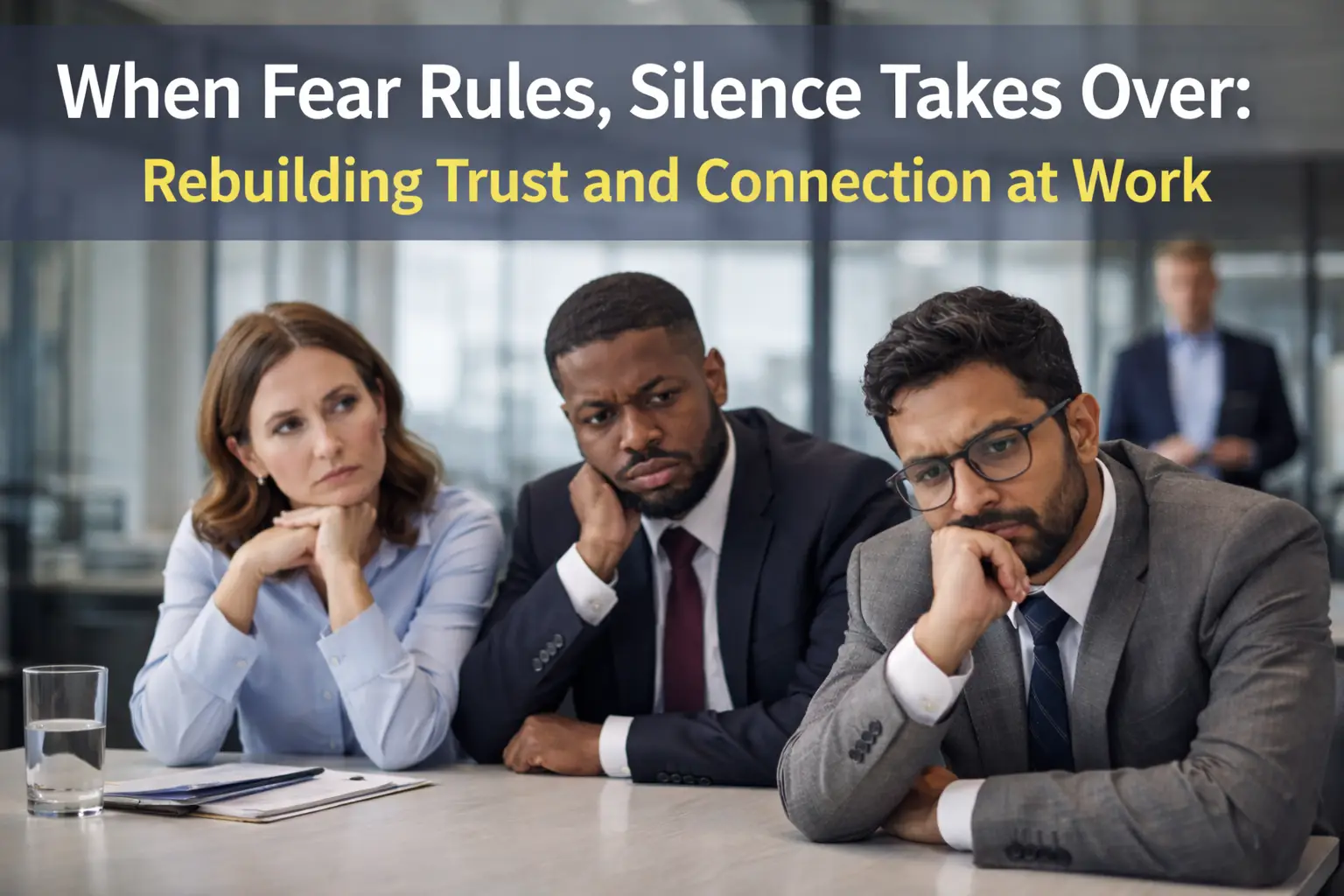
Why leadership awareness is the antidote to fear-driven performance
I still remember sitting in that meeting with a few senior managers. My mind was racing. We were under enormous pressure to deliver on customer expectations, yet falling behind. And I knew I had to bring up a delicate subject: the growing signs of overload in my team. The evidence was everywhere. People were tense, tired, and easily irritated. Communication had become strained, concentration was fading, and collaboration was breaking down. And I wasn’t immune either — I recognized the same fatigue in myself. Too many priorities, too much noise, and no space to breathe. That day reminded me of something I’d experienced years earlier, working as an operations manager in the transport industry. Back then, a culture of fear had slowly taken root. People stopped speaking up. Decisions were made in small circles. Conversations became political. Eventually, it reached a point where employees felt bullied, treated unfairly, and disconnected from the organization — and even from themselves. They showed up, did what they were told, but the spirit was gone. Performance collapsed. Leaders, under pressure to fix the numbers, pushed harder — which only deepened the spiral. It was a deadly loop of control, fear, and disengagement.
What I learned — and why it still matters today
That experience changed how I lead. It taught me that leadership starts with self-awareness — knowing your own values, triggers, and behaviors under pressure. If you want to take fear out of the organization, you have to start by leading yourself. People trust leaders who are consistent, predictable, and genuine. Trust isn’t built through words — it’s built through behavior. When leaders stay grounded in their values and act with integrity, they create psychological safety: the freedom to speak up, to experiment, and to fail without fear of punishment. In every organization I’ve worked with since — from logistics to high-tech manufacturing — this has held true: healthy performance follows trust, not control.
Recognizing fear in an organization
Fear doesn’t always show up as shouting or conflict. It often hides behind polite silence, compliance, and performance metrics. But it’s there. If you recognize more than three of the following patterns, fear is already shaping behavior in your organization: micro-management, simple decisions not allowed at appropriate levels; time measurement instead of output; unhealthy competition or idea theft; reactions based on distrust; resistance to new ideas; performance numbers dominating judgment; “us versus them” culture; real discussions happening outside meetings; political behavior; dependence on supervision; reluctance to admit mistakes; denial of issues; and “we know it all” thinking. The more of these you observe, the more likely your organization is operating in fear mode — a state where control replaces creativity, and compliance replaces commitment.
The VUCA connection
In a VUCA world — one defined by volatility, uncertainty, complexity, and ambiguity — fear spreads faster than ever. Constant change and pressure amplify insecurity. When fear takes hold, people cling to control and routine, even when it hurts performance. But fear and VUCA are opposites in how they shape energy: fear narrows focus — people protect themselves. VUCA-ready leadership broadens awareness — people adapt together. The shift from fear to trust is a leadership act. It requires courage to replace control with clarity, to replace judgment with curiosity, and to build systems that enable ownership instead of dependency. Reframing fear is the essence of VUCA leadership — turning uncertainty into learning, complexity into collaboration, and volatility into purpose.
How leadership can deal with fear in the organization
Dealing with fear starts long before performance drops. It’s a process of seeing, naming, and shifting. Below are five strategies I use with leadership teams to transform fear-driven cultures into trust-driven ones:
1. Acknowledge what’s not being said. Fear grows in silence. As a leader, invite open conversations about tension, pressure, and mistakes. Show that speaking up is not a risk but a contribution.
2. Reframe control into clarity. Replace “checking” with “connecting.” Set clear expectations, but give people ownership of how to achieve them. Clarity reduces anxiety — control amplifies it.
3. Model consistency under pressure. In fearful cultures, people watch leaders closely. Your tone, words, and predictability matter more than any policy. Be the calm in volatility.
4. Create shared responsibility. Move from “leaders decide, others execute” to “we co-own outcomes.” Co-creation builds belonging and dismantles the us-versus-them dynamic that feeds fear.
5. Rebuild rhythm and reflection. Fear makes people reactive. Restore rhythm through regular reflection moments — team dialogues, learning reviews, feedback loops — where people can reset, learn, and reconnect. When fear is present, courage must lead. And courage is not the absence of fear — it’s the willingness to address it together.
How I work with teams on fear and trust
When I coach teams that operate under pressure, fear often shows up as silence, sarcasm, or distance. People protect themselves, and connection fades. My first step is always to make this visible — not to confront, but to observe together what’s really happening in the room. I invite the team to describe what they experience rather than what they think. This shift from judgment to observation opens the door to awareness.
From there, we rebuild rhythm and trust through my way of working:
assignment > diagnostics > co-creation <> delivery <> evaluation >
hyper care > handover > on-demand support.
The <> between co-creation and delivery symbolizes iteration: a continuous loop of reflection and learning. In practice, that means I work with teams to experiment with new behaviors, debrief what happens, and anchor what works.
Step by step, fear loses ground because people rediscover ownership, connection, and confidence. It’s not about fixing people — it’s about helping teams remember how to trust each other again.
How leaders can break the cycle
- Model transparency: Admit what you don’t know, and share what you’re learning. invite voices: Ask questions instead of giving answers. Listen for what’s not being said.
- Create clarity: Define priorities and success in simple, shared language.
- Protect space: Make reflection and recovery part of performance.
- Celebrate honesty: Reward those who speak up or challenge the status quo. Fear thrives in silence. Courage grows in conversation.
Reflection for leaders
Where in your team might fear be shaping behavior more than trust? What’s one action you could take this week to invite more openness, even in uncertainty?
Work with me
In my coaching and leadership programs, I help leaders and teams rebuild trust, clarity, and energy — especially in environments shaped by pressure and change. If you recognize any of these patterns in your organization, let’s start a conversation. Together, we can design a healthier way of leading — one that replaces fear with focus and control with connection.