VUCA is not just the new management jargon
Executive summary
VUCA should not become another piece of management jargon used to excuse uncertainty or indecision. Volatility, uncertainty, complexity and ambiguity are different conditions, and each demands a different leadership response.
This article argues for distinguishing the nature of the challenge before selecting the approach. Some situations require better information, others more flexible planning, understanding of interdependencies or experiments that produce learning. Executives still need direction and accountability even when the environment changes quickly. The value of VUCA lies in sharpening diagnosis and judgment, not in making the business world sound more unpredictable than it is.
“Calling change VUCA adds no value until it changes how you decide and lead.”
Jan Salomons
Introduction
Enterprises operating in a world where technological developments, rapid digitalization, and global boundaries are eliminated, deal with complex services and products, unforeseen developments, and constantly fluctuating market conditions to influence customer decision-making. Prevention of uncertainty, ability to analyze and speed were the most important factors in preventing and solving the crises and problems that showed up in the past. But it is not possible to avoid uncertainty in today’s conditions. None of the classic management techniques and tools make any sense anymore. Without effective risk management, strategic management cannot be without effective process management, nor can these techniques and tools, which do not capture integrity and cannot be integrated into the system in harmony, be expected to have any effect. These techniques, tools and systems can only make an impact within a VUCA-based, accurate management process. Failure to create this management process will reduce these techniques, tools and systems to an idle capacity and impose unnecessary costs on businesses. When the relevant national and international literature is examined, it is observed that very few studies have been carried out on the VUCA phenomenon. Today, most researchers, practitioners and professionals express that VUCA is a permanent phenomenon and its impact will increase day by day.VUCA concept
With the VUCA phenomenon, the modern world is defined where classical leadership skills are not sufficient and reformist decisions are made at the point of leadership. In the world of VUCA, the need for leaders to overcome uncertainties plays a key role. Today’s business world, where VUCA terms apply, exhibits playful, ambiguous, complex and ambiguous features (Areete, 2011). The concept of VUCA is an acronym derived from a military term in the US Army to express the turbulence of global systems, surprising, controversial and dubious world order that was treated as multipolar after the end of the Cold War era declared by the USSR and the US (Kinsinger and Walch, 2012). The concept of VUCA was introduced with the aim of having a clear vision, differentiating their way of thinking, and providing flexibility in strategic actions such as attack, defense and combat training (Allen and Coates, 2009). From its inception until today, the concept of VUCA has found its place in a wide range from state politics to the daily decisions of people, and has been used to make institutions and individuals suffer less harm when dealing with complex phenomena that are unknown and unseen (Shaffer and Zalewski, 2011). VUCA refers to complex and variable business circles faced by corporations and individuals (Sullivan, 2012b). The concept of VUCA, which is often used in political conjunctures, has also established a very close bond with the business world today. In the past, while businesses were planning to solve much more uncertainty, today, uncertainty has become an expected feature in order to manage businesses. But managers and leaders need to take an agile and proactive approach in order to conduct this administration properly and effectively (Sharma, 2015). The last thing that the managers and leaders will do is to act reactive. Rather, managers and leaders must be first and design the future.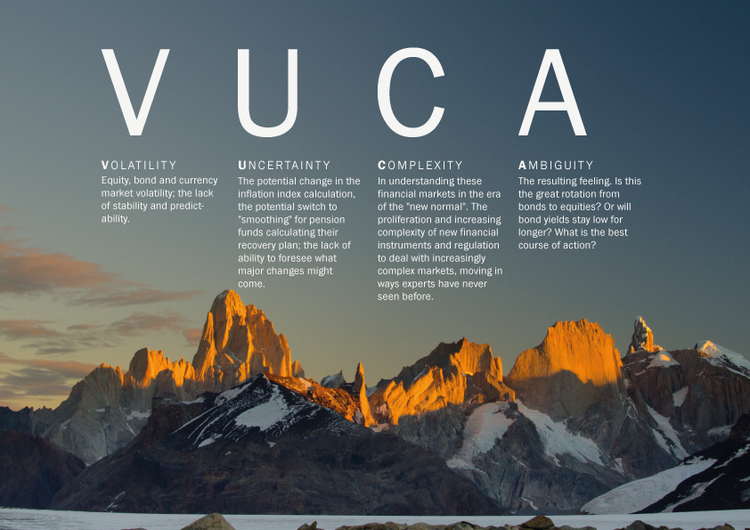 VUCA is an expression of an environment in which playful, ambiguous, complex and ambiguous circumstances prevail, as expressed in previous paragraphs. These components that today’s managers and leaders will often encounter are explained in detail below.
Volatility
The turbulence caused by the constantly increasing change and the speed of this change is defined as volatility (Michel, 2016). In other words, it is unpredictable and non-constant. The closest component of the VUCA concept to the classical definition handled in business life is volatility. Rapid and violent changes bring about instability on behalf of leaders, managers and organizations (Cooke, 2013a). At this point, it should be noted that volatility is not uncertain. In a situation where volatility is present, information about conditions and situations is obtained and results of activities can be predicted. The only problem at this point is the speed of the rate of change. Therefore, when it comes to volatility, the strategies to be implemented will not be appropriate for the other components. Strategies that can be used against the state of volatility include (Loyd, 2015):- Leaders and managers often think that the problems that occur in businesses are due to technology. But a better business model, implementation, execution and culture always outstrips technology.
- Teams need to be encouraged by the idea of achieving it together.
- Where volatility is high, relationships between individuals should be at the highest levels. As connections between individuals become critical, leaders and managers should concentrate on connecting and communicating with stakeholders.
- Since a change in one of the business circles may lead to opportunities in another area, developments should be followed carefully.
Uncertainty
The reduction of predictability levels in decision-making phases of organizations and individuals is expressed as uncertainty (Michel, 2016). In other words, the phenomenon of uncertainty is a lack of knowledge with vital implications for a specific environment and with unforeseen consequences (Bennett and Lemoine, 2014). In today’s business world, which has unpredictable results and disruptive features within organizational structures and business models, businesses are experiencing difficulties especially with the lack of clear conditions regarding customer preferences, industry and markets. Current and future uncertain events, efforts towards change, and reduced tolerance for rapid acquisition of knowledge have made collaborations, decision-making processes, organizations, and interpersonal relationships much more fragile (Bauman, 2008). Strategies that can be used against the state of uncertainty include (Loyd, 2015):- In contrast, mentoring should be focused on new perspectives that are likely to bring relatively new individuals to the sector and industry
- Importance should be given to learning and experience.
- Storytelling and scenario planning help to minimize possible uncertainties.
- Business blindness should be avoided by applying different perspectives from outside the organization.
- Environmental screening is important in order to eliminate uncertainty.
- The level of uncertainty decreases when the desired results are made clear.
Complexity
Complexity refers to the dense knowledge in today’s business world that arises from the external environment and intertwines without varying effects (Bennett and Lemoine, 2014). Individuals dealing with any business in various fields can have more than one problem, decision and solution in their organizations. This is described as an expression of the complexity in today’s business world. As organizations grow, they become more complex in the problems encountered. Therefore, an effective leader and manager must first bring clarity to events in their own mind in environments with high levels of complexity. Because this is the first step towards mobilizing subordinates (Casey, 2014). Strategies that can be used against the state of complexity include (Loyd, 2015):- Simplifying every possible item of work is the most important step to take against complexity.
- Leaders need to be aware of social networks within the organization that are often stronger than the hierarchical order.
- Leaders should recognize that individuals, teams and organizations are complex systems in nature.
- Within the organization, leaders need to have the flexibility and tolerance to think the opposite.
Ambiguity
The confusion of cause and effect, the potential for misjudging situations and events, and the blurring of facts are defined as ambiguity (Guterman and King, 2014). The phenomenon of ambiguity differs from the phenomena of volatility and complexity. In the phenomenon of ambiguity, there is only a deficiency of what will happen in the next step. At this point, the basic element that distinguishes uncertainty from ambiguity is that one can have an idea of the reason why the state of uncertainty arises. The results of specific causes and action paths are quite difficult to identify, as ambiguity usually occurs around a new opportunity, market or product (Bennett and Lemoine, 2014). Strategies that can be used against ambiguity are as follows (Loyd, 2015):- The reasons for the issue should be investigated and uncovered.
- Steps should be taken with the end users in mind. Solutions should be provided to meet the needs of end users.
- Although the benefits of the solution cannot be realized by end users, it must not be abandoned and progress must continue despite objections and resistance.
- It is important for business stakeholders to have a say. But the difference between having a say and having the right to decide must be distinguished.
- Feedback should be received with empirical approaches and appropriate arrangements should be made accordingly.
- Emphasis should be placed on the use of prototypes in order to gather effective, accurate and early feedback.

You may also like


The Ultimate Guide to the Impossible Operating Plan

New Leader, Existing Team, Team Reset