salomons.coachsalomons.coach
  • Home
  • About Me
  • Blog
  • Shop
  • Downloads
    • Your Own Career Coach
    • Cross-Cultural Leadership Compass
    • Your stress Profile
    • Psychological Safety Field Guide
    • Energy Awareness Journal
    • The Executive Presenting Framework
    • The Executive Ownership Reinforcement Framework
    • The Evidence Base for Coaching Effectiveness
    • The Art of Time Boxing
    • VUCA Leadership WorkBook
    • VUCA Leadership Book
  • Services
  • Testimonials
  • Session Scheduler
  • Contact
  • Change language to Nederlands
Back
  • Home
  • About Me
  • Blog
  • Shop
  • Downloads
    • Your Own Career Coach
    • Cross-Cultural Leadership Compass
    • Your stress Profile
    • Psychological Safety Field Guide
    • Energy Awareness Journal
    • The Executive Presenting Framework
    • The Executive Ownership Reinforcement Framework
    • The Evidence Base for Coaching Effectiveness
    • The Art of Time Boxing
    • VUCA Leadership WorkBook
    • VUCA Leadership Book
  • Services
  • Testimonials
  • Session Scheduler
  • Contact
  • Change language to Nederlands
  • Home
  • Blog
  • Blog
  • Transforming Year-End Reviews: From Obligation to Opportunity

Blog

14 Feb

Transforming Year-End Reviews: From Obligation to Opportunity

  • By salomons.coach
  • In Blog, Organizations & Culture

Do your performance appraisals feel like a mere checkbox exercise?

For many managers, year-end reviews are dreaded, overly formalized, and often fail to deliver meaningful results. It feels like a must do. But what if these sessions could become powerful tools to strengthen relationships, enhance performance, foster better team dynamics, and build trust? If you have to do these sessions, why not create them in the opportunity to motivate, develop and connect?

Here’s how to transform these meetings into a strategic advantage:

Rethink the Purpose of Year-End Reviews

  • Shift the focus from evaluation to collaboration: Use the session to co-create goals and pathways for success.
  • Invest in the relationship: See it as an opportunity to connect, align, and inspire your team member.
  • Build trust through transparency: Honest and empathetic conversations foster a culture of trust and openness.

Practical Advice for Better Year-End Reviews

  1. Prepare, Don’t Wing It
    • Review performance data and team feedback beforehand.
    • Consider the individual’s strengths, growth areas, and aspirations.
    • Draft specific examples to illustrate points—be it achievements or areas for development.
  2. Start with Curiosity
    • Ask questions like:
      • “What are you most proud of this year?”
      • “What challenges did you face, and how did you overcome them?”
      • “Where do you feel you need more support?”
    • Actively listen without interruption or judgment.
  3. Balance Feedback with Encouragement
    • Use a “What went well” vs. “What could be better” structure.
    • Make feedback actionable—specific behaviors to continue or change.
  4. Turn Goals into a Shared Vision
    • Align individual goals with team and organizational objectives.
    • Break down long-term goals into achievable milestones.
  5. End on a High Note
    • Reinforce the value the individual brings to the team.
    • Express confidence in their ability to grow and succeed.

Behaviors that Strengthen Trust

  • Be authentic: Avoid corporate jargon; speak with sincerity.
  • Demonstrate vulnerability: Share your challenges as a leader and invite feedback.
  • Follow through: Actions after the review matter more than words during the session.

Quick Wins for Improving Team Dynamics Through Reviews

  • Celebrate contributions: Highlight examples where the individual positively impacted team performance.
  • Discuss collaboration: Ask about dynamics with peers and explore ways to improve teamwork.
  • Address conflicts early: Use the session to understand and resolve underlying tensions.

Year-end reviews don’t have to be dreaded rituals. When done with intention, they can unlock performance, deepen trust, and strengthen your team. Start by asking yourself:

Are you using this opportunity to help your people thrive—or just checking a box.

Tags:appraisalsfeedback culturegrowthHRDlearning organizationperformance managementreflection
  • Share:
salomons.coach
Jan Salomons is a seasoned leader/executive who shares his knowledge and experience as an executive mentor/coach/trainer as well as a transformation and operations excellence expert. He has over 35 years of experience working with senior leaders across more than 55 countries, and is an elected member of the Harvard Business Review Advisory Council.

You may also like

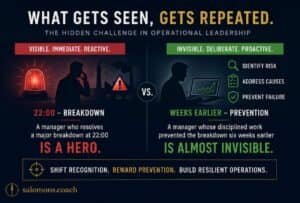
Infographic titled 'What gets seen, gets repeated' showing two columns: left red section 'Visible. Immediate. Reactive.' with a red alert siren, a worker on the phone, factory silhouettes, and a '22:00' breakdown; caption 'IS A HERO.' Right green section 'Invisible. Deliberate. Proactive.' with a worker at a laptop displaying a rising graph and icons labeled 'Identify risk', 'Address causes', 'Prevent failure'; caption 'WEEKS EARLIER – PREVENTION' and 'IS ALMOST INVISIBLE.' Bottom banner reads 'Shift recognition. Reward prevention. Build resilient operations.' and shows salomons.coach.

What Gets Seen, Gets Repeated – Firefighters vs Preventers

  • 26 September 2026
  • by salomons.coach
  • in Blog
A manager who fixes a breakdown at 22:00 is a hero. The manager whose work prevented it six weeks...
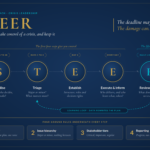
Infographic titled STEER showing five circular steps (S, T, E, E, R) for crisis leadership on a dark blue background. Steps: Stabilise, Triage, Establish, Execute & inform, Review & refine.
Five Steps to Take Immediate Control of a Crisis
24 September 2026
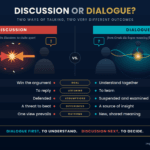
Infographic comparing Discussion (left) and Dialogue (right): clash graphic vs connected waves, with goal-focused comparisons and a shared outcomes section.
Most Leadership Teams Lack Dialogue
22 September 2026
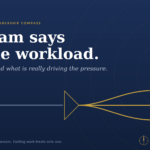
Infographic poster with a dark blue background, large white headline reading “My team says it’s the workload,” and a diagram highlighting pressure factors (Ambiguity, Conflict, Overload) in orange.
It is not the workload. Stop calling it the workload.
18 September 2026

Leave A Reply Cancel reply

Your email address will not be published. Required fields are marked *

This site uses Akismet to reduce spam. Learn how your comment data is processed.

Categories

  • AI (3)
  • Blog (150)
  • Books & Publications (7)
  • Change & Transformation (30)
  • Download (2)
  • Innovation & Strategy (6)
  • Learning & Development (12)
  • Organizations & Culture (40)
  • Self & Personal Growth (74)
  • Teams & Collaboration (34)
  • Tools & Methods (38)
  • Video (16)
  • VUCA & Leadership (77)
  • Web Courses & Programs (4)
  • Workshops & Events (14)

Recent Posts

Infographic titled 'What gets seen, gets repeated' showing two columns: left red section 'Visible. Immediate. Reactive.' with a red alert siren, a worker on the phone, factory silhouettes, and a '22:00' breakdown; caption 'IS A HERO.' Right green section 'Invisible. Deliberate. Proactive.' with a worker at a laptop displaying a rising graph and icons labeled 'Identify risk', 'Address causes', 'Prevent failure'; caption 'WEEKS EARLIER – PREVENTION' and 'IS ALMOST INVISIBLE.' Bottom banner reads 'Shift recognition. Reward prevention. Build resilient operations.' and shows salomons.coach.
What Gets Seen, Gets Repeated – Firefighters vs Preventers
26Sep,2026
Infographic titled STEER showing five circular steps (S, T, E, E, R) for crisis leadership on a dark blue background. Steps: Stabilise, Triage, Establish, Execute & inform, Review & refine.
Five Steps to Take Immediate Control of a Crisis
24Sep,2026
Infographic comparing Discussion (left) and Dialogue (right): clash graphic vs connected waves, with goal-focused comparisons and a shared outcomes section.
Most Leadership Teams Lack Dialogue
22Sep,2026

Tags

4R model (6) accountability (7) authenticity (5) behavior (8) career (12) change (28) coaching (51) communication (8) cross-cultural leadership (8) culture (15) decision-making (9) dersonal-development (6) emotions (6) executive-coaching (8) executive coaching (6) feedback (4) focus (4) growth (6) leadership (66) leadership behavior (47) leadership coaching (8) leadership development (8) learning (9) mindset (5) psychological safety (29) redundancy (9) reflection (34) resilience (21) self-awareness (56) self-leadership (14) self-management (9) self-regulation (6) stress (10) team-dynamics (10) team alignment (5) team coaching (9) teams (7) TED (5) Time Management (5) tools (19) transformation (5) trust (7) VUCA (37) VUCA leadership (39) work-life balance (5)
All posts - searchable table
Recent videos
the-adhd-watch-list-hero

The Best ADHD Videos for Leaders: Science, Stories, Strategy

In 14 July 2026
No Comment
Female speaker on stage delivering a TEDx talk, with a headset mic and gesturing, while a lower-third bio identifies her as a professor of organizational behaviour.

The Authenticity Paradox | Professor Herminia Ibarra 

Brooks – Harvard – on Happiness

Happiness as a Leadership Strategy

L360 youyrownjourney landing page L360

Find your true purpose

GET IN TOUCH

Salomons.Coach
KvK: 72129131
+31 6 53 89 75 67

jan@salomons.coach

The Netherlands

USEFUL LINKS

  • About
  • Privacy policy
  • Term & Conditions
  • Refund & Returns
  • Payment policy
  • Digital Policy
  • Methodology & Sources

LinkedIn

  • Linkedin
Receive blog updates

salomons.coach by J.K. Salomons Holding B.V., 2018-2026

  • Home
  • About Me
  • Blog
  • Shop
  • Downloads
    • Your Own Career Coach
    • Cross-Cultural Leadership Compass
    • Your stress Profile
    • Psychological Safety Field Guide
    • Energy Awareness Journal
    • The Executive Presenting Framework
    • The Executive Ownership Reinforcement Framework
    • The Evidence Base for Coaching Effectiveness
    • The Art of Time Boxing
    • VUCA Leadership WorkBook
    • VUCA Leadership Book
  • Services
  • Testimonials
  • Session Scheduler
  • Contact
  • Change language to Nederlands
Change language to Nederlands